Category Archives: Stories

Art in Hotels

For the record: I love hotels. And I think museums could learn a lot from them about making visitors feel welcome. But there’s one thing that continually catches my eye from a professional point of view. So allow me to share a few words today on the topic of “Art in Hotels.”

Art in hotels is great. Art can comfort those who are feeling lonely. It can lead to new discoveries and awaken treasured memories. Art can be inspirational, and it can have a calming effect after a hectic day. But art can also do the opposite: it can make a hotel guest feel extremely uncomfortable. I experienced the following examples myself, during one long weekend in various hotels.

1. The Subtle Horror of Heirlooms

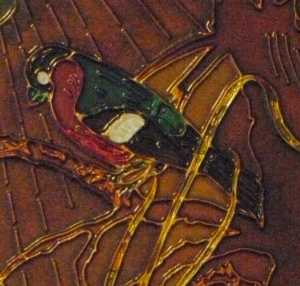
Nothing is nicer than art we inherit. There are often real pearls in the well guarded treasures of our ancestors. There is, however, a simple rule of thumb: if you must remove something from your house because it gives your grandchild nightmares, it’s hardly appropriate to hang it in a hotel room instead:

A nature scene in copper? Perfect for a country hotel! What’s not to like?
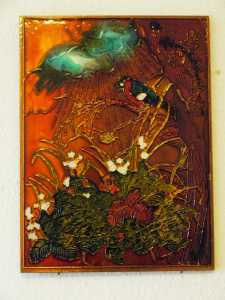
horror

After all, what says “Welcome” better than the dead eyes of a zombie-bullfinch (Pyrrhula pyrrhula)?
horror_detail

2. You’ll Hang Right with Us!

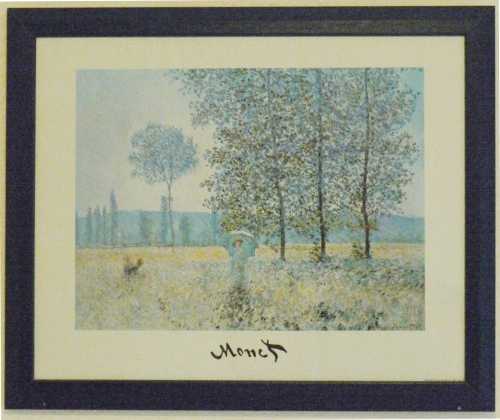
A while ago, a clever publisher of art posters had an idea: In a society in which we can no longer be sure that people will recognize art when they see it, a little help might be required. So he supplied reprints of famous works of art with enlarged, stylized signatures of the artists—“Vincent,” “Monet,” “Manet,” etc. It seems like hotels are fond of this kind of art print, and I bet you’ve already seen this on one of van Gogh’s sunflower bouquets or another. In one hotel I had Monet’s “Fields in the Spring” above my bed.
monet

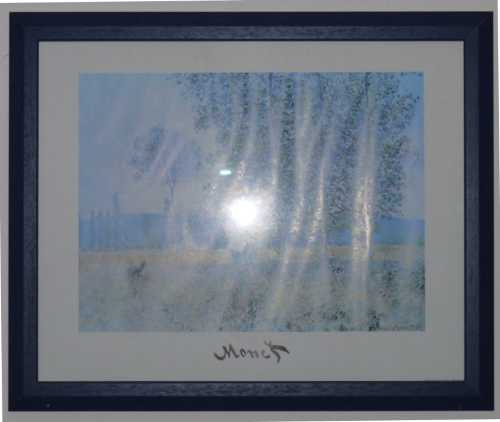
The original is undeniably a masterpiece of Impressionist art. Yet in this case it was a picture under which no registrar could ever sleep well. You can see in the first photo that the colors have faded after years of exposure to UV light. But the true horror doesn’t become apparent until the photo with flash.
monet2

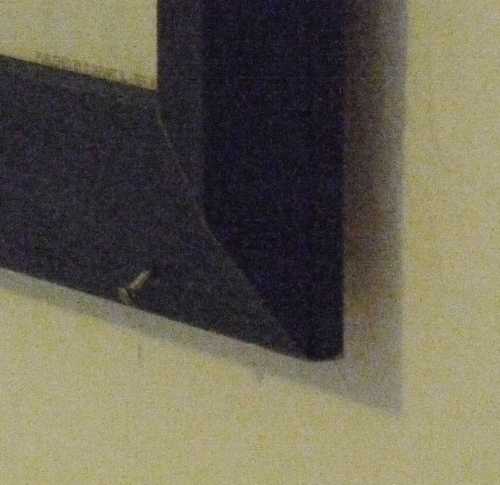
The environmental conditions in the hotel room were obviously anything but ideal. As if that weren’t enough, the frame was secured in a manner I have not often seen before. Unfortunately, the lighting was too dim to document this sufficiently:
nagel

The picture was actually nailed to the wall through the frame… In the hotel’s defense, the room was otherwise fine and the food was excellent.

3. Do You Have the Monet in Apricot?

Art reproductions have enjoyed a long and honorable tradition. They present us with the opportunity to be surrounded by valuable art without having to spend huge amounts of money on it. Naturally, one usually chooses the work of art to suit the room. Recently, though, I noticed some hotel art that turned this principle upside-down: instead of finding art that suited the room, the art was made to suit it.

Sometimes sections are extracted from masterpieces in ways the artists never originally intended. For example, there’s the woman with the umbrella in the aforementioned “Fields in the Spring,” extracted, enlarged, and in portrait mode. She fits better in the corridor that way, and there isn’t so much unnecessary undergrowth in the picture… In an extreme example, the colors are adjusted to make them a better match with the wallpaper.

Another annoying custom is mass production made to look like real paintings. Closer examination reveals these to be inkjet on canvas stapled to boards made to look like a stretcher frame. This kind of mass-produced art can be found in any style (particularly popular, for example, is something based on Edward Hopper for fast-food restaurants), and abstract themes are especially common. Presumably because they’re extremely low-maintenance: they’re considered intellectual from the start and can be produced in any color imaginable. And whoever finds a motif that can hang as a matched set over a double bed wins:
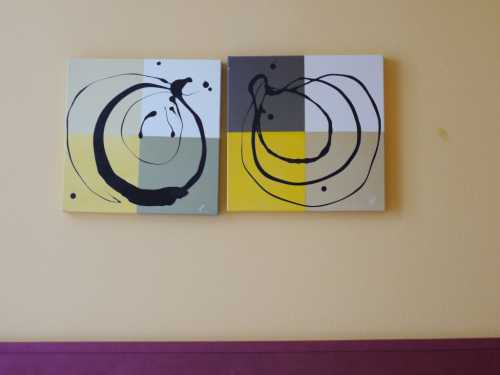
kunst1

Whether it’s really art is debatable. In this case, I think someone went through a catalog looking for décor to match the room. And the fact that you can’t borrow a level from the reception desk to get them hung straight, at least, was the final straw.

I can’t exclude the possibility, however, that the hotel owner especially liked the piece shown above. Beauty ultimately lies in the eye of the beholder. Still, even if you like something a lot, so much so that you can’t get enough of it, a hotel owner should never make the mistake—even with mass productions—of hanging the same piece in two places to which the same guest has access!
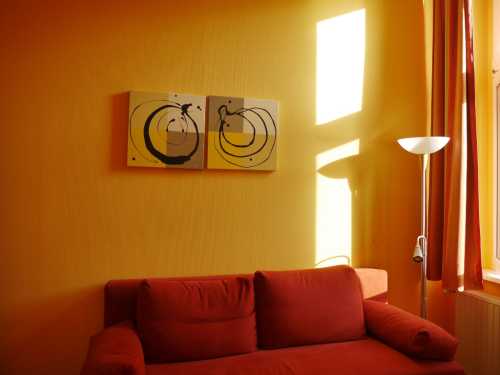
kunst2

I find it amazing that they managed to hang both sets nearly identically crooked!
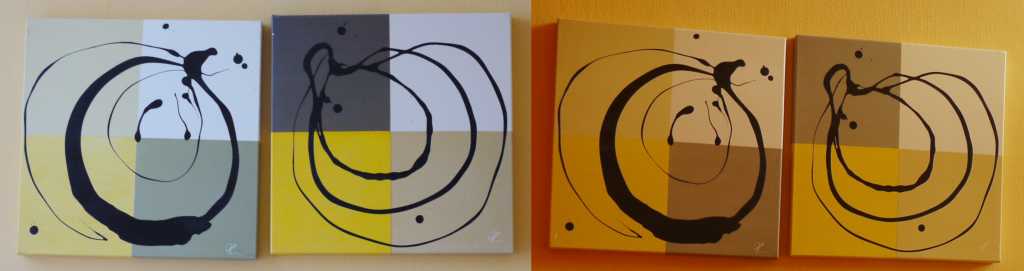
kunst3

Sleep well!
Angela

Translated from German into English by Cindy Opitz.

This text is also available in French translated by Marine Martineau.

FAUX Real: On the Trail of an Art Forger Part 10

picture: LSU University Art Museum
The forger – Mark Augustus Landis
Also known Aliases:
2009 – Steven Gardiner
2010 – Father Arthur Scott
2011 – Father James Brantley
2012 – Mark Lanois
2013 – Martin Lynley
This Friday, I have the opportunity to continue to educate the public on Landis, this time… maybe future Registrars, a group of students.

I will be at the Taft Museum here in Cincinnati at 1pm, EST not only talking about paintings and the like as a curator would, but my experience as a Registrar leading up to my findings on Landis. I say this to you so that if you remain a Registrar or choose another field, do not let go of those experiences you have had to help educate those in the field or outside the field. Each of us, in whatever country or state that chose the field of Registration, have a responsibility to be the sole caretakers of objects, personal effects, and beloved treasures that have been acquired over the years even if we or the records cannot account… we ARE the heartbeat of any institution.

Remember that crew, you are the heartbeat. Do not take yourself for granted or anyone else. You are who you are and your talents and gifts will take you to places you have never dreamed of. Keep up the pace, the endurance, and due diligence that makes a great Registrar great. Life will open doors, and of course close them, but staying true and having a great network such as this, you will remain strong. Straying away from them will close doors.

That is all for now. Again any findings on the names listed below or any suspect you may have in any acquisitions, please contact me. My contact information on Registrar Trek is complete and accurate. I look forward to any response or questions regarding myself or the Landis case, and until the ‘mean’ time…. Stay strong and know that you are a part of a unique group of people and I am grateful to Angela Kipp and the crew with Registrar Trek..

The forger-Mark Augustus Landis

Alias:
Steven Gardiner
Father Arthur Scott
Father James Brantley
Marc Lanois
Martin Lynley

Talk soon!
Matt

This text is also available in French translated by Kelsey Brow.

Read more:

A Registrar’s Hack: Puss in Boots

You all know that in a perfect museum everything is at the right place at the right time. Unfortunately, this isn’t a perfect world, hence: no perfect museum. So, part of a registrar’s job is to improvise. Find bug fixes, workarounds and substitutes, use common sense and sometimes parts from your local DIY store. Often, you use your experiences from your everyday life to apply them to you museum work. Just now I discovered that it also works the other way round.

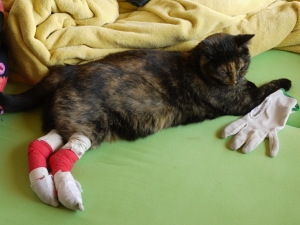
Recently, my cat fell from great height onto something very rough and hard, we suspect from a scaffold, roof or building crane to the asphalt road. As a result her back paws were torn open, she ruined her claws and lost two of them. The vet bandaged the legs, but when she tried to walk with it, she always slipped on our parquet floor. Well, as you might imagine from the accident, it isn’t my cat’s idea of fun to lie around doing nothing. So she kept on walking and slipping. That’s when my registrar’s brain started thinking…

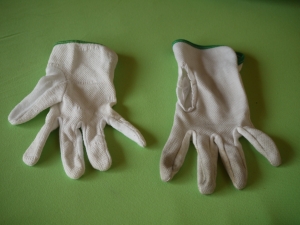
Like most collections people I have a private supply of gloves: nitril, latex, cotton, leather… for every purpose the right glove. Among these are those handy little things most of you will know:

gloves

Not suitable for all purposes, for the little pimples on them are made from vinyl, but the right ones for carrying around something with a very smooth, slippery surface. In my case, it was the other way round: they should carry something on a slippery floor.

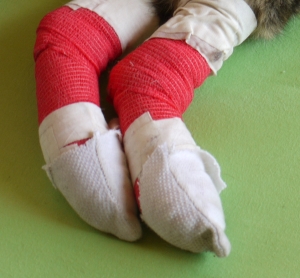
I sacrificed two thumbs to have improvised socks I could pull over the bandage.

socks1

Later I fixed them with some sticking plaster to hold them in place. Now, she still isn’t exactly a happy cat, she’s still a little insecure with the bandages (pun intended: she’s all thumbs with her rear legs…) but can walk around without slipping again.

Puss in Boots

Case solved.

Angela

Straying from the path: a book about wallpaper

The great thing about being a museum professional is that you never know when and where the skills you learn along your path will be needed in the future. This is a story about it.

A few months ago I discussed with Robert M. Kelly an article he was writing for a journal. Having dealt with museum texts a number of times before I was able to give some hints. I guess all of you who ever wrote or edited exhibitions and catalog texts know what it means to use the surgeon’s knife on filler words or the butcher’s ax on whole passages to make a text fit into the given word count…

When we were through, Bob asked me to help him on a book he was writing. A book about wallpaper. The early years of wallpaper.

I said: „Bob, I’m a collection manager, I don’t know anything about wallpaper and I’m no native speaker.“
Bob said: „Yeah, exactly what I’m looking for.“
Sometimes I’m glad that most conversations nowadays are via email, because if he had asked if it’s okay to ship the Mona Lisa via [insert favorite parcel service] I would have given him exactly the same facial expression.

Anyway, now, exactly 9 months after I started to read the first sentences of the manuscript the book is out and I’m proud as hell!

Backstory of Wallpaper book face

Why should I read a book about wallpaper, you ask?

Well, there are many good reasons: wallpaper is on the walls of historic houses and we have to care about it just the same as we care about the furniture, the carpets and the other artifacts. We might have wallpaper in our collections, as brand-new rolls that were never delivered and installed, as fragments being rescued from destroyed houses, as wallpaper pieces inventoried by mistake as lining paper (or vice versa) or as study collection for design questions. As always: the more you know about something, the easier it is to care for it.

But this is not a book about conservation or registration issues. It tells the social and economic story of how wallpaper was made in the early days, how it was sold and how it became popular on the walls in Europe and the North American colonies. And it’s a book about people.

We meet people who made, sold, bought and installed wallpaper. We meet Jean-Michel Papillon , who did the wonderfully detailed descriptions and drawings of the craft intended for Diderot’s Encyclopédie (some to be seen in the book) – but was forced into this trade by his father and turned his back on it as soon as he could. Thomas Coleman who began selling wallpaper in London and later moved over to the American colonies to do the same. Catharine Mac Cormick who was one of the few installers we know by name, representing the countless female and male paperhangers who didn’t leave a mark in the records.

Following the traces of people makes the book easy and fun to read. While it is a book about the history and technology of wallpaper, it is not a dry one. It’s a journey into the past.

Now, as I continue my journey on the path of a collection manager and museum professional, I am very curious when and where the skill of having helped a book about wallpaper to see the light of day will be needed in another project. In the meanwhile, I will have a picture of a wallpaper as a wallpaper on my screen….


Angela


The book is available in every bookstore:

Robert M. Kelly: The Backstory of Wallpaper. Paper-Hangings 1650-1750. Published by Wallpaperscholar.com, hardcover, 190 pages.
ISBN-10: 0985656107
ISBN-13: 978-0985656102

You can take a look inside here:
http://www.amazon.co.uk/The-Backstory-Wallpaper-Paper-Hangings-1650-1750/dp/0985656107/ref=sr_1_1?ie=UTF8&qid=1378396917&sr=8-1&keywords=Backstory+of+wallpaper

This post is also available in Dutch, translated by Jiska Verbouw, in Zulu/Ndebele, translated by Phineas Chauke and in French, translated by Marine Martineau.
The Next Generation

I’ve always said I don’t like taking work home however I’ve always found saying that is easier than accomplishing it!

When I first started out in this industry, I was what you would call a backstage roadie dealing with the logistics of international exhibitions with a well known company in Spain. I found that gave me a very different perspective when I went to museums in my own free time. I’d notice if things were not hung level, when labels were missing, when the support to a piece looked funny and even when the paint job was a little off.

If I had worked on a show I’d know all the details of what really went on behind the scenes. Despite the beauty or importance of a piece, if something had delayed it’s arrival or an issue had arisen with it it’s all I would be able to focus on (though seeing it in its spot made me sigh with relief). If i hadn’t worked on the show I wondered how things had been packed, handled an transported. What crates were used/ built?

Most people don’t notice clearance levels in hallways, stairwells or door frames but I did. There was no avoiding looking at access points and loading docks differently, no matter where I went! I know what fits and what doesn’t on standard international palletized flights and whenever I’m on a plane I can’t help but wonder what that belly holds apart from luggage.

My husband likes to say I’m a little bit of a control freak so the shoe fits with this industry. When I transferred over to the museum side my experience helped me greatly and my slightly OCD side was complemented in my day to day tasks as a Collections Manager/ Registrar. In front of me I had a whole collection that needed TLC. The thought of re-organizing, re-housing and properly inventorying everything was like throwing a kid in a toy store!

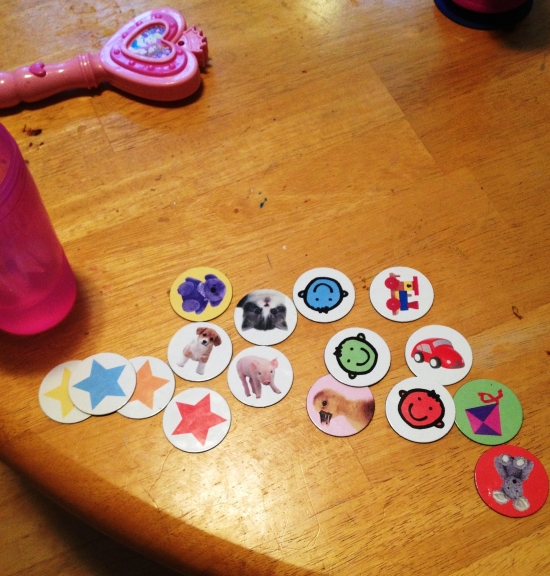
I didn’t realize just how much my job influenced my life until I one day when my daughter was sorting through some stickers and did this:

iPhone2

It was then that I realized why no babysitter was ever able to follow my toy storage technique. All musical toys go in one bin, all sorting/ stacking toys go in another bin, toys that roll in another and so on. I was bringing work home and passing it on to my littles! Suddenly I realized why she liked to neatly stack coasters and freaked out in stores when items were off their shelf and on the floor. I knew then I had a very important responsibility: to train the next generation!

I’m hoping I’ll be able to live up to the task, at least that way her room will be clean and she’ll understand the importance of a proper IPM plan!

Maria C. O’Malley

FAUX Real: On the Trail of an Art Forger Part 8

picture: LSU University Art Museum
Mark Landis
Also known Aliases:
2009 – Steven Gardiner
2010 – Father Arthur Scott
2011 – Father James Brantley
2012 – Mark Lanois
The New Yorker piece should be out by the end of the month. I have much to share about Landis and will certainly do so but somehow at the moment this feels like a one-way street. I’m sitting here writing all I know about Landis, keeping you informed about my findings, telling my story but I don’t know if I am just talking to myself or if I reach you collections people out there.

I really would like to hear if any of you have either encountered Landis or his alias that I have spoken about or what you have encountered in your research on lenders that raised a red flag. I have spent five years of my life on this one person and I know there has to be more people like, or not exactly, like Landis out there. What does your development office do in researching donors or philanthropists? What have they found? Has this case of Landis made you ask questions or have a wow moment in your current position? I like to hear from you.

I love blogging, and one part of blogging is asking questions and giving answers. So, for the next part I thought we’ll make a part that we’ll call

Questions to Matt

You ask questions, here in the comments section or through mail or phone and I’ll answer them in the next part. I am anxious to hear even the most obscure inquiry from you on the case or even my background…

You all are the best and please keep up the good work where ever you are currently working knowing that your next adventure will be even bigger and better than where you are currently. Do your job well, keep your nose clean and you will be fine.

Talk soon!
Matt

Read more:

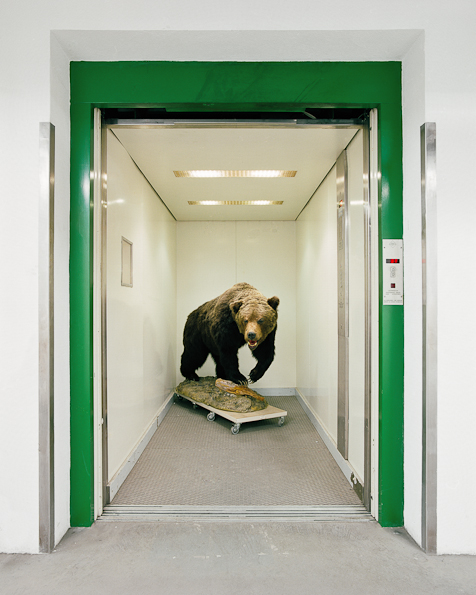
The bear in the elevator

Picture (c) by Klaus Pichler

Are time travels possible? Well, I believe they are, at least in our mind. A picture, a sentence, a smell and you are suddenly somewhere else, a few years back, undergoing a certain situation once again. These sudden recalls are sometimes nice, sometimes awful and sometimes just funny. The last time it happened to me was when I first saw the bear in the elevator from the “Skeletons in the Closet” project by Klaus Pichler (see his article “On tour with Noah’s helpers” for more details).

I was visiting some former colleagues at the Landesmuseum für Technik und Arbeit short before the opening of the exhibition “Kosmos im Kopf” (the cosmos in the head). I pressed the button at the staff elevator and waited for it to arrive. The door opened and I suddenly jumped backwards. A gigantic Great Dane stood before me, staring at me, jar slightly open. For a moment I considered this a rather ridiculous but somehow adequate way to die for a museologist, but then I thought again. It was not logical that a man-eating dog would use the elevator to search for its next prey. After the first shock I looked closer and discovered that the Great Dane was just stuffed. Apparently, the dog was “parked” in the elevator until the preparators would need it.

I decided to join the dog in the elevator and it reminded me of another occasion a few years earlier. I had just started studying museum studies and was still trying to make up my mind which path I wanted to chose in the field. So I took an internship at the Naturkundlichen Sammlungen (Collections of Natural History) in Berlin-Charlottenburg. In the workshop of their taxidermist stood a stuffed wolf that looked so realistic one had to touch it to be sure it wasn’t alive. Their taxidermist was a real artist. He explained to me how he “stuffed” animals (a term he used to distinguish ordinary “stuffers” from real taxidermists who learned and studied the trade). Before he did anything with the dead animal, he tried to get a picture of the animal when it was alive. A picture in the most comprehensive meaning of the word: he tried to get pictures, videos, tried to talk to people who knew it when it was alive and so on. He explained that if you don’t do this, you just prepare an animal that is one of its species. If you want to do a taxidermy of a certain animal, only this unique animal, then you have to know its personality otherwise no-one will recognize it when it’s ready. And this is true. Try it yourself when you are visiting a museum of natural history the next time. I promise you that you will spot animals that look just “right”, nearly alive. And there will be some that look just “wrong” although they are anatomically correct (you will find some that aren’t even that – but that’s a different story).

Since this internship I have a great respect for the job the taxidermists do – and I discovered that I will never have the patience to be one myself.

Book: ‘Skeletons in the Closet’, photos by Klaus Pichler, texts by Klaus Pichler, Julia Edthofer and Herbert Justnik, english edition, is out now and can be ordered via the homepage of Klaus Pichler.

Off the shelf – Requests from the public

Just in case you thought I’d been twiddling my thumbs in between all the stuff I’ve written about in past issues, let me tell you about

Requests from the Public

Let me set the scene – I have two interns waiting for me to tell them about their next project. Not just what it is, but how to do it. And not just tell them but show them. And do a few myself so they get the idea. Then Kris is on the phone to tell me that she needs me to proof the texts for the Eagle Project panels before she sends it to the printer at 2:30. It’s 1:00. I bring up the texts on the computer, and then go over to the table to show the interns how to pad and wrap children’s dresses in tissue and put them into boxes. But the phone rings, it’s an elderly voice soft as sorghum molasses……

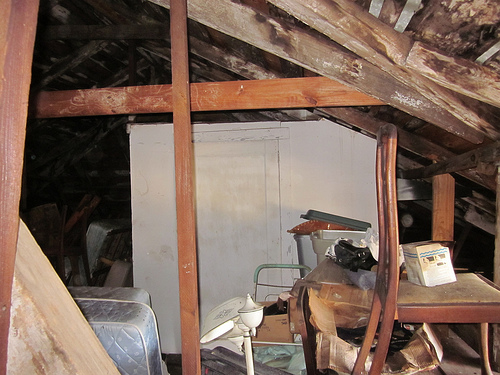
In attic, 1780s house, Nine Mile Point, Jefferson Parish, Louisiana. View towards 20th century closet constructed within the attic. by Infrogmation via flickr“They told me that I needed to talk to you. We’ve been cleaning out the chicken house at my great grandpappy’s farm and we found this rock, I think it’s really old, it looks like something the Indians must have used, it’s all sparkly but it has these scratches in it. We washed it real good so it doesn’t smell too bad, and I went over it with a file to get rid of some of the scratches. I’m bringing it over in 15 minutes, I hope you don’t mind. I’m sure it’s valuable.”

Well, yes, I exaggerate. But by far the greatest number of calls from potential donors start out with “We were cleaning out the attic at my (choose your relative)’s house.” If it sounds like something we might want, I check with Kris and we arrange to go see it or have it brought in. If it doesn’t fit our collections parameters, I suggest other museums that might take it. If the caller wants to know something about the value of an item, particularly if they plan to donate it, I am forbidden by museum ethics to give them an appraisal. We keep a list of appraisers and websites to which we refer them. If they just want to know what something is, I try to help them over the phone, but if I can’t, I either have them bring it in or I try to suggest somebody else to help them.

Another common type of call is from a person wanting to know how best to preserve a family treasure. I try to find out as much as I can – what the object is made from, what condition it’s in, what the person wants to do with it. I also ask whether the area they want to store it in is heated and air conditioned, and what kind of light it has. It’s a ticklish situation sometimes, because I have to try to get an idea over the phone about whether the person is willing or able to spend any money on specialized storage materials. If so, I suggest what they might need and give them information about where to get it. If not, I often resort to the old quilt-in-a-pillowcase strategy. There’s also the zip-loc- bag strategy, the if-you’re-comfortable-it’s-probably-comfortable-too strategy, and the anything-but-cardboard-boxes-in-the-attic-strategy. I usually try to convince them that washing or polishing up something frequently does more harm than keeping it in less than ideal conditions. If I find I need to do more research myself, I tell them I’ll call back. And I do.

I even got myself into a volunteer gig of my own through a phone request for information. Later this month I am going to a small local museum to teach their only paid staff member and some of their volunteers how to mark objects.

I love helping people with these things, but it takes time. And I’ve got to go update the database.

Shanti
Anne

A day in the life of a Museum Curator in Greece: coping with bureaucracy

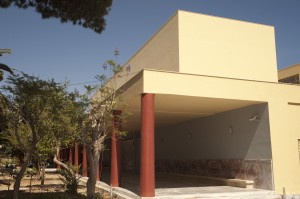
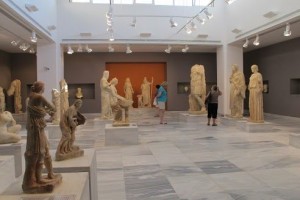
Heraklion Archaeological Museum by Georgia FloudaAfter my latest virtual hang-out with Angela and having familiarized myself with the philosophy of the project, I have come to realize that there is scope in writing on the practicalities of working as a museum curator in Greece. This blog serves as a forum of communication between museum registrars and curators from all over the world. In this framework, let me elaborate a bit on what it means to work in a public archaeological museum in a state hampered by economic crisis.

With the exception of a few museums, the New Acropolis Museum being the most famous of them, most of the archaeological museums in the country are under the jurisdiction of the newly baptized General Secretariat of Culture. This was formerly part of the Ministry of Culture and since June 2012 it belongs to the Ministry of Education, Religious Affairs, Culture and Tourism. The concept for this change was the reduction of the administrative departments within the Greek state public sector. As time goes by, this also means some form of degradation in the expectations of the members of the Greek Archaeological Service and of the museum professionals among them. The numbers speak for themselves.

Heraklion Archaeological Museum by Georgia FloudaWhen Ministry of Culture still existed it always had the lowest budget among all Greek ministries. The so-called General Secretariat for Culture now has to fund most, if not all of its actions, through EU funded projects. These projects are approved and then run under strict specifications through the so-called National Strategic Reference Framework (NSRF). From their inception and throughout their implementation the museum or other archaeological projects are administered centrally on a national level. Nevertheless, in many cases they absorb as much as half of the daily energy of the involved museum curators in order to sustain the labyrinthine bureaucracy of NSRF. So aiming at more museum projects virtually means more bureaucracy and one naturally wonders where the exit of the maze can be.

FAUX Real: On the Trail of an Art Forger Part 7

Sorry gang it has been a while since my last entry and I hope you welcome me back. The last four months have had its up and downs and now I am in a down time. Why? I am once again seeking full time employment.

As some of you may know I have been in the fine arts, non profit field for 15 years. I lost my position with the local art museum a few years back. I had to step outside my comfort zone to land a job. This Landis investigation helped me to do that. How you may ask how? I met Marty and Jan Sikora of Cincinnati at the opening of FAUX Real last April 1st, 2012. I talked with them about Landis and my experience in the art realm and how I may help them someday with their franchise. Months go by and I stay in touch and still no job. December 2012 comes still no job and much uncertainty going into 2013. Landis at this point did as he said and stopped his scheme, so little activity for me to follow.

2013 comes and Landis follows me into a new season. I was contacted by a veteran writer for The New Yorker and he interviewed me for twelve hours over a two day period and even watched the Daytona 500 with me. We had a great time and I learned some new things regarding Landis. He is still active and I now know of his current, fifth, alias. Look for an upcoming publication on Landis in The New Yorker very soon. It will probably be the strongest piece yet written on the subject and reaching more readers that I know have not heard of Landis.

So back to the job search. The week my unemployment dried up, I got that call from Marty and he hired me on as an inside sales administrator. I knew nothing about the business and being in a for profit world was so foreign. Well to say it simply, was not a good fit and the business was not doing well. I lost my job due to attrition last week. Landis basically was integral insofar that if Marty and Jan had not come to the opening, I would not have had a paycheck for the last four months. I say this to say, don’t get too comfortable in your current position. Think outside the box and make an effort to believe that you can do whatever you put your mind to. Give it your best effort even if you don’t know the first thing about what you are doing. There are people out there that will see you for who you are and what you can do. Take comfort in this folks. There are still good people out there that will give you a chance and I will remember this as I move forward in my life.

Look for the piece in The New Yorker that should come out this summer and as always, keep Trekking!

Talk soon!
Matt

Read more: