Hello registrar’s world!

march13

On January 2nd we started off with a weird idea: A platform to connect registrars around the world. Now, three months later it’s time for a first review. Now, what does the map say?

We see where the visitors of Registrar Trek in March 2013 came from:
North America: 1165
Europe: 426
South America: 94
Oceania: 84
Middle America (including Mexico): 18
Asia: 7
Africa: 3

We guess that means we reach registrars around the world and we can easily spot the areas where the registrar is a known species and where it is still a profession that is scarce.

When we look at the overall visitors from January 2nd to March 29 we have 9,576 visits by 4,453 unique visitors which we think is, well, how should we say it best?…

Roar!


Moving on we hope that you will continue with telling us great stories from your everyday work or about how you became a registrar or write great articles about our profession that we can publish and translate (mail us at story@museumsprojekte.de).
We are grateful to everyone who is willing to translate something into a new language. Just drop us a line if you feel like joining our team.

Angela and Fernando

How I became a museum registrar III

Breaking News; Journalist discovers she’s a registrar

Tracey Berg-Fulton
GUAlumniProfileKI remember the day I decided to go in to museum work quite clearly. I was sitting on a bench in the Ulster Museum in Belfast, Northern Ireland, having just finished interviews for a newspaper piece I was writing. As is the custom, it was a rainy gray day, and I took shelter in the museum.

As I sat, I thought about what I had been doing – journalism – and asked myself if I could really sustain myself in it for thirty years.

The answer was a clear, resounding, heart-sinking, no. So having incurred thousands of dollars in educational debt to get to this point, what on earth will I do now?

And then I looked around me.

This. This is what I want to do. I had always loved history, art, libraries and museums, so why not make it my life officially?

I applied to an art history postgraduate program at the University of Glasgow on a whim, thinking that I’d be rejected out of hand, lacking British qualifications and only tangentially related undergraduate degrees in photography and journalism. I was shocked to be accepted to start in autumn of 2007.

At Glasgow, I was thrown headlong into research and writing, and took the opportunity to do work placement with a stained glass conservator at Glasgow Museums. Our work focused on an inventory of stained glass, and during that process I learned about the various roles within the museum. I couldn’t get enough of the objects and spending time in the vaults, and then I discovered that the person who has the most contact with the most stuff is, of course, the registrar.

My course was set. Famous last words, right?

I graduated in December of 2008, and returned to my hometown of Pittsburgh, Pennsylvania in the United States. I had heard about the recession in the US, but being in Scotland I hadn’t fully understood the impact. I began applying to every museum I could, and then any related businesses, and then just any job in general. Nothing.

Finally a connection introduced me to another connection that helped me get in to a volunteer role at the Carnegie Museums of Pittsburgh. Having had a job since I was 14, I was relieved just to be working, even for no pay. I also began volunteering at a small community run museum, creating an inventory of their collections.

Then in April of 2009, I had an accident while running that left me with a broken hip and temporarily unable to walk, sit, drive, work, or do anything but lie in bed. I lost six months of my life to my recovery.

After I recovered, I returned to my volunteer work at the Carnegie, and had a change of roles after a successful application, into a part-time position as an imaging technician. Not quite registrar work, but still interacting with lots of objects. I enjoyed my work, but I kept hoping for a registrar opening, and applying for open positions around the country.
375_513434167185_2390_nOne of those applications was successful – and I left to take an assistant registrar position in Oklahoma in 2010. It was a wonderful learning experience, but the economy had made it so that I had to work in Oklahoma while my husband remained in Pennsylvania. Then came a string of health problems in my family, and the need to return home was too strong. I left my position with no museum job to come home to.

Returning to Pittsburgh was rewarding in that I was home with my family, but the job situation was dire. I returned to working retail with an outdoor retailer while I sorted out where I was going to go next.

Then one day it dawned on me- why not be a contract registrar? If there isn’t a job, why not create one for myself? One of the benefits of living in a mid-sized city, I discovered, is that there aren’t a lot of folks doing contract work here (presumably they’ve all been snapped up by clients already!).

I sought out a mentor from the Registrars Committee of the American Alliance of Museums, and began to network and mention that I was doing independent work. Then I filed my papers to incorporate as an LLC. I had a surprisingly strong response from the Pittsburgh community, and I was off and running.

Contract work really suited me- I got to be a registrar, but really, my title was more appropriately “fixer”. I loved solving strange problems for my clients, everything from figuring out how to ship a massive photograph across the country overnight to how to replace the handle of a toilet (hint: turn the plastic nut the opposite way from every other nut and bolt you’ve ever tightened). It was the perfect blend of art history, carpentry, power tools, and diplomacy. I made my own hours and got to choose my projects, which was a blessing when a family member was diagnosed with cancer.

But something was missing. While my dog is a wonderful listener, he’s not much of a conversationalist, so I desperately missed having colleagues. I missed having a collection that I know down to the finite detail. I missed having a building that I know like an old friend. I missed having semi-regular hours- what no one tells you about “flexible working” and working from home is that it really means you’re working 24 hours a day, answering e-mails, billing, doing taxes, doing actual client work, looking for clients, keeping up on best practices, networking, etc.

And so that brings me to today. I’m one month in to my full-time staff position as Registrar at the August Wilson Center for African American Culture. We are a young institution, and it is exciting to be able to help implement policies, troubleshoot challenges, and break new ground when needed. I’m happy to be working in an organization that serves an important cultural function in our city, and my work is incredibly rewarding.

It’s been a long and winding road to get to this point, but I’ve seen some amazing things along the way. I’ve had the pleasure of meeting and learning from so many of my colleagues at conferences, over coffee, and through the RC-AAM listserv. I also have the pleasure to serve as Chair of the Website Committee of the RC-AAM. Every day I learn and do something new. Every day I see the most amazing and intimate objects of civilization- from baptismal gowns to goalie pads. I get to indulge my love of shiny things. And I get to scratch my technology itch (and I’m still waiting for a responsive designed web-based database, developers!). What could be better?

Going forward, I hope to continue growing in my profession, and I hope to become more involved in the wider world of museums, and to actively participate in bringing museums to a 21st century visitorship.

Text: Tracey Berg-Fulton

FAUX Real: On the Trail of an Art Forger Part 6

picture: LSU University Art Museum
Mark Landis
Also known Aliases:
2009 – Steven Gardiner
2010 – Father Arthur Scott
2011 – Father James Brantley
2012 – Mark Lanois

Landis has been shopped and stopped… not by the Feds, not by Police, not by the ‘Law’… but by the best detectives out there who are registrars and collections managers that take their work seriously and even take their work home and ponder over their concerns. Should you take your work home? No… but there is not one of us out there that can say that when we have a difficult lender, logistics problems or even a difficult direct report that we do take things home with us and it can keep us up at night… not healthy and non-productive.

For years Landis and his antics have kept me thinking on a daily basis, but not keeping me up at night at this point, about if he truly will stop making the forgeries and passing them off as the real deal. Landis told me face to face on April 1, 2012 at the opening of “FAUX REAL: A Forger’s Story” at the University of Cincinnati that he would stop because he was tired and bored with what he had been doing for so long. But what keeps me on this blog and why am I still so interested in tracking Landis when he personally told me he would stop? I do not think that he can or will even to this day.

Let me ask all of you this one question: Which one of you have researched this case and have actually informed your peers and fellow staff members of Landis and the four aliases? Some are concerned about their reputation for their selves or the institution for which they are employed. Since there has been no actual crime committed and no worry to come forward why do I still believe there are more than the fifty or so institutions out there that have been scammed and will not say so? No one wants to believe they have not personally been duped nor the museum they work for has been scammed and have to admit so… especially when they know what I know and have shared and continue to give updates and refreshers over the years.

So I encourage you to look deep into your records, databases, development offices and share with your peers this strange story of Mark Augustus Landis and the one that discovered and revealed the most overzealous forger the museum field has known in years. I encourage you all to email or call me if you even have the slightest feeling of a gift from Landis or someone that resembles the forger. My contact information is on the authors page and as I always say… do your job well, keep your nose clean and you’ll be fine.

Talk soon!
Matt

Read more:

The registrar: A strange, endangered breed of animal rarely spotted

Recently, I read an email by Alana Cole-Faber, Registrar at the Hawaiian Mission Houses in Honolulu, Hawaii, USA. The context doesn’t matter here, but her words were:
„…us who are, literally, isolated. Like, on islands. In the middle of oceans. Where registrars are a strange, endangered breed of animal rarely spotted.“

A
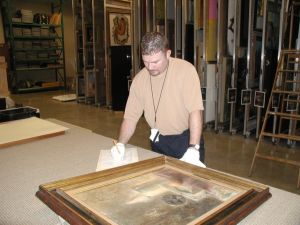
A registrar in his natural habitat: caring for collections. Thanks to Matt Leininger for the picture.

I was thinking again and again about these words. Alana works on an island, so her words hold especially true for her position, but I found it a brilliant description of our jobs as registrars, collection managers or curators of collections in general.

Sometimes, when I go through the aisles of our outside storage, searching for an artifact that has to go out for a loan and is marked in the database as “location unknown” I can nearly hear the voice of Sir David Attenborough: “The registrar sneaks through the jungle of objects in search of its prey. Some way down the aisle an artifact sits together with some fellows, suspecting nothing. The registrar comes closer. She looks, checks the record and with a short, purposeful snatch grabs the artifact.”

A look at the figures

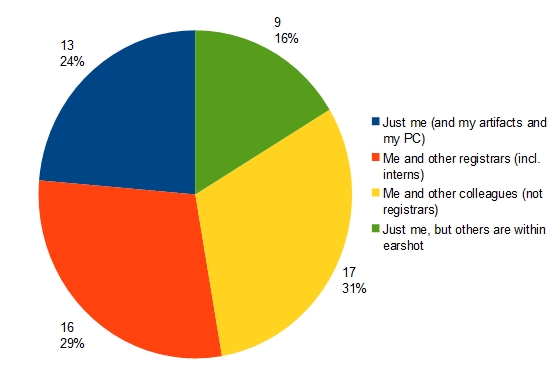
But joke aside, isn’t it really so that the registrar is an animal rarely spotted? Most of our work is done behind the scenes. So much behind the scenes that we are even out of sight and sometimes even out of mind for most of our colleagues. I started a non-representative survey on certain field-related LinkedIn groups1 to see if my personal experience of the working setup is right. The question was: “As a registrar: What is your normal working setup (more than 50% of your average working time)?” See what I’ve got:

230213

Fortunately, the lone wolves that have to roam their territory all by themselves with no one within reach are not the majority. But, to stay in the picture, registrars don’t form packs. The registrar’s work has to be done alone by 71%.

The hermit in the storage area

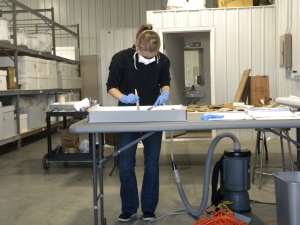
Registrars often work concentrated behind the scenes.Thanks to Lisa Verwys for the picture.
Registrars often work concentrated behind the scenes.
Thanks to Lisa Verwys for the picture.

How is it like to work all alone? I like to quote a comment2 made by Antony Aristovoulou that throws a light on this: „I rarely received inspections or signs of interest from those who were managing me, and it it became a very lonely process. The artefacts became my friends.“
No-one will deny that it is great to be alone in the storage area from time to time. Working alone as a registrar has an amount of freedom few people can afford nowadays. Depending on the architecture and infrastructure of the storage it might even mean no internet and mobile connection. Separated from the rest of the world, on a lonesome island.

What are the consequences? Well, there are certain dangers. Firstly, the pure, physical ones. There has to be a security concept for the one that works all alone. Generally, the one who is forced to work alone should always have the possibility to call for help and assistance. It should be made sure that it is recognized when he or she gets in a situation where he or she is not able to call for help. Possible ways: A routine in calling him or her by phone to check if everything is alright. A mobile phone that he or she always carries with her / him (given there is mobile-phone reception). A checkup procedure that makes sure he or she doesn’t get locked in a storage area. Extra inspection tours of the security guard. All of this should be organized before someone starts working alone.

But there are other, less obvious dangers in working alone. Chances are high no one thinks about the one that works in the storage area when all go out for lunch. Important information in institutions is often passed on over a cup of coffee during a break. People who don’t get feedback or have the possibility to exchange with their colleagues tend to become solitary. It’s the task of the registrar him/herself to avoid total isolation by taking part in the community of the museum. But it’s also the task of his/her colleagues not to forget the one in the storage area. And last but not least it’s the job of the ones that are responsible for the working organization in the museum to create possibilities of exchange between the staff members. This might be the only way that the registrar becomes not the „strange animal from the storage“ but stays the colleague. Okay, make it „the colleague with the strange job“, but still: the colleague.

The one that spoils the fun

Giving clear directions of what to do and what not is part of the job.Thanks to Zinnia Willits for the picture.
Giving clear directions of what to do and what not is part of the job.
Thanks to Zinnia Willits for the picture.

The numbers show why many registrars feel isolated, even within a team. This has much to do with the job the registrar has to perform. He or she has to care for the well-being of the objects in the collection. That includes often saying „no“ when it comes to loans or events within the museum. If the head of the institution wants to have a big party in the galleries, the registrar has to stand his or her ground by saying that this can’t include food and drinks. If the marketing team wants to collect school groups with a historic school bus, the registrar most certainly has to say that this isn’t possible. If a befriended institution wants to borrow a flag and plans to hang it in the entrance of the exhibition without protection, he or she can only shake her head. He or she acts as an attorney for the artifacts, who can’t speak for themselves. Although on paper all staff members are responsible for preserving objects for the future, the buck often stops at the desk of the registrar. But the registrar is not the head of the institution. Usually, he or she is not even the head of the department. This means although the responsibility lies on his or her desk, his or her decision may not be the final one. This adds up to the feeling of being isolated.

For the team members, it is the other way round. Curators have great ideas for upcoming exhibitions. Designers have new ideas how to present the artifacts. Marketing people think intensely on how to attract visitors. And then the registrar comes and just says „no“ to their ideas. Of course, for them it looks like the registrars are strange animals! They are the ones that spoil all the fun! But the painful truth is: that’s the job. If the registrar is lucky, there are also conservators on the team that back up his or her opinion. Otherwise he or she can just point to policies and standards (which is rather boring for the rest of the team) or present cases where it went wrong because nobody listened to the registrar (which is more entertaining, but not necessarily more convincing). In the end, the registrar can’t do more than state his opinion and document the whole process of decision-making to be on safe ground.

An endangered species?

High-quality work is important - and needs enough time and money. Thanks to Sharon Steckline for the picture.
High-quality work is important – and needs enough time and money.
Thanks to Sharon Steckline for the picture.

So, is the registrar an endangered species? Well, the registrar might not be more endangered than any other museum professionals today. When money is tight, cultural institutions are the first that are looked upon with a frown by authorities. But as far as I can see, this is not limited to collection management. Politicians tend to ask if a certain museum can be run by fewer people or is necessary at all. In fact, many institutions in countries outside the US just recently realized what registrars are good for and create more jobs in this field. But that’s just one part of the story.

Another part is that quality of our work is really in danger. When money is tight, decisions on where the money should go are hard to make. And often, the squeaky wheel gets the grease. Registrars, trained to act as inconspicuous as possible by trade, often are the ones that are not heard in their requests for archival materials and manpower. But again, that’s just one part of the story.

In many smaller museums money is so tight that it’s not the decision between archival boxes for collection management or advertising in the newspaper, it’s the decision between fixing the roof or having an exhibition. In this cases human resources are a big issue3. Here, the position might be called „registrar“ but it comprises much more. He or she might be also the visitor guide, complaint manager, shop assistant, cashier and curator all in one person. This often means that this person can’t invest as much time in collection management as is needed.
Other museums decide they can’t afford a registrar on permanent staff. They will hire freelance registrars when urgently needed. This is a good idea when it comes to planning new storage units, get consulting on how registration should be organized, have the artifacts of a temporary exhibition in safe hands4 or do an inventory on a certain collection. However, if an institution holds a collection that exceeds a certain amount of objects (not easy to draw a line here, this depends as well on the scope of the collection as on how it is „used“ by the institution), collection management is a full-time job. The idea to let a registrar do an inventory on the collection and then have „someone do it along his regular duties“ or „all the staff cares for the collection“ doesn’t work.

der
Quality in museum work is always a combined effort. Teamwork is the key. Thanks to Matt Leininger for the picture.

A registrar is more than a human data base. If you have all collection items absolutely accurate in your data base (name a museum that has!), this doesn’t mean it stays that way. Keeping track of the objects is a permanent effort. Having everything correct in the data base, too. You can have all staff members swearing an oath to always document every movement of objects in the data base, you will still have St. Entropy messing around in your storage area! A good registrar will have an eye on that. But there’s more to it. Like in every library, some objects get „lost“ by being put in the wrong storage place. A registrar that is familiar with his / her collection will have an idea where to search for it – based on his experience and on the knowledge who handled the object recently. Don’t forget you usually not only contract a registrar – you contract an elephant’s brain! Lastly, a registrar who is in charge of a collection for a long time will somehow merge with his or her collection and storage area. He or she develops something like a sixth sense for things that are wrong: an unusual increase in humidity before someone checked the hygrometer, an object that just doesn’t look the way it always looked, a voice telling the registrar to take a walk around the outside storage hall once again before leaving… That’s something that develops over time. You can’t have it with short-term contracts for only a few months or a year.

Conclusion

As we saw, the registrar is in fact an animal rarely spotted. It is a combined effort not to let it become an endangered animal:

  • As an individual: all who work in the museum have to take care that the registrar is safe during his time working alone and doesn’t become isolated from the rest of the museum community.
  • As a professional: all the colleagues need to understand what is the job of the registrar. It’s not that he or she wants to spoil the fun, it’s his or her job to protect the objects so others can enjoy them in the future, too.
  • As a museum: authorities should think in-deep about the value of professional collection management. It is an old hat that preventive conservation and professional storage saves costs in the long run. Cutting budgets here might result in higher costs later.
  • As a society: politics, communities and tax-payers in general should think about the value of museums and their collections. We all know that a person that loses his memory will lose himself. It’s the same with a society that loses its history. Preserving our heritage is not only a cost factor, it has high value for a society.

Just my two cents on this issue. Now, I got to go, I need to roam my territory, I think I spotted some undocumented objects further down that aisle…

Angela Kipp

—————–

  1. Association of Registrars and Collection Specialists, Collections Management and Collection Preservation and Care, dates collected from 01/27 until 02/23/2013
  2. Comment made concerning the survey posted in the Association of Registrars and Collection Specialists Group on www.LinkedIn.com
  3. When I asked „Calling all museum staff responsible for collection management and registration! What are the main issues in your job?“ on LinkedIn „Collections Management“ Group, an overwhelming 50% answered „Staff issues“, before „Funding for climatization, security, etc“ (16%), „Funding for packing material, racks, etc“ (12%), „Donations“ (10%) and „Borrowing and loaning“ (9%). The discussion thread there is rather interesting and highlights the issues collection management has to deal with: http://www.linkedin.com/groupItem?view=&gid=3280471&type=member&item=175582165&qid=4a59729e-7bf2-4bb6-8b6b-e2883014a660&trk=group_search_item_list-0-b-ttl
  4. I strongly recommend to have a registrar in the exhibition team when doing an exhibition that contains a certain amount of artifacts. See my article „5 tips for dealing with registrars“ https://world.museumsprojekte.de/?p=24

Know your Artwork!

Recently, I got to know Eduardo De Diego, PSP from Applied Security Research Associates, based in Canada. Security is always a big issue in museums and I enjoyed his insights in moving collections. Naturally, I told him about our blog. I asked him if he had a good story to tell. Of course he had (and I sincerely hope for more)! Enjoy the read and thanks, Eduardo, for submitting!

During an audit of security practices and controls at a major, internationally-recognized museum, an incident was related to us that the Chief Curator (who shall remain nameless to protect the institution) had invited a television news crew to do a “show and tell”.

The Curator wanted to show off to media and presented a superb forgery of a very well known work. The news crew asked how could you tell it was a forgery? and the Curator said OK I will show you and then proceeded to extract the original work from the vaults (this was a breach of security access and movement control protocols). He brought out the original, placed the original and the forgery on two identical easels, and proceeded to demonstrate how his superior knowledge of the subject allowed him to discern the real one from the forgery. The Curator then proceeded to show other pieces and provide interpretation, leaving the first two paintings unattended. One member of the news crew decided it was time for a prank and switched the two works without Curator being aware of it, as his attention was elsewhere. Curator returned and the news crew asked again, for their viewers, which one was the real one please? He identified the forgery as the authentic work.

Afterwards the Curator was told what had occurred and it was weeks before independent verification identified the real work and returned it to storage.

Happy ending, but expensive.

Text: Eduardo De Diego

FAUX Real: On the Trail of an Art Forger Part 5

Here we are at my fifth entry for the FAUX Real blog and I hope that you have been enlightened and feel free to contact me directly with questions.

I mentioned the aliases of Gardiner, Scott, Brantley and Lanois the last time in part four. Let us start with the first alias Steven Gardiner. This was in 2009 with the Mississippi Museum of Art when Landis gifted a watercolor by Stuart Davis. Later he gifted forgeries of the Lepine oil on panel as well as the self portrait by Marie Laurencin. The interesting thing that I mentioned when I started this blog is that Landis gifted these forgeries in honor of his mother or dad as he refers to them. When Landis used Gardiner, he gifted in honor of Joane Green Gardiner his mother… his mother was Jonita Joyce Brantley… now giving his mother an alias. How does that honor her memory since she passed in April of 2010.

picture: LSU University Art Museum
Mark Landis
Also known Aliases:
2009 – Steven Gardiner
2010 – Father Arthur Scott
2011 – Father James Brantley
2012 – Mark Lanois
Second alias of Father Arthur Scott (in memory of his mother Helen Mitchell Scott) I discovered in September of 2010 when he approached the Ackland Art Museum in Chapel Hill wanting to gift them a black chalk drawing by a French academic supposedly from the 17th century not to be confused with the red chalk drawing of a reclining nude I found over the years that was also 17th century. Landis dressed the part as a Jesuit priest with the balck suit, white plastic collar and the Jesuit lapel pin driving his late mother’s red Cadillac Seville. Maybe the diocese would drive a Caddy but a priest? That was one thing that made Landis suspicious to the institutions that were approached by Landis disguised as a priest. Mark Tullos at the Hilliard University Art Museum brought Fthr. Scott to my attention and now Tullos is the Deputy Director of the Louisiana State Museums. Good for Mark! Tullos, not Landis.

After Landis confessed to what he had been doing over thirty years to The Financial Times, I figured Landis had been shopped by me and would stop… or at least take some time to figure out how to start back up. To my surprise I get a call from a high school in New Orleans and the same day a call from a university in Georgia telling me that they had just been visited by Fthr. James Brantley… aka Mark Landis. It did not take Landis even six months to come up with a new name and believe it or not James Brantley was the name of his mother’s second husband… James E. Brantley!

Now to the fourth and final, at this point, alias Mark Lanois. Landis approached and gifted 10-11 forgeries to Loyola University in New Orleans ten years earlier and had talked with the same development person in February 2012 and told him his name was Mark Lanois. The staff person at Loyola had been following my updates over the years and contacted me regarding Landis and his dealings with them. I could not believe that now after a year of confessing to The Financial Times he was still at his con and now had come up with two more alias. Guys I have so much to share with you on this case and look for an upcoming publication in The New Yorker by a writer that has been with The New Yorker since 1980 and was at my home this past weekend and interviewed me for over twelve hours. This should come out this spring. So keep a look out and do your due diligence and…

Talk soon!

Matt

Read more:

FAUX Real: On the Trail of an Art Forger Part 4

picture: LSU University Art Museum
Mark Landis
Also known Aliases:
2009 – Steven Gardiner
2010 – Father Arthur Scott
2011 – Father James Brantley
2012 – Mark Lanois
So left I left you hanging with the thought of Picasso. As I have been talking with you, I mentioned that my mission has been to inform and educate people regarding Landis, his alias and his movements. Let’s go to Jacksonville Florida.

I called Holly Keris, curator at the Cummer Museum, and had told her of Landis and what I had discovered in 2008, the Cummer had not been ‘hit’. I called Holly a week later to check on her and the museum to see how they fared after a hurricane passed through. Holly told me she was fine and the collection was not hurt by the hurricane. But, Holly tells me over the phone, ‘guess what Matt, I have a FedEx envelope with an oil on panel by Picasso sitting on my desk’. Turns out, they had been gifted Portrait de Lora by Picasso an oil on panel that had been bought in at a US auction in 2008. Guess who the buyer was? Good guess, I have no idea! Landis forged and gifted a Picasso to another major US institution, the Cummer. A Picasso, yes! What I have discovered gang is Landis is not just making forgeries of lesser known artists but majors such as Picasso, Signac, Daumier, and many others, which also includes forged documents from John Hancock and Thomas Jefferson. I found that he had cut blank pages from the backs of centuries old books from libraries and used those pages to help him create and authenticate ‘the real McCoy’. Some kind of guts and foresight to make this happen. The institution that I know of for this occasion will remain anonymous. I can tell you Landis was caught and is no longer welcome…

So where do we go from here? I have been giving you tidbits on my discovery and how I came to find Landis. The truth is my fellow bloggers, is I have so much to share and so little time that I really do not know how to begin with all of this. I mean ask yourself if you were the sole person to discover an art forger, not know when to release this information to the authorities and track someone five years and pressing on, what would you do? I was afraid of slander, libel, and defamation of Landis. I had the proof in the pudding and evidence that this was real. I have never wanted or thought that this whole Landis case would take me anywhere nor is it what I sought after. However, this case on Landis has not only proven to strange and interesting, but it reawakened my life to not take things at face value but be diligent in your work and personal lives. Always be aware of the wolf in sheep’s clothing because they are real and they are out there. More later and I once again want to thank Angela for asking me to be part of The Team of Registrar Trek and I look forward to comments and contacts from you.

So this week, I ask you all to keep yourselves alert, check your files on the last name of Landis, Gardiner, Scott, Brantley and Lanois. Why you may ask yourself, those are the last names of the first four alias that I have found. Remember to look for my contact information is on the authors page of Registrar Trek.

Talk soon!

Matt

Read more:

The Registrar Trek blog goes Costa Rica

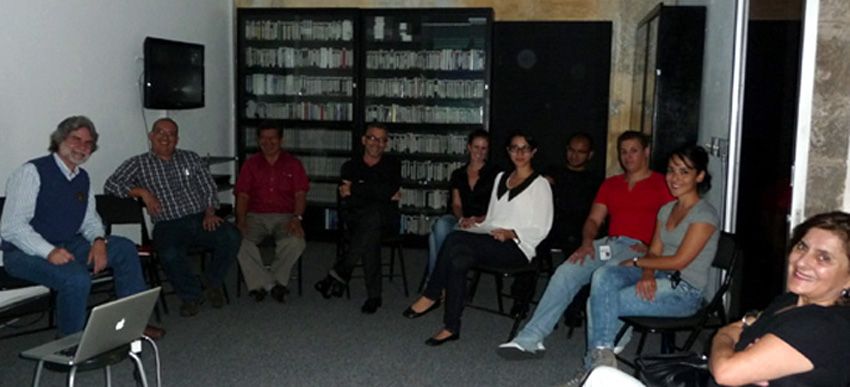
Some people from the discussion group. Photo: Georgina DeCarli

During this past January I was focused on a project with the ILAM Foundation-Latin American Institute of Museums, San José, Costa Rica. As you know, I am professor of virtual workshops and classroom courses on the registration area and cataloging collections there. These workshops have already seen eight editions, and I have taught for almost all Latin American countries.

On this occasion, Mr. Esteban Calvo, Registrar at the Costa Rican Art Museum who attended one of the workshops, had the great idea to do a talk, an informal chat with some colleagues from museums in San Jose. The event, held at the Museum of Contemporary Art and Design in San Jose on Wednesday, January 23, was attended by some directors, curators, registrars and educators from several museums. Georgina DeCarli, Director of the ILAM Foundation, also accompanied us, and updated us about the opportunities and terms and virtual and face trainings offered by the ILAM for museum workers. We talked cordially about interesting topics related to our practice, and we got a valuable feedback loop for all.

We talked cordially about interesting topics related to our practice, and we get a valuable feedback loop for all.

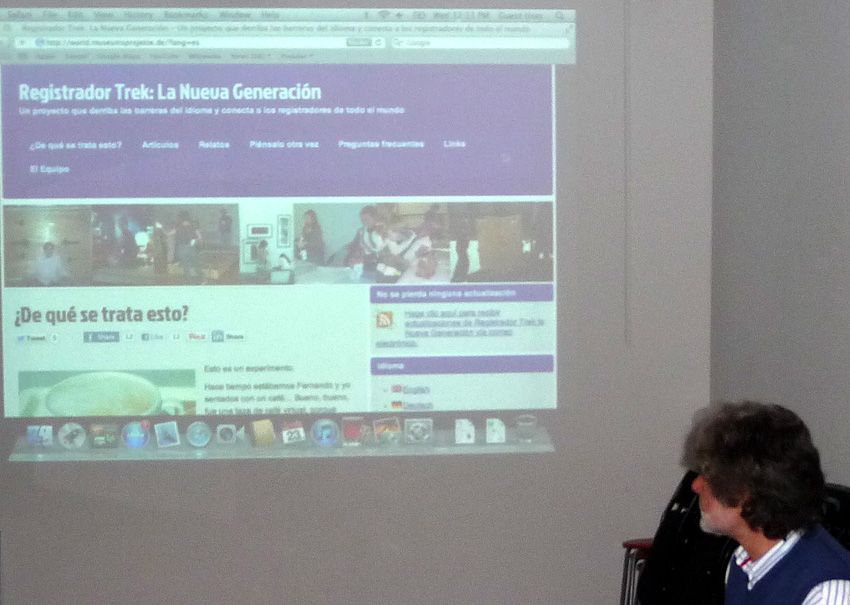
Projection of the website. Photo: Georgina DeCarli

We took the chance and I presented our blog Registrar Trek: The Next Generation by projecting images of the website and inviting them to visit and write for it. There were good anecdotes about the founding of our blog, plus the peculiarities of everyday work in our museums. I have brought with me a couple of pictures of this meeting so special.

Fernando

FAUX Real: On the Trail of an Art Forger Part 3

picture: LSU University Art Museum
Mark Landis
Also known Aliases:
2009 – Steven Gardiner
2010 – Father Arthur Scott
2011 – Father James Brantley
2012 – Mark Lanois
Hopefully I have sparked your interest on Landis thus far and are sharing this with others, even if they are not in the ‘art realm’. So Landis has been up to this for over 30 years. But why, people ask me – for example in a comment to part 1 here. There has never been any money exchanged, no mail or insurance fraud, no fraud of any type that has any interest to the authorities. Former FBI agent, Bob Wittman told me that if there has not been money exchanged or if Landis never sold his forgeries, then he has done nothing wrong. Except Landis has taken valuable time of museum professionals over the years and there are indirect and direct costs and they all hurt budgets and I believe museum professionals reputations. There are over 17,000 institutions here in the US that either showcase art or are collecting entities. And I have only found or have had 52 come forward, I know there are more out there that Landis has duped but they do not want to admit to themselves or their institutions being part of Landis’ game.

How does one detect a forgery you may ask? I have had not formal training or education into investigation. I was curious about the Signac gifted to the Savannah College of Art and Design (SCAD) and the Lepine gifted to St. Louis1. When I started to get suspicious, my anal retentive, registrar, OCD frame of thinking kicked in. I looked at the six gifts from Landis to Oklahoma City under a simple magnifying lupe and ultraviolet light. Each piece, the Signac, Lepine, Daumier, Laurencin, red chalk 17th century drawing and Valtat that we had received earlier, all had some kind of querky things about them. The Lepine glowed white under black light. Why? Where ever Landis did not use his 20th century oils to paint over the digital reproduction, they glowed white. The red chalk drawing supposed to be 17th century… not only did areas in question glow white or a dark blue but there was some other tool I used to confirm my suspicion… my nose. For a 17th century drawing to be authentic, the matting it was affixed to should have been brittle and snapped with little effort. I remember peeling back the lower left corner of the mat expecting it to snap, not harming the image, and guess what… it was stark white… brand new. Then I lifted the exposed area to my nose and it smelled like COFFEE! Fake!

After having conversations with more than 20 institutions in less than 60 minutes, I uncovered the most prolific art forger of our time. But not like any that has been shopped in the past, but an unusual character that was not in it for the money, but to be philanthropic, honor if mother and dad and to be treated ‘nice’. Landis had no interest in seeing the FAUX Real exhibition I put together at the University of Cincinnati last April. And I quote ‘I don’t care to see this stuff, I have already seen it. Is there anyone here to speak to that is nice? Yeah, that would be nice. Is there anyone here to talk to that is nice?’. Words from Landis… try three days of this as I did in the summer of 2008… it will wear you out. So my fellow sleuths, don’t be afraid to use your gut instinct and ask questions. You just be the next registrar to uncover something as big as my case on Mark Augustus Landis. Discerning eyes, experience, due diligence, patience, inquisitive nature… don’t take things at face value. You may get duped!

More specifics on this scam coming soon. I could write for hours on this case but I am trying to keep my two week series concise only giving you enough to wonder why and get you thinking. Oh wait until I share the forgery of the Picasso! Remember to look for my contact information is on the authors page of Registrar Trek. Talk soon!

Matt

Read more:

FAUX Real: On the Trail of an Art Forger Part 2

picture: LSU University Art Museum
Mark Landis
Also known Aliases:
2009 – Steven Gardiner
2010 – Father Arthur Scott
2011 – Father James Brantley
2012 – Mark Lanois

Well, I mentioned at the end of part one of this blog that I had the complete story on Mark Landis… I should have said ‘incomplete’ as I am still tracking Landis to this day. It is amazing, to say the least, that I have put five years of my life thus far tracking this individual’s movements, but still have the gut feeling he is laying low on how he can restart his scam even though Landis told me he was going to stop. Yeah stop what he has been doing for the last thirty plus years? I thought this was the case when I found his third alias, Father James Brantley in 2011. This was shortly after the story was released by the Financial Times where he confessed to what he had been doing and how he had been doing ‘it’. I figured after reading the article (you can find the article on the internet) that he truly had been shopped and would stop… my quest was over… and Landis was done. It was not until February of 2012 that I received an inquiry from a development officer at Loyola University in New Orleans. This particular gentleman knew I had been tracking Landis over the years and he had some new news! Landis had approached Loyola, as he did ten years earlier as Mark Landis, now as Mark Lanois. I guess that Lanois must be French for Landis, right! I recorded this in my dossier and now I have four alias’ (I will talk about each in the upcoming parts).

So let’s back up before I get ahead of myself and get you all excited. On August 7, 2008, after finding something was not right with the gifts to Oklahoma City, I put out a call to my colleagues at other US institutions to see if anyone had a donor and gifts from Mark Landis. Within the first hour, I had over twenty inquiries via phone and email wanting to know what was going on. I shared my story with each one that I conversed and the stories were each the same. Landis had either sent a gift via FedEx or showed up in person promising more art and money for an endowment. Each institution gave him carte blanche in their museum shops, gave him dinner never to hear from him again. My favorite question I asked each one was… ‘did he mention he had a bad heart and was to have surgery?’. To my amazement the answer was yes! I guess he has been having heart surgery for over thirty years then, right? That was his ploy to why people may have wondered why he never resurfaced. Maybe the surgery didn’t go well or maybe he was in bad health. That was not the case. He used this as one of many reasons not to show up again… you know why? He used many tactics to keep himself under wraps even though I do not believe he felt he was doing anything wrong. But fraud is fraud and a forgery is a forgery. If you knowingly give something to someone else under a false pretence, then you are knowingly defrauding that individual. Plain and simple. You do not have to get money for what you do or scam or scheme or however you wish to eventually categorize Landis after reading my blog. Landis has knowingly been doing this for a long time and you know he knows, otherwise why would he change his name and appearance four times in five years? He knew someone had discovered him and has been tracking him… yeah me!

More in a few weeks and please feel free to contact me with questions or any comments. My contact information is on the authors page of Registrar Trek. Talk soon!

Matt

Read more:

A project to break down language barriers and connect registrars worldwide