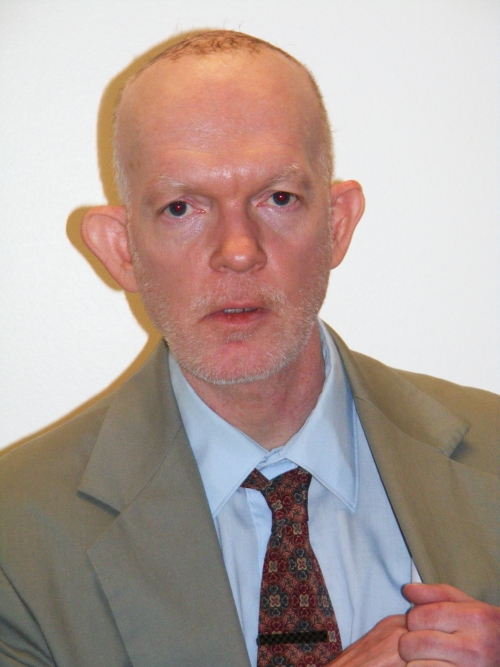
The forger – Mark Augustus Landis Also known Aliases: 2009 – Steven Gardiner 2010 – Father Arthur Scott 2011 – Father James Brantley 2012 – Mark Lanois 2013 – Martin LynleyThis Friday, I have the opportunity to continue to educate the public on Landis, this time… maybe future Registrars, a group of students.
I will be at the Taft Museum here in Cincinnati at 1pm, EST not only talking about paintings and the like as a curator would, but my experience as a Registrar leading up to my findings on Landis. I say this to you so that if you remain a Registrar or choose another field, do not let go of those experiences you have had to help educate those in the field or outside the field. Each of us, in whatever country or state that chose the field of Registration, have a responsibility to be the sole caretakers of objects, personal effects, and beloved treasures that have been acquired over the years even if we or the records cannot account… we ARE the heartbeat of any institution.
Remember that crew, you are the heartbeat. Do not take yourself for granted or anyone else. You are who you are and your talents and gifts will take you to places you have never dreamed of. Keep up the pace, the endurance, and due diligence that makes a great Registrar great. Life will open doors, and of course close them, but staying true and having a great network such as this, you will remain strong. Straying away from them will close doors.
That is all for now. Again any findings on the names listed below or any suspect you may have in any acquisitions, please contact me. My contact information on Registrar Trek is complete and accurate. I look forward to any response or questions regarding myself or the Landis case, and until the ‘mean’ time…. Stay strong and know that you are a part of a unique group of people and I am grateful to Angela Kipp and the crew with Registrar Trek..
The forger-Mark Augustus Landis
Alias:
Steven Gardiner
Father Arthur Scott
Father James Brantley
Marc Lanois
Martin Lynley
Juggler, mediator, orchestrator, actuator, über1 collections manager, yoga master, risk manager, project manager, customs broker, transport coordinator, preparator, inventory controller, diplomat, bureaucrat, legal associate, communication hub, document diva or divo, and shepherd: all terms describing museum collections registrar’s loans processing skills.
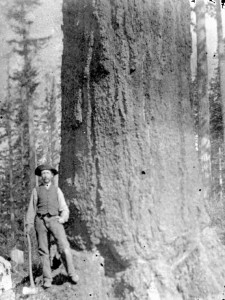
The purpose of this article is to enhance the understanding of the registrar’s role by linking the above core skills with job duties. These skills divide into four categories: mental predisposition; communication and organizational capacities; collections management skills; and documentation abilities. I’ve got this under control, I think? Image I-27378 courtesy of Royal BC Museum, BC Archives Multi-tasking is a predisposition shared by “jugglers” and registrars. Simultaneously processing numerous loans, in varying stages of progress, with differing degrees of complexity, equates to the task of a juggler keeping a stream of airborne objects of various sizes and weights aloft without one dropping to the ground. Like a “yoga master” the mental disposition of the registrar is calm, in this case, under a stressful, heavy work load, and flexible transitioning from one loan to another, driven by ever changing loans processing priorities.
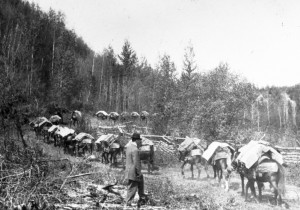
Okay, I guess we’re not on the same page yet. Image C-04790 courtesy of Royal BC Museum, BC Archives
From the role of communicator emerges the ability as “mediator”. The registrar helps with issue resolution between loan team members and her/his institution and the borrower/lender’s. The tact required draws on the skill of a “diplomat”. To facilitate the flow of accurate information the registrar functions as “communication hub” becoming the one point of contact for the institution and a conduit channelling questions, answers and information from the borrower to the loans team and vice versa.
In the capacity of organizer the registrar focuses both on the broad picture, keeping the loan moving forward, while being mindful of the narrower picture, making sure no step is missed. The loans team at the ready. Image C-02802 courtesy of Royal BC Museum, BC Archives This likens to a “shepherd” keeping the flock together, herding it on, watchful so none of the group is lost in the journey. As “orchestrator” the registrar, like a conductor, guides the harmonious processing of the loan, cueing team members, or the borrower, when an action is required. The skill of “shepherd” and “orchestrator” support the function of registrar as “project manager”, assuring all steps are followed in the most time and labour efficient manner in order to meet all deadlines.
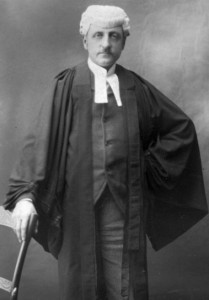
So what were those crate dimensions again? Image B-03338 courtesy of Royal BC Museum, BC Archives
The registrar assumes the over-arching role of “über collections manager”. This is defined as: extensive collection management knowledge and experience encompassing all the collection types under the registrar’s purview. Supported by conservation staff and discipline specific collections managers, this ability assures application of the correct loan protocols and practices given the specific needs of any object loaned from any collection. As the loan is readied for transport the supplemental knowledge of “preparator“ enables the registrar, when needed, to oversee and enforce appropriate crating and packing methods for artefact transport and apply best practices to maximize protection of any loan item.
This relates to the responsibility of registrar as “transport coordinator” to only employ artefact carriers who use optimal safety measures and shipping techniques. Providing the best crating, packing and utilizing top museum quality transport translate to registrar as “risk manager”. Perhaps we should find a new artefacts transport company. Image B-07174 courtesy of Royal BC Museum, BC Archives This role incorporates additional important elements including provisions that loan items are insured at correct current value; ascertaining that the borrower facility meets international standards for environment, structural integrity, inherent building security, human security presence, qualified collections staff, etc. As “actuator” the registrar initiates the acquisition of risk management related documents and information through requests for Certificates of Insurance, Facilities Reports, etc. Another component of risk management ties in with “inventory controller” where all loan items are accounted for when arriving or departing from an in or outgoing loan, and while on-site assigned accurate location codes.
You don’t have the loan agreement signed. I see. Image C-04362 courtesy of Royal BC Museum, BC Archives Before a loan can leave the institution to cross the city, or country or move on to other nations the “legal associate” aspect of registrar surfaces. Legal documents such as loan agreements are created, and when needed, CITES or other permits, attained. Understanding the regulations and documentation related to export and imports aligns with the occupation of “customs broker”. The acquiring and safe keeping of all such important documents makes the registrar a “documenter” and “document diva or divo” and uncompromising adherence to precise standards requires her/him to be a good “bureaucrat.”
The skills described above are neither comprehensive nor exclusive to the role of registrar. Various combinations of these skills are shared by many professions. The entire “package” of skills, however, makes the role unique.
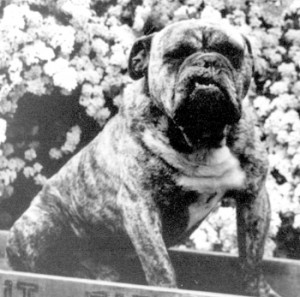
So are we masters of all the above skills? I’m certainly not. I have the required academic background solidified and tempered by on-the-job training and with greater experience I find comes greater ability. Ralph Waldo Emerson wrote: “The years teach much which the days never know.” I’m serious. Don’t mess with the collection Image C-02996 courtesy of Royal BC Museum, BC ArchivesDespite my thirty plus year career encompassing collection management of Art, Ethnology, Modern History, Natural History collections along with duties as preparator, curator, preservation specialist, and registrar, I’m still learning new things and polishing these skills. For me, the years of practical, rather than academic, experience have been the best, and at times only, learning tool. I trained, for example, early in my career, as a preparator by working alongside a veteran in the field. I made many mistakes but these often resulted in the greatest learning opportunities. Mark Twain’s once said: “A man who carries a cat by its tail learns something he can learn in no other way.”
There is one salient skill not mentioned above. Perhaps it would be better called an obsession. We doggedly champion our institutional collection standards. We are programmed, in our profession as registrars, to adhere to elevated ethical principles and to propel our professional abilities to an ever higher level. This is a good thing. As Michelangelo is attributing to saying: “The greatest danger for most of us lies not in setting our aim too high and falling short, but in setting our aim too low and achieving our mark.”
This post is also available in Polish, translated by Natalia Ładyka, the translation originally appeared on the blog of the Polish Museum Registrar Association http://inwentaryzatorzy.blogspot.de/.
The German word “über” has made it’s way into Canadian English, meaning “the ultimate”. Editor’s note ↩
The forger – Mark Augustus Landis Also known Aliases: 2009 – Steven Gardiner 2010 – Father Arthur Scott 2011 – Father James Brantley 2012 – Mark Lanois 2013 – Martin LynleyWell The New Yorker piece came out in August and thought it was well done. Film crew from New York was here for the last time last week and should be wrapping things up on Landis and the now narrative feature in 2014.
I decided today to revisit and again share my findings as an update. Believe it or not, after I sent an email to two museum lists, I got a response. As some wish to remain anonymous if they have something from Landis, I respect that. So I can tell you that today I found another attempt by Landis that was from February 2007 to an institution in California requesting information on his genealogy along with a print-out he wished to donate, which the names, with no wonder, did not exist. His return address was from a town here in Ohio. The director to whom the letter was mailed from Landis returned his documents and told him that they did not know of his genealogy and could not accept his donation of a print-out of his genealogy as it was not in their collections plan. Good for them! Or they may have been approached by Landis today under another name. This institution did not know about Landis in 2007, but they know about him now and I know they have been informing their co-horts!
I say all of this to bring back to you the name of the now known art forger, although having been deemed not doing anything illegal, is still out there. Whether he is still active after all the media attention or is just laying low until he believes he can begin again, I do not know. But as I did with the two museum lists, I will once again share his true name and alias with the fifth alias being rather recent. And I ask those that have been following or the new people in the field to look at your records and ask questions and spread the word. This will not only inform others of Landis but also make people think twice before accepting a work or making a purchase as I discovered something not quite right on August 7, 2008.
There are good days and there are bad days. This is a bad, sad day. A day I hoped would never come – or if it did, then in the far, far future when Registrar Trek is a myth the old registrars tell the young registrars about.
This project started out as a project of two people: Fernando and me. We had been exchanging thoughts for … well, almost exactly a year. We laughed, had fun, inspired each other and out of this, Registrar Trek was born. A small project at first. Two people writing articles and translating them in their mother tongue. When we went live in January, we soon gained more authors, translators and more languages. Registrar Trek grew rapidly, up to 37 contributors.
Rapid growth is great, but it’s difficult to keep an eye on everything. So, while I was busy managing new team members, adding translations and writing stuff, I didn’t notice that one team member was not happy with how things were going. A very important team member, my Captain (we often joked that his role model was Captain Jean-Luc Picard and mine was Admiral Kathryn Janeway).
The problem with working with team members from all over the world via internet is that you don’t meet people face to face. In the normal museum business your eyes or your intuition tell you that something isn’t understood the way it is said or that one team member is not happy. When this occurs, you could grab two cups of coffee, close the office door and sit down and talk. On the internet you have to rely on what you read from others, a very limited view of what is going on in another human being.
Maybe it was words I wrote that weren’t understood the way I meant them, maybe it was other things I did or said (or didn’t do or didn’t say), but the fact is that Fernando has decided to leave the Registrar Trek. No chance to reach him, no chance to set things straight, no chance to hold him back. I always said that if one of us stopped having fun, this would be the end of Registrar Trek. And in a way I still feel I don’t want to steer that ship without my captain, co-founder and co-administrator. So my first impulse was to close the project down.
But then, there are all of the great colleagues who offered their help with translations and the many people I know are working on contributions for Registrar Trek. And of course there are you, the readers of the blog, who keep us motivated to invest our free time in articles and translations. So, I feel a responsibility to carry on. I can’t promise that we can do it as well as we did before. Now, the captain is missing! But we will carry on.
You all know that in a perfect museum everything is at the right place at the right time. Unfortunately, this isn’t a perfect world, hence: no perfect museum. So, part of a registrar’s job is to improvise. Find bug fixes, workarounds and substitutes, use common sense and sometimes parts from your local DIY store. Often, you use your experiences from your everyday life to apply them to you museum work. Just now I discovered that it also works the other way round.
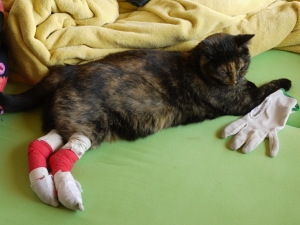
Recently, my cat fell from great height onto something very rough and hard, we suspect from a scaffold, roof or building crane to the asphalt road. As a result her back paws were torn open, she ruined her claws and lost two of them. The vet bandaged the legs, but when she tried to walk with it, she always slipped on our parquet floor. Well, as you might imagine from the accident, it isn’t my cat’s idea of fun to lie around doing nothing. So she kept on walking and slipping. That’s when my registrar’s brain started thinking…
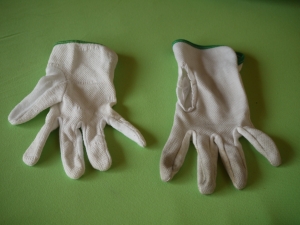
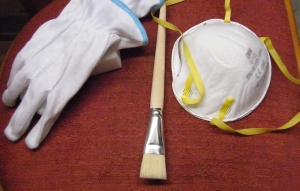
Like most collections people I have a private supply of gloves: nitril, latex, cotton, leather… for every purpose the right glove. Among these are those handy little things most of you will know:
Not suitable for all purposes, for the little pimples on them are made from vinyl, but the right ones for carrying around something with a very smooth, slippery surface. In my case, it was the other way round: they should carry something on a slippery floor.
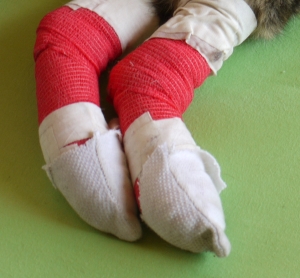
I sacrificed two thumbs to have improvised socks I could pull over the bandage.
Later I fixed them with some sticking plaster to hold them in place. Now, she still isn’t exactly a happy cat, she’s still a little insecure with the bandages (pun intended: she’s all thumbs with her rear legs…) but can walk around without slipping again.
The great thing about being a museum professional is that you never know when and where the skills you learn along your path will be needed in the future. This is a story about it.
A few months ago I discussed with Robert M. Kelly an article he was writing for a journal. Having dealt with museum texts a number of times before I was able to give some hints. I guess all of you who ever wrote or edited exhibitions and catalog texts know what it means to use the surgeon’s knife on filler words or the butcher’s ax on whole passages to make a text fit into the given word count…
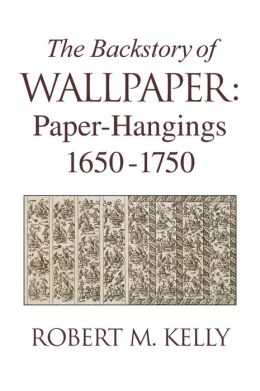
When we were through, Bob asked me to help him on a book he was writing. A book about wallpaper. The early years of wallpaper.
I said: „Bob, I’m a collection manager, I don’t know anything about wallpaper and I’m no native speaker.“
Bob said: „Yeah, exactly what I’m looking for.“
Sometimes I’m glad that most conversations nowadays are via email, because if he had asked if it’s okay to ship the Mona Lisa via [insert favorite parcel service] I would have given him exactly the same facial expression.
Anyway, now, exactly 9 months after I started to read the first sentences of the manuscript the book is out and I’m proud as hell!
Why should I read a book about wallpaper, you ask?
Well, there are many good reasons: wallpaper is on the walls of historic houses and we have to care about it just the same as we care about the furniture, the carpets and the other artifacts. We might have wallpaper in our collections, as brand-new rolls that were never delivered and installed, as fragments being rescued from destroyed houses, as wallpaper pieces inventoried by mistake as lining paper (or vice versa) or as study collection for design questions. As always: the more you know about something, the easier it is to care for it.
But this is not a book about conservation or registration issues. It tells the social and economic story of how wallpaper was made in the early days, how it was sold and how it became popular on the walls in Europe and the North American colonies. And it’s a book about people.
We meet people who made, sold, bought and installed wallpaper. We meet Jean-Michel Papillon , who did the wonderfully detailed descriptions and drawings of the craft intended for Diderot’s Encyclopédie (some to be seen in the book) – but was forced into this trade by his father and turned his back on it as soon as he could. Thomas Coleman who began selling wallpaper in London and later moved over to the American colonies to do the same. Catharine Mac Cormick who was one of the few installers we know by name, representing the countless female and male paperhangers who didn’t leave a mark in the records.
Following the traces of people makes the book easy and fun to read. While it is a book about the history and technology of wallpaper, it is not a dry one. It’s a journey into the past.
Now, as I continue my journey on the path of a collection manager and museum professional, I am very curious when and where the skill of having helped a book about wallpaper to see the light of day will be needed in another project. In the meanwhile, I will have a picture of a wallpaper as a wallpaper on my screen….
Angela
The book is available in every bookstore:
Robert M. Kelly: The Backstory of Wallpaper. Paper-Hangings 1650-1750. Published by Wallpaperscholar.com, hardcover, 190 pages.
ISBN-10: 0985656107
ISBN-13: 978-0985656102
Installing an exhibition is teamwork. Thanks to Matt Leininger for the picture.An exhibition may be conceived in a number of ways. Usually the idea is first, and the text and artifacts are brought together in support of the idea. Sometimes an artifact or group of artifacts embodies an idea, and the rest of the exhibit is built around them. Sometimes, in order to be bomb-proof or portable, an exhibition is done entirely with graphics, and it is images of the objects that support the idea. Whether the objects are part of the museum’s collection or are to be borrowed from another institution or individual, the collections department becomes part of the equation early in the process.
Choosing of candidates from among available objects is first a matter of research – into the database, into the holdings of potential lenders. A list of possibilities is given to collections staff who bring them out for the curator and exhibition designer to see. Each item is evaluated not only for suitability in telling the story, but for its condition and its vulnerability to the stresses of handling and light exposure. Sometimes mere size or weight are limiting factors, or whether or not the item can be protected from curious visitors who don’t recognize the damage their handling can cause.
Once choices are made, a series of steps is followed in order to prepare the items for exhibition. Condition reports are updated or written, and images made to support them. The exhibition designers must know sizes and lighting requirements in order to determine casework and placement, as well as the possible need for rotation of vulnerable items. Collections staff in turn must determine what mounts or supports to construct to ensure stability of each object. Both exhibition designers and collections staff must have a thorough knowledge of acceptable materials for a safe exhibition environment. This includes not only casework, mounts, and coatings, but also graphics substrates and inks, and adhesives.
Just in case… the registrar makes sure the lights are alright. Thanks to Abbi Kaye Huderle for the pictureInstallation is always a joint project. In order for it to go smoothly, everyone has to know where and when each piece is to go in. Staff and volunteers work together to transport items from storage to the gallery, clearing the path and opening and closing doors as needed. Once any objects are in the gallery, someone has to be there at all times to keep unauthorized people from wandering in. Mounts and isolating material are placed, objects are installed, and then lighting levels must be adjusted. Exhibitions staff up on ladders, collections staff on the floor, work to aim and control light levels so the objects are clearly illuminated but not endangered by too much light. The comfort of the public must also be taken into account, as a brilliant light striking into a visitor’s eyes from across the gallery is a serious flaw. A last polish of plexi vitrines, and the opening can take place.
Even after an exhibition is buttoned up, exhibits and collections staff must check regularly that vitrines are clean, that nothing has been jarred out of place, that visitors haven’t found ways to handle or disturb the objects, and that light levels are properly maintained. Collections staff also inspect for evidence of pests. If anything is found to be awry, it is reported to the appropriate department and remedied with as little disturbance to the exhibition as possible.
I’ve always said I don’t like taking work home however I’ve always found saying that is easier than accomplishing it!
When I first started out in this industry, I was what you would call a backstage roadie dealing with the logistics of international exhibitions with a well known company in Spain. I found that gave me a very different perspective when I went to museums in my own free time. I’d notice if things were not hung level, when labels were missing, when the support to a piece looked funny and even when the paint job was a little off.
If I had worked on a show I’d know all the details of what really went on behind the scenes. Despite the beauty or importance of a piece, if something had delayed it’s arrival or an issue had arisen with it it’s all I would be able to focus on (though seeing it in its spot made me sigh with relief). If i hadn’t worked on the show I wondered how things had been packed, handled an transported. What crates were used/ built?
Most people don’t notice clearance levels in hallways, stairwells or door frames but I did. There was no avoiding looking at access points and loading docks differently, no matter where I went! I know what fits and what doesn’t on standard international palletized flights and whenever I’m on a plane I can’t help but wonder what that belly holds apart from luggage.
My husband likes to say I’m a little bit of a control freak so the shoe fits with this industry. When I transferred over to the museum side my experience helped me greatly and my slightly OCD side was complemented in my day to day tasks as a Collections Manager/ Registrar. In front of me I had a whole collection that needed TLC. The thought of re-organizing, re-housing and properly inventorying everything was like throwing a kid in a toy store!
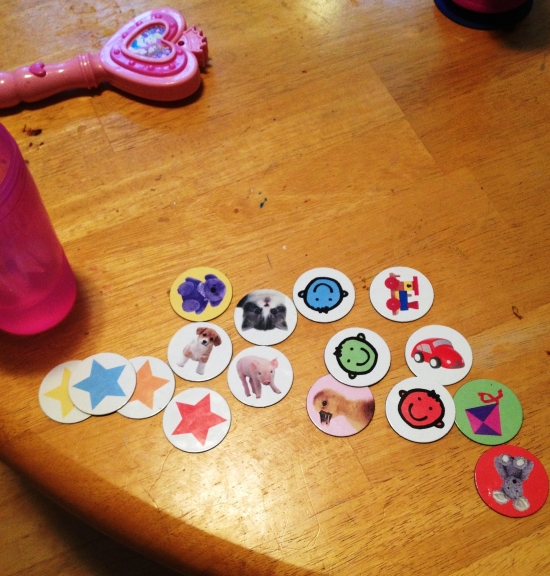
I didn’t realize just how much my job influenced my life until I one day when my daughter was sorting through some stickers and did this:
It was then that I realized why no babysitter was ever able to follow my toy storage technique. All musical toys go in one bin, all sorting/ stacking toys go in another bin, toys that roll in another and so on. I was bringing work home and passing it on to my littles! Suddenly I realized why she liked to neatly stack coasters and freaked out in stores when items were off their shelf and on the floor. I knew then I had a very important responsibility: to train the next generation!
I’m hoping I’ll be able to live up to the task, at least that way her room will be clean and she’ll understand the importance of a proper IPM plan!
I recently started a survey on journals, magazines and newsletters for conservators. The aim was and is to gather a comprehensive list of information sources world wide.
Until today there doesn‘t seem to exist anything alike and I believe that it will contribute to better information and networking among museum professionals.
Since registrars are gaining importance and taking over duties that where formerly carried out by conservators I believe it’s interesting and important to collect sources for registrars too, broaden the horizon and interlink both groups alike.
There are, at the time I’m writing these lines, 46 journals listed in a database that I made available online. Only a handful of them are covering topics that are interresting for registrars.
You can make the difference! Please help me to collect online and ofline resources for registrars.
The datbase is available online: http://83.150.7.6/fmi/webd#magazines_for_conservators_and_registrars
> Login as Guest “Gastkonto” to browse and search the entries.
> Login as “Editor” and use “contribute” as passphrase to add or edit entries.
> You may also write me a mail (a.franz[at]divisual[dot]net) with your suggestions and recommendations.
Thank you very much!
Yours
Andreas Franz, dipl. Conservator FH/SKR
A registrar needs a whole bunch of materials to work with. They may vary from museum type to museum type and from working setup to working setup, but in 2013 a brainstorming among registrars on the RC-AAM listserv put together a list of useful tools and supplies that covers the needs for many registrar’s duties. The Registrar Trekkers (authors and translators of this blog) had a look at this list and added some more items. After we finished our brainstorming we give the list to you, our readers. Feel free to add what is missing in the comments section and we will update the list from time to time.
Working setup:
Lightweight Toolbox
Camera
LED Flashlight
Extra batteries
Small Notebook or Tablet PC
A good computer software! We don’t normally think of software as a “tool,” but without it, cataloging is impractical and making the catalog available to others is impractical to impossible.
Plastic plank or board for support of notebook or paper
Trolley