Your do what for a living?

by Derek Swallow

”So what do you do for a living?” I’m asked. “I work as a museum collections registrar.” I reply, gazing on the now blank look of the asker. I continue, briefly describing my job duties: registering potential acquisitions, tracking the process through to the collections committee and ultimate accessioning. This usually draws the ego crippling words: “That sounds interesting” said in that particular pitch that translates to “what a deadly boring job.”

The Beautiful: Buprestis aurulenta – The Golden Buprestid. (Interesting fact – the larvae feed on the wood of recently dead or dying trees and may take more than 60 years to mature if the wood is very dry. (From the Entomology Collection - Royal BC Museum)
The Beautiful: Buprestis aurulenta – The Golden Buprestid. (Interesting fact – the larvae feed on the wood of recently dead or dying trees and may take more than 60 years to mature if the wood is very dry. (From the Entomology Collection – Royal BC Museum)
Barely controlling my irritation I refrain from spitting out the words: “I love my job. It’s really interesting. You really know nothing about it. So what the heck do you do that’s so wonderful – are you an astronaut or something?” Instead I take a deep breath, smile amiably and prepare for my crushing blow.

Bizarre: Goose-neck Barnacle (Pollicipenes polymerus) Stalked barnacles that grow in clusters or colonies along exposed shores of the BC Coast) (From the Invertebrate Collection – Royal BC Museum)
Turning slightly away, to show mild indifference, I softly roll out these charged words: “And I manage multi-million dollar loans, sending our priceless museum artefacts to exhibits around the globe.” A brief silence follows, the listener’s head turns, the facial expression transformed to one of amazement, then the response: “What a fascinating and important job you have!” The words “Got ya” drift through my mind. Then, I’m peppered with questions about these awe-inspiring loans. Fair enough, loans do have a certain cache. However, in reality they provoke a huge amount of very unromantic work, often have nearly unattainable time lines and can drive a teetotaler to the nearest pub.

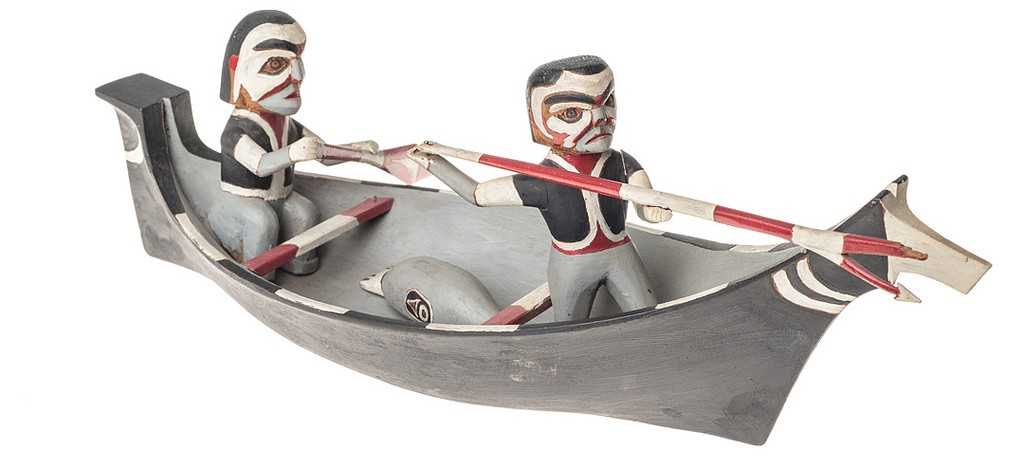
Ethnologically enlightening: Kwakwaka’wakw model sealing canoe (early 20th century) (From the Ethnology Collection – Royal BC Museum #14097 a, b)
I’m not saying I don’t enjoy loans work – I really do. But our acquisition work is underrated as an interesting component of our job. Without doubt, the process has mechanical aspects but few jobs in a museum open access to information spanning the entire spectrum of the collections. I’m privileged to know exactly what enters these collections, on a monthly basis, whether it augments our archival, modern history, ethnological or natural history holdings and how these records, objects, or specimens demonstrate relevance to the human and natural history of our province: intellectual candy for a life-long learner like myself. It’s a pleasure to play my small role in the acquisition of some notable objects – from the historically stellar, to ethnologically enlightening, to the bizarre and the beautiful.

Sir James Douglas – A-01229 (from the BC Archives Collection – Royal BC Museum
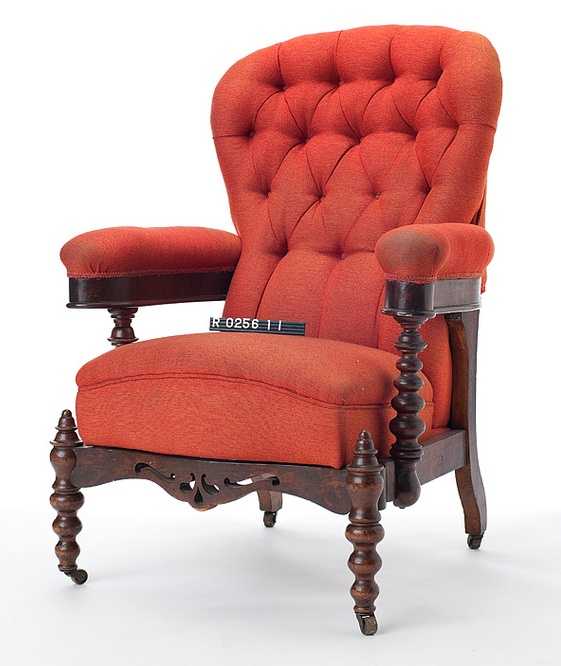
Most often a registrar’s participation begins after a collection enters the door of the museum. A few years ago I had the good fortunate to assist one of our history curators retrieve the Douglas chair (see image) and other components of the Douglas collection; the curator needed an extra pair of hands considering the size of some of the objects. The donor was a relative of Sir James Douglas, a renowned historical political figure in British Columbia. Douglas founded the fur trade post Fort Victoria In the mid-19th century then later led the small population of European settlers when this west coast region attained British colonial status. During Douglas’ retirement, in 1871, the colony joined Canada as the 6th province: British Columbia. Not long after the union he suffered a heart attack. In 1877, Douglas died in his residence while seated at his chair.The chair remained a utilitarian object in the family. map of Canada-1With original fabric worn out, the chair was reupholstered in the 1960/70s using a popular colour fabric and colour from that period – Danish Modern orange. Sir James Douglas, despite his auspicious career and elevated rank, was a practical man. I’m sure he would have approved of extending the service of the chair to over 140 years through such refurbishment.

Historically Stellar – Douglas Chair – C1870 – Victorian Parlour Chair - History Collection – Royal BC Museum
Historically Stellar – Douglas Chair – C1870 – Victorian Parlour Chair – History Collection – Royal BC Museum
For curators, collections managers and registrars the restored chair provokes an interesting question. Is it still authentic? To be authentic and worthy of museum collection must an object retain its original appearance or does it suffice that it need only retain its original function and association? In this case, it is still a chair, the very chair where James Douglas died whether it has original upholstery or not. Reviewing our museum’s collection policy, which guides what we do and do not collect, the Douglas chair fits into our collecting parameters: it has historical significance to the province of British Columbia, clear provenance, and meshes with our requirement for its “condition or completeness” The policy states: “Objects included in the collections of the RBCM [Royal BC Museum] will be complete, sound, and/or in original condition, where possible.” The phrase “where possible” permits us to collect objects of enormous historical significance, such as the Douglas chair, despite modifications made over time.

I stumbled upon this interesting link which I’d like to share with you. The author muses on the term “authenticity” within the heritage/museums context. She has some very interesting points. http://ejarchaeology.wordpress.com/2013/03/29/my-bike-the-authentic-object-with-its-own-biography/. I look forward to your comments on this subject. I would also be interesting to learn your museum’s particular guidelines regarding “authenticity”.

A Registrar’s Trilemma – The Outcome

I hope you all enjoyed thinking about the situation I presented in the first part and have now decided what you would do.

What was the real outcome?

First of all, you will remember that I said in the first part that real life doesn’t work like an exercise. So, I didn’t have all the pieces of information as well-organized as they were when I presented them to you. I had to draw them together in the continuing process of trouble-shooting – with limited time and with a snowstorm approaching.

As you may have guessed, although option a) (pull out the trucks) was possible in theory, I dumped it pretty soon. It was the most likely to damage the trucks, either in the process of moving or because of weather/climate issues. Imagine moving historical trucks in great haste at the beginning of a snow storm! What are the odds that everybody stays calm and does the right thing? How likely is it that someone loses his head, letting go where he shouldn’t or not watching his step? Preventing artifacts from danger is only one aspect. Avoiding accidents, especially the ones that could lead to injuries, is another and more important to me.

I leaned toward option c) (wait until Monday) at first. Then I checked the webpage of the Deutsche Wetterdienst (DWD, German meteorological service), the precipitation radar and the weather dates of the nearby airport (which is our reference for local weather because it’s only 4 kilometers away).


At the moment we had about 55% relative humidity outside at about -3C. The weather forecast for Monday predicted the temperature would rise to 2-5C with a rain probability of 85%. The precipitation radar told me that the snow front was coming, but was likely to arrive some hours later than the warning time of 10 a.m.

So, I figured out I would have a small time slot for option b) (open gate, place cherry-picker on the outside, work on the inside), because Monday there would be exactly the same problem but with weather conditions worse than today’s. The longer-term weather forecast didn’t give me much hope that conditions would improve within the next week. In fact the -3 °C/55% RH setting seemed to be the best in the foreseeable future.

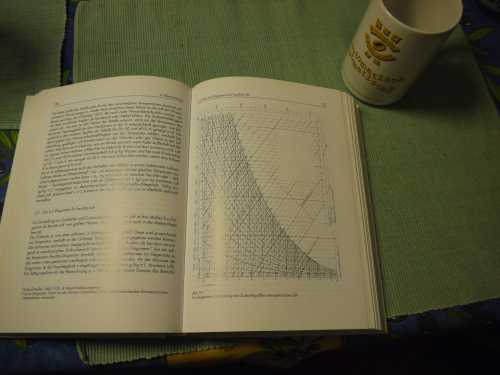
hxdiagrammTo double-check my intuition, I took out my faithful Molier hx-diagram. It told me that with this setting I would not reach the dew point in the hall (remember: 11°C/42% RH). The air would first mix, resulting in an increase of temperature and a decrease of relative humidity before the temperature would start descending. And with all artifacts being well heated at 11C, the risk of condensation seemed low (as opposed to what happened some years ago when some smart guy decided to open the gates to let the “beautiful, warm spring air” (18 °C/80%) into the hall (11°C/50%)).

If the snow front arrived early, we would still be able to interrupt the work and have the gate closed in about 10 minutes. So, I decided to take option b), but, honestly, I didn’t feel comfortable with this solution and would have been thankful for anyone providing an option d).


We were lucky. The detector was changed within one hour and the snow front reached us as late as 2 p.m. We re-heated the hall very carefully (which wasn’t problematic because the heating system is very weak) and all went well.

Why do I have all the data? Did this happen recently?

Some of you may have wondered why I have all the exact data present although I ran into this situation a long time ago. Cross my heart, I didn’t have to make it up! I just had to look it up.

In general, if there are problematic situations you can talk with experts in your museum or in the field to find the best possible solutions. You can make the decision yourself after you have double-checked with colleagues to see if you haven’t missed something important. Or you can present it to upper management and let them make the decisions. Whatever approach you take, you can say you did what you did to the best of your knowledge. Then, there are situations like this one where you are left to your own devices. You have to decide on the basis of the limited data you have, your experience and your gut feeling.

In these cases it’s important to do a double-check afterwards. Sure, if something goes wrong you know that your decision was wrong and you will do it better the next time. But if all goes well you will never be completely sure if it went well because your decision was right or just because you had an enormous amount of luck. This leads, in the worst case, to do the same thing again next time but with far less luck.

So after the incident, I wrote to many colleagues asking them the question I asked you: “What would you have decided?” It was very interesting to read their responses. In general, they approved of how I acted. Some asked if it hadn’t been possible to take the risk of having only one fire detector active, because since it is infrared it would surely react if there were a fire, even if it was in the other part of the hall. There were a few reasons I didn’t take that risk:

  1. The two infrared detectors were installed at exactly the same time. If the malfunction had been a production issue, perhaps the second detector wasn’t fully reliable either.
  2. In case of a fire I was not sure how the insurance would have taken the fact that one of the fire detectors wasn’t activated.
  3. My main concern was this: What if a small fire were burning for some time in the area of the broken fire detector without the other detector taking notice? The fire could gain strength and when the other one finally did take action, we would have lost precious time for the firefighters to react. The hall was made of stone, so statics were not the main concern. But imagine the amount of oily, probably toxic smoke that would be produced by burning oily wood, trucks and trains, the contaminated air and how it would affect every artifact in the hall. And, at least among colleagues of technology museums, the pictures of what remained of the Nürnberg Transport Museum roundhouse are still present: http://en.wikipedia.org//wiki/Nuremberg_Transport_Museum#Damage_following_the_fire_of_17_October_2005

Some colleagues had additional ideas, such as forming a voluntary fire watch among the staff for the weekend, to see if the weather really would be that bad on Monday, an idea I will definitely keep in mind for other cases to come.

When I was about to write this story down, all I had to do was to dig into my email archive of the year the incident took place under the keyword “trilemma” and there I could re-read all the data and some additional facts I have since forgotten, along with all the suggestions I’d received from fellow registrars and collection managers.

Conclusion

Looking back, there was much to learn from this incident:

  • When planning storage, consider how safety appliances can be maintained without putting artifacts at risk.
  • Keep all records of past incidents; you never know when you’ll need them.
  • Murphy’s Law is still in force.

I hope you enjoyed this little real-life collections manager crime scene, and if you ever feel like sharing one of your stories, we would be glad to publish it on Registrar Trek.

Best wishes
,

Angela

Brought from rough into correct English by Molly S. Hope. Thanks Molly, I would be lost without you!

Children in the Palace

by Alana Cole-Faber

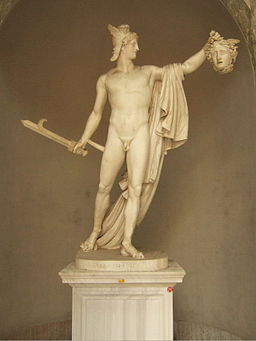
Perseus by Antonio Canova, picture by Hans Weingartz
A few weeks ago, I took my four-year-old twins to the Metropolitan Museum of Art in New York to see the museum’s beautiful Neapolitan crèche. Of course, once we arrived we were easily distracted by mummies and temples and sculpture and barely made time for the crèche itself. While strolling through one of the European sculpture halls, my children became enthralled by Antonio Canova’s Perseus with the Head of Medusa. We had read the story of Perseus several times in the past, and this depiction of the hero was immediately recognizable to them. My daughter was pleased to see that Perseus was wearing a helmet, but my son was rather upset that he seemed to have forgotten a crucial gift from Athena: a reflective shield. While the twins were debating the accuracy of the sculpture, two men walked by. One said to the other, “Oh, hey, it’s a sculpture of that guy from that myth.” My daughter overheard and softly replied, “Perseus,” but the men did not hear her. The second man said, “Yeah, it’s that guy who killed Medusa. What was his name?” The men stood silently scratching their heads for a few moments. “Perseus,” my daughter said a little louder, but again she was ignored. “Perseus!” exclaimed the first man after a long pause, at which point my daughter turned to me and said, “I told him it was Perseus, but he didn’t listen to me.”

“He didn’t listen to me.” I could hear my daughter’s words in my head as I read the recent article about children in museums by Tiffany Jenkins entitled, “Children Should Be Seen and Not Heard.” The author asserts that museums have become too child-friendly in recent years and claims this is essentially a waste of funds, since she believes children are incapable of truly benefitting from the collections that museums offer. The article so severely critiques the inclusion of children in museums that it almost reads as satire. Almost.

Children discovering the secret of calculating machines in the TECHNOSEUM in Mannheim/Germany. TECHNOSEUM, picture Klaus Luginsland
Yes, children are often noisy in museums. Yes, sometimes they run when they should walk. Yes, sometimes they touch when they should not. However, children are brought to museums for their education, and this education includes more than simply who made what and when. Bringing children to museums teaches them that these institutions have value, that what is inside them has value, and that the people who work there have value. With the help of a committed docent, the children might even learn how to behave themselves in the galleries, but even if they do not, the seeds are nonetheless planted for future growth. Studies made by the National Endowment for the Arts indicate there are numerous benefits to involving children in the arts and that those benefits are especially significant for children from low-income families.

Ms. Jenkins’s assertion that museums have become too child-friendly is impossible to support. I have worked with and visited many museums in many different countries over the years. Not once have I ever believed that any museum was too child-centered. I recently visited the Smithsonian’s Air and Space Museum, which in the United States is a sort of museum mecca for little ones. Airplanes and rocket ships hang from the ceiling, and there are interactives and videos throughout the galleries. There are children everywhere, and plenty of things for them to touch and climb upon. If any museum might be accused of being overly geared towards children, this one might be it. Yet I noticed at each interactive, there were at least as many adults participating as children. Grandfathers pointed out famous aircraft to their small companions, and children asked repeatedly of their parents, “What does this say? What is that?” It was loud, sure, but there was learning taking place in every nook and cranny of those galleries by visitors of all ages. I have no doubt at least some of those children will be returning as adults, sharing their experience with their own children and grandchildren.

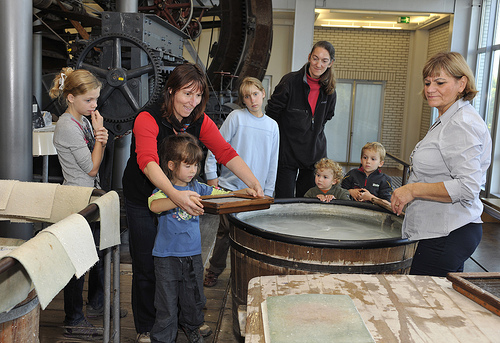
Hand papermaking at the TECHNOSEUM in Mannheim/Germany. TECHNOSEUM, picture Hans Bleh
If our museums are not for children, then whom are they for? Are we not in this business to preserve art, culture, and history for future generations? For those of us who work behind-the-scenes with collections, it is easy to think of the work of enticing our youngest citizens into museums as something apart from us. At some point in our careers, most of us have said, “Oh, I’m not really a curator and/or educator.” But we who preserve the stuff are part of that educational mission, and it is in our best interest that it succeed. If we are not teaching our youngsters that what we do matters, that all of this old stuff we care for has value, then we are surely all out of a job when the next generation comes of age, and Ms. Jenkins will be without her “palace of knowledge” altogether. Next time we hear a noisy bunch of school children wandering through a museum gallery, perhaps we should be thankful someone cares enough to bring them. And then we can make sure they don’t touch anything they are not supposed to.

If you were waiting for the outcome of the Registrar’s Trilemma, wait one more week, we will reveal it on January 17.

A Registrar’s Trilemma – How would you decide?

fire-truck-4912_640When you are studying museum studies or taking a course in artifact handling and preventive conservation, you learn a lot about ideal storage conditions, improving climate conditions, what to do, what to avoid. However, all exercises you solve in class are clear-cut cases. Normally, there will be one right answer to the question, “What would you decide?”

Then, there is real museum life. And like real life in general it doesn’t consist of clear cases. You will always run into situations where you have to decide not which solution to a problem is the best but which one is the least bad. Best practice is great but sometimes all you can do is decide between the disaster and the catastrophe.

This is a true story which I will tell in two parts. In the first part I will confront you with a situation, provide you with some additional information and leave you with the question, “How would you decide?” so you can think about the situation until I tell you how the story turned out.

The setting

You are the collections manager of a museum with a large collection of technological artifacts. It’s 7:30 on a Friday morning in December when you receive a call from the maintenance department: A fire detector has caused one false alarm in the night, with two fire brigades marching out. The detector was reset and caused another false alarm early this morning. It needs fixing.

The storage hall is provided with two similar infrared fire detectors, each one controlling one half of the hall. In order to fix it, the fire detector must be checked and eventually replaced by an external service technician and can only be reached using a cherry picker. The place where the cherry picker could stand inside the hall to reach the fire detector is blocked by two large historical trucks.
Alternatively, when one gate is opened, the cherry picker can stand outside the hall reaching inside and the technician can work from there. As a result, the temperature inside the hall would drop from 11C to around zero next to the gate, and a little more in places further down the hall.

Storage hall climate conditions

  • Artifacts stored in the hall are trucks and railway material
  • The temperature in the hall is 11 degrees Celsius
  • relative humidity is at about 42%

Weather conditions

The local weather station currently reports a reading of -3C at 55% relative humidity, and the weather is overcast but dry. There is a weather warning by the meteorological service for heavy snowfalls, approximate starting time: 10 o’clock a.m.
The weather forecast for next week: on Monday, the temperature will rise to 5C with an 85% chance of rain. The weather will stay warm and wet for the next one or two weeks.

Telephone messages

FFS – Fine Fire Services, call 7:56 a.m.
A service technician can be there at 9 a.m. Work on the fire detector will take approximately 1 to 2 hours, depending on whether the detector needs only to be cleaned or completely replaced. The workers would have be notified by 10 a.m., otherwise they would not be able to come until Monday morning.

Conservator Trucks&Cars, call 7:59 a.m.
Trucks can be moved, but need heavy equipment and support from maintenance department.

Head of maintenance department, call 8:05 a.m.
Tow bar and truck able to pull the historic trucks are available; staff to help the conservator is available.

Conservator Trucks&Cars, call 8:07 a.m.
Where to pull the trucks? The only possible place is the forecourt outside the hall. How long will it take to pull them there? If work begins immediately, they can finish by approximately 9:30 a.m.

NOW IT’S UP TO YOU

Do you have all the information you need to make a decision? How would you go about deciding?

a) Pull the two trucks out of the hall so the technician can work inside?

b) Open one gate so the cherry picker can stand outside and the work can be done inside the hall?

c) Wait until Monday or later, leaving 50% of your hall without a fire warning system, until the temperature rises and it will be dry?

Now, my dear readers: How and what would you decide?

Read the real outcome here.

Happy anniversary, Registrar Trek!

celebrationOn January 2nd 2013 we started a project with the purpose to inform the public about collections work and bring collections people around the world together. Now, a year later, we are a team of four authors and 32 translators from 19 countries, providing 16 languages.

I guess you, our faithful readers, are more interested in what we have in stock for the next year of Registrar Trek than in statistics*.

First of all, be insured that we will keep you entertained with stories and articles from the world of collections management. And we are happy for every new contribution you will send in. Our plan is to hunt for more practical hands-on stories, examples of good practice in registering, good storage solutions and smart ideas in documentation and collections management. We will even have some real world stories that will end with questions like “How would you decide?” leaving you with the possibility to chew on the problem until we reveal the outcome in one of the next posts.

Matt will keep us informed about art forger Mark Landis and his aliases, Anne has some more to tell “off the shelf” and Derek will take you all into the fascination of registrar’s work. Angela is planning to launch a small fun series called “The Museum of Spam”.

And of course, there will be stories and articles from guest authors. We’ve actually got one in the pipeline from a data base enthusiast and there are several others promised.

So, stay with us and stay tuned!

 
Your Registrar Trek Team


* Statistics: We published 62 posts, had 12,000 visitors who visited our blog nearly 20,000 times. Over 300 subscribed to our RSS-feed.

This post is also available in Italian, translated by Silvia Telmon.

Season’s Greetings from Registrar Trek

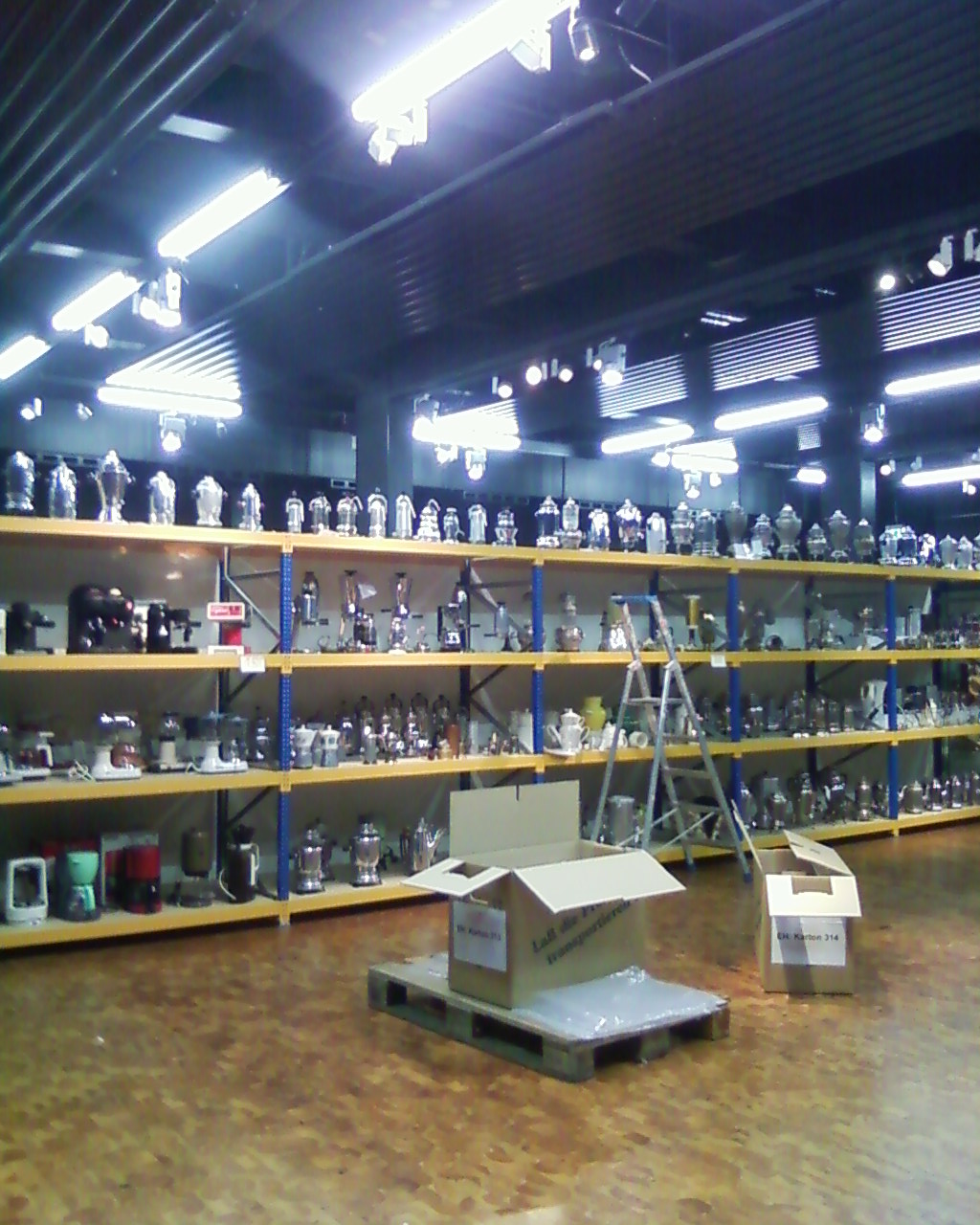
Working on an installation of 173 coffee makers. Still more to come...
Working on an installation of 173 coffee makers. Still more to come…
The special exhibition area is abandoned. Where only half an hour ago artifacts were put into racks or cleaned by conservators, everything is quiet. The last working day before Christmas. Usually, that’s the day to arrange papers and thoughts, review the past year, look ahead to upcoming projects and share some of these thoughts with colleagues.

This year is different. Christmas „catches“ me in the middle of the installation of our upcoming special exhibition, on electrical household appliances. Last year was packed with taking care of vacuum cleaners, pressing irons, food processors, hair-dryers, coffee makers… well over 1500 objects were picked for exhibition, many more were researched and their data corrected in the data base. Now everything must be put in the right place, get individual treatment (i.e. fixing of loose parts or cleaning) and a correct label. No contemplative working process that invites reflectiveness. But I don’t want to leave for the holidays without my own personal review and outlook, especially because this time I can share it with colleagues all around the world:

Aside from the challenges of the aforementioned collections exhibition the last year was defined by the start and growth of Registrar Trek. We went live on January 2nd and I’m sure that there will be time for a special review on our first anniversary. It’s great to see how a weird idea from two people has developed within one year into a project that is known and supported by so many colleagues around the globe.

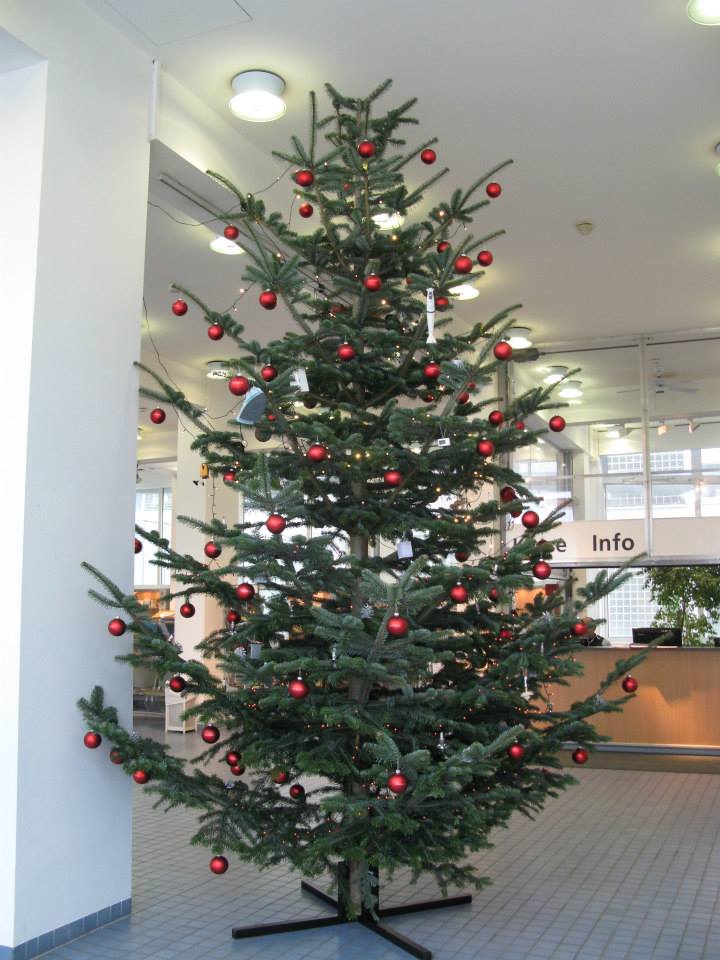
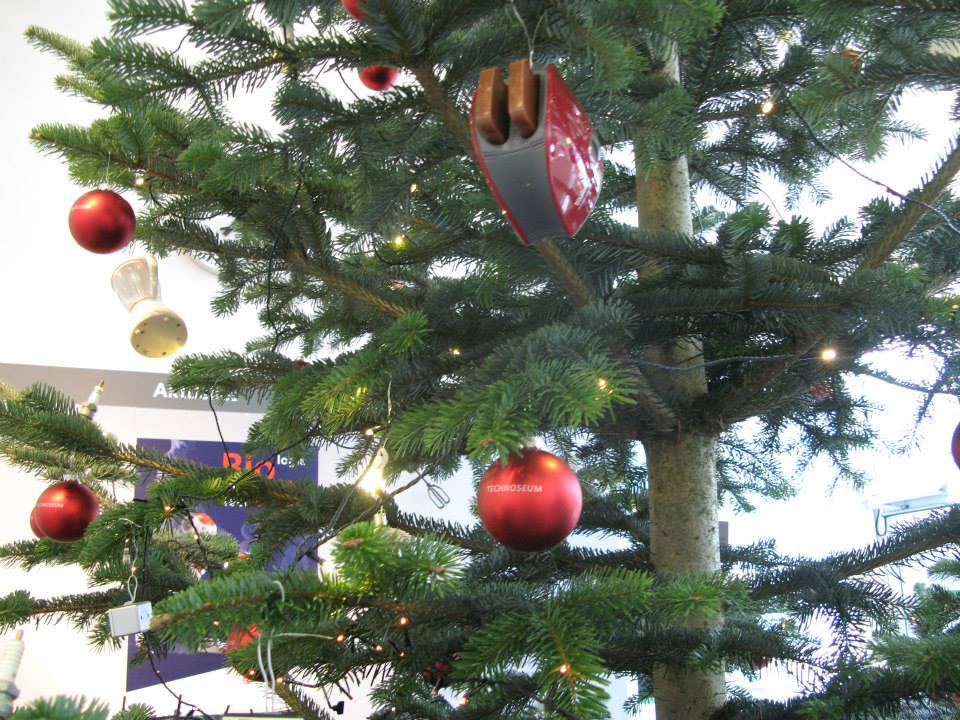
Christmas tree at the TECHNOSEUM: decorated with household appliances. TECHNOSEUM, picture by Klaus Luginsland
Christmas tree at the TECHNOSEUM: decorated with household appliances… TECHNOSEUM, picture by Klaus Luginsland
The financial crisis in North America and Europe is clearly noticeable, especially in the cultural sector. I know that many of our readers and some members of the Registrar Trek team are trying desperately to get back into a job in the field of collections management. Unfortunately, all that we can do is keep our fingers crossed and wish them the best of luck, courage and the power of endurance.

Those who are in permanent contracts feel the growing pressure of taking over more responsibilities because the work must be done with fewer colleagues and declining budgets. Combining professional ethics and financial needs is a difficult task. Amidst of all this trouble, let us not forget that the collections field is not the only one affected by the crisis. I have seen many discussions on professional groups and listservs about how money is spent on the wrong things and wrong projects, and it seems to me that every colleague envies the other for funded projects. Personally, I feel that’s not a successful approach. As registrars, collection managers, curators of collections or documentation officers we are in the same boat as conservators, educators, guides, guards, curators, marketing people… The boat is called „museum,“ and we will need each others’ skills to avoid shipwreck.

...obviously, our marketing department likes the upcoming exhibition as much as we collections people do. TECHNOSEUM, picture by Klaus Luginsland
…obviously, our marketing department likes the upcoming exhibition as much as we collections people do. TECHNOSEUM, picture by Klaus Luginsland
So, for the new year, let us do what we collections people do best: take care of the things that need close attention to detail, help with paperwork and organizational tasks, and, in the figurative sense, wrap the frayed nerves – our own and those of our colleagues.

I’m really glad that the Registrar Trek Team does consist of so many professions: there are of course registrars and collection managers, but also conservators, curators, marketing specialists, visitor guides and people from totally different fields. This variety keeps the exchange of thoughts interesting and the development of this project joyful. For the upcoming year, we have more exciting stories and articles in the pipeline, so stay tuned.

Now I’m going to gather some waste and stack a few pallets before I leave for Christmas. But before that, in the name of the whole Registrar Trek Team:

We wish you Merry Christmas and a happy healthy and successful New Year 2014!

Angela

This text is also available in Italian translated by Silvia Telmon.

FAUX Real: On the Trail of an Art Forger Part 11
– Final Entry for 2013

Dear Trekkers,

Matthew C. Leininger
It has been an interesting year in the life of a former Registrar, yes me, for 2013. This will be my last entry for 2013 and look forward to talking again in the new year.

I want to again thank Angela for asking me to be a part of the team in January. I want to thank all the readers and participants with Registrar Trek. You all are the life blood of this site.

The narrative feature film is in post and will be entered into The Sundance Film Festival in Utah in January, stay tuned. Not really much on the Landis front at this point however I still track him via the internet and word of mouth. Remember to keep a look out for anything that seems suspicious in your collections and keep the diligent eye. Remember, a Registrar is a unique and special person to be or have been and remember you will always have that Registrar inside you ready to utilize your talents in whatever direction life takes you.

Until 2014, thank you once again for watching for my next blog entry. Have a blessed, safe Christmas and New Year.

The forger-Mark Augustus Landis

KNOWN ALIAS FOUND BY YEAR
STEVEN GARDINER 2008
FATHER ARTHUR SCOTT 2010
FATHER JAMES BRANTLEY 2011
MARC LANOIS February 2012
MARTIN LYNLEY September 2012
JOHN GRAUMAN October 2012

Talk soon!
Matt

This text is also available in French translated by Kelsey Brow and in Italian translated by Silvia Telmon.

Read more:

Update: Art in Hotels

Sometimes we receive feedback regarding our articles on Registrar Trek from the farest regions of our planet. But last Monday it was feedback from just next door:
“Guess what I saw this weekend?” Dr. Hajo Neumann one of our curators asked me.
I was clueless.
“Hotel Art!” he grinned and showed me this picture:

Foto00061 by Hajo Neumann

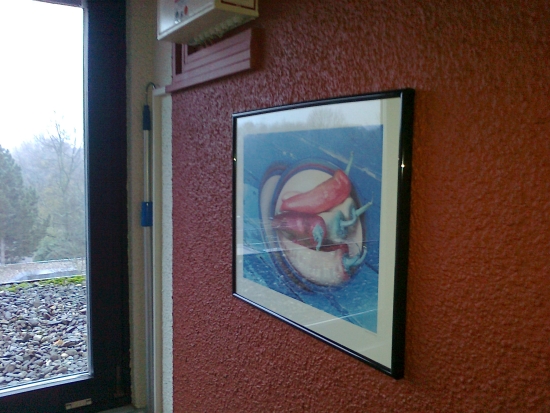
Yes, folks, someone actually nailed the picture directly to the wall! So close the whole frame bends. That it was hung so close to the window that it gets all the UV exposure it can possibly get is a nice extra.

How I became a Registrar IV

Preparator, Collections Manager, Registrar, Teacher – Never stop learning

Derek Swallow

My attraction for the cultural historical sector began in the mid 1970’s when I worked as a guide at Ft. Edmonton Park, a reconstructed fur trade post, and a volunteer information officer for the Strathcona Historical Society in Edmonton, Alberta, Canada. This stimulus led me to study Anthropology and History, earning me a Bachelor’s Degree in these subjects. Following my degree I became acquainted with Museology and through self-study learned about registration/collections management work.

springcleaningSince then, and for almost three decades, registration, collections documentation and loans of cultural collections have been my focal career goal. My experience, in this area, started in 1982, when I took on a long-term voluntary position as Assistant to the Registrar at the Art Gallery of Greater Victoria (AGGV). In 1984 my association with the Royal BC Museum in Victoria, British Columbia, Canada, began with volunteering in Ethnology cataloguing First Nation’s collections. This inspired me to study First Nations art and do a subsequent BA and MA in History in Art. In 1990, I undertook a one year Collections Management Internship (which included several University of Victoria Cultural Resource Management Courses). In 1991 I joined the BC Archives as Preparator/Collections Manager. To augment my experience, I also volunteered for nearly a year at the Maritime Museum in Sidney, BC – just outside of Victoria – its collection’s strength being Natural History. I worked in the area of registration and collections management. With the union of the Royal BC Museum and the BC Archives in 2003 many exciting avenues of learning opened for me. The most rewarding was an arrangement where our head of registration offered to fully mentor me in the registrar’s profession. Over the last ten years my official role has transitioned from that of collections manager/preservation specialist to full-time registrar.

From the outset of my career, I understood the significance and importance of the registrar as the linchpin position that maintains cohesive control over collections location tracking, proper handling, storage and preservation, as well as the critical paper and electronic records which carry the important data about these collections. Further, the registrar understands and carries out the processes and safeguards required to timely, and securely loan out artifacts and care for those which are brought in for exhibit, research, etc.

Derek behind the scenes:

I’m married with three children: a son; daughter; and a large shaggy dog who thinks he’s one of my offspring. I enjoy reading well-written fiction, writing articles, dinghy sailing, and taking my dog for long walks on local trails or the beach. I’m also devoted to what my wife refers to as my second, full-time unpaid job: I coordinate, create lesson plans, and teach, as a volunteer, at an adult-targeted, free-to-participant ESL program which focuses on developing verbal English skills (I have a TESL Certification, and am a certified British Columbia School teacher).

I have the great fortune to live in Victoria, British Columbia, Canada, one of the most beautiful cities in our country and with one of the mildest climates. While hardly the tropics we say with slight exaggeration that we have only two seasons: the wet season – winter and the dry season summer. The city is situationed on Vancouver Island on the west coast of Canada.

I grew up in Alberta, one province to the east of British Columbia. My home city is the provincial capital: Edmonton. In spring we slog through drifts of slushy snow, too hot in our winter coats and too cold in our lighter jackets. Relief comes with our relatively hot and dry summer, dramatically punctuated with fierce thunderstorms. The downside, areas of standing water create breeding grounds for mosquitoes. The beautiful warm evenings are disrupted by clouds of these blood-thirsty insects driving everyone indoors. Autumn is beautiful. The mosquitoes are gone and the trees blaze, red, orange and yellow – then comes winter. From November often to May we have snow. The temperature fluctuates but we frequently suffer savage cold and wind, sometimes with temperatures dropping to -40C or below, which can freeze exposed fingers or parts of the face in under a minute.

Now you know why I fled to Victoria, where average winter temperatures range between + 6 C to + 9 C. It’s heaven out here but a wet heaven. We have lovely summers but rainy winters.
I am so pleased to be a part of Registrar Trek: The Next Generation. The blog is such a great idea. It not only opens up the opportunity to communicate globally with other registrars but acts to disseminate information about our profession and potentially could provide training information for small museums and new registrars worldwide.

Cheers,

Derek Swallow
Registrar Royal BC Museum

Art in Hotels

For the record: I love hotels. And I think museums could learn a lot from them about making visitors feel welcome. But there’s one thing that continually catches my eye from a professional point of view. So allow me to share a few words today on the topic of “Art in Hotels.”

Art in hotels is great. Art can comfort those who are feeling lonely. It can lead to new discoveries and awaken treasured memories. Art can be inspirational, and it can have a calming effect after a hectic day. But art can also do the opposite: it can make a hotel guest feel extremely uncomfortable. I experienced the following examples myself, during one long weekend in various hotels.

1. The Subtle Horror of Heirlooms

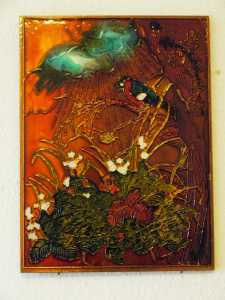
Nothing is nicer than art we inherit. There are often real pearls in the well guarded treasures of our ancestors. There is, however, a simple rule of thumb: if you must remove something from your house because it gives your grandchild nightmares, it’s hardly appropriate to hang it in a hotel room instead:

A nature scene in copper? Perfect for a country hotel! What’s not to like?

horror

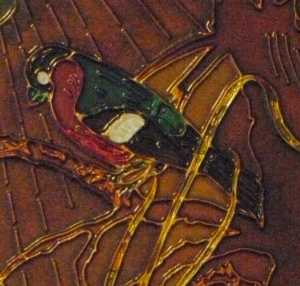
After all, what says “Welcome” better than the dead eyes of a zombie-bullfinch (Pyrrhula pyrrhula)?

horror_detail

2. You’ll Hang Right with Us!

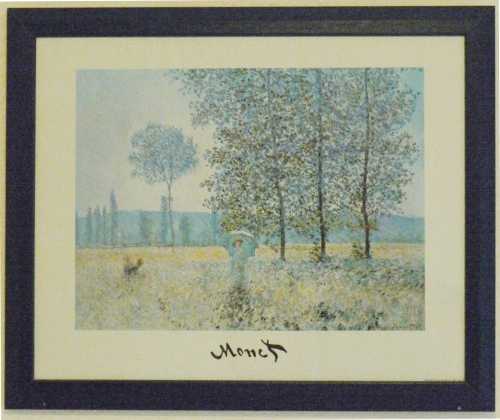
A while ago, a clever publisher of art posters had an idea: In a society in which we can no longer be sure that people will recognize art when they see it, a little help might be required. So he supplied reprints of famous works of art with enlarged, stylized signatures of the artists—“Vincent,” “Monet,” “Manet,” etc. It seems like hotels are fond of this kind of art print, and I bet you’ve already seen this on one of van Gogh’s sunflower bouquets or another. In one hotel I had Monet’s “Fields in the Spring” above my bed.

monet

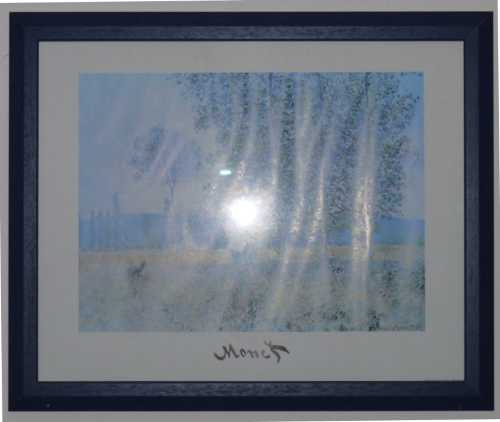
The original is undeniably a masterpiece of Impressionist art. Yet in this case it was a picture under which no registrar could ever sleep well. You can see in the first photo that the colors have faded after years of exposure to UV light. But the true horror doesn’t become apparent until the photo with flash.

monet2

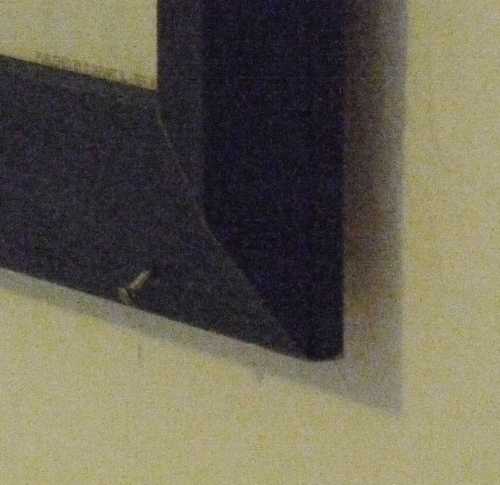
The environmental conditions in the hotel room were obviously anything but ideal. As if that weren’t enough, the frame was secured in a manner I have not often seen before. Unfortunately, the lighting was too dim to document this sufficiently:

nagel

The picture was actually nailed to the wall through the frame… In the hotel’s defense, the room was otherwise fine and the food was excellent.

3. Do You Have the Monet in Apricot?

Art reproductions have enjoyed a long and honorable tradition. They present us with the opportunity to be surrounded by valuable art without having to spend huge amounts of money on it. Naturally, one usually chooses the work of art to suit the room. Recently, though, I noticed some hotel art that turned this principle upside-down: instead of finding art that suited the room, the art was made to suit it.

Sometimes sections are extracted from masterpieces in ways the artists never originally intended. For example, there’s the woman with the umbrella in the aforementioned “Fields in the Spring,” extracted, enlarged, and in portrait mode. She fits better in the corridor that way, and there isn’t so much unnecessary undergrowth in the picture… In an extreme example, the colors are adjusted to make them a better match with the wallpaper.

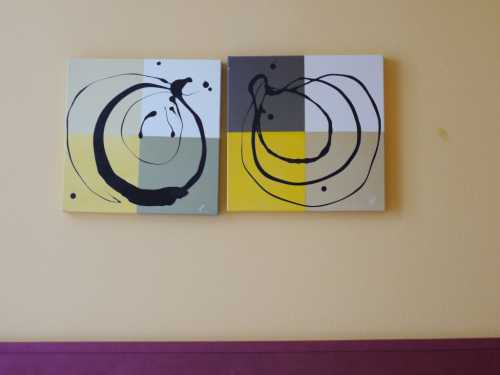
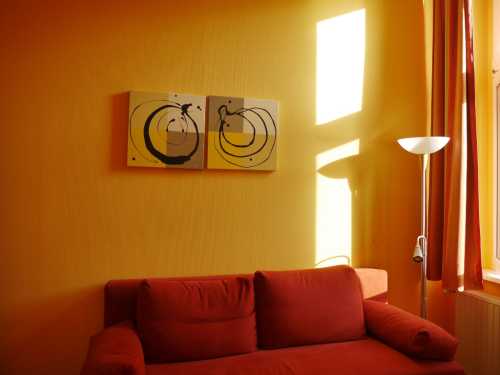
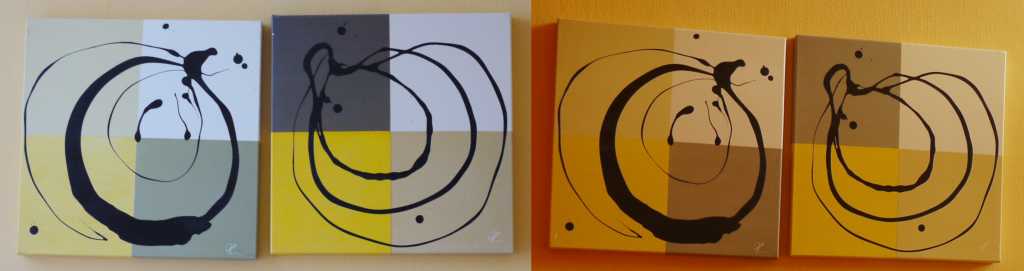
Another annoying custom is mass production made to look like real paintings. Closer examination reveals these to be inkjet on canvas stapled to boards made to look like a stretcher frame. This kind of mass-produced art can be found in any style (particularly popular, for example, is something based on Edward Hopper for fast-food restaurants), and abstract themes are especially common. Presumably because they’re extremely low-maintenance: they’re considered intellectual from the start and can be produced in any color imaginable. And whoever finds a motif that can hang as a matched set over a double bed wins:

kunst1

Whether it’s really art is debatable. In this case, I think someone went through a catalog looking for décor to match the room. And the fact that you can’t borrow a level from the reception desk to get them hung straight, at least, was the final straw.

I can’t exclude the possibility, however, that the hotel owner especially liked the piece shown above. Beauty ultimately lies in the eye of the beholder. Still, even if you like something a lot, so much so that you can’t get enough of it, a hotel owner should never make the mistake—even with mass productions—of hanging the same piece in two places to which the same guest has access!

kunst2

I find it amazing that they managed to hang both sets nearly identically crooked!

kunst3

Sleep well!
Angela

Translated from German into English by Cindy Opitz.

This text is also available in French translated by Marine Martineau.

A project to break down language barriers and connect registrars worldwide