Museum professional, lover of all collections work, former collections manager of the TECHNOSEUM in Mannheim, Germany. Now Professional Services Specialist for Gallery Systems. Independent museum professional.
Cat wrangler and #SciFi enthusiast.
Views are my own. Of course, they are. I can't make anybody responsible for the garbage my brain produces!
It has been a while, but now I’ll grab my traveling boots again and go to see colleagues, clients, friends. Not necessarily in that order.
This time it will be two weeks in London, another one and a half week further North in Walsall, Sheffield, and Leeds. So, my October is dedicated to England. If you are in that area and like to catch up over a cup of coffee or a pint, just drop me a line.
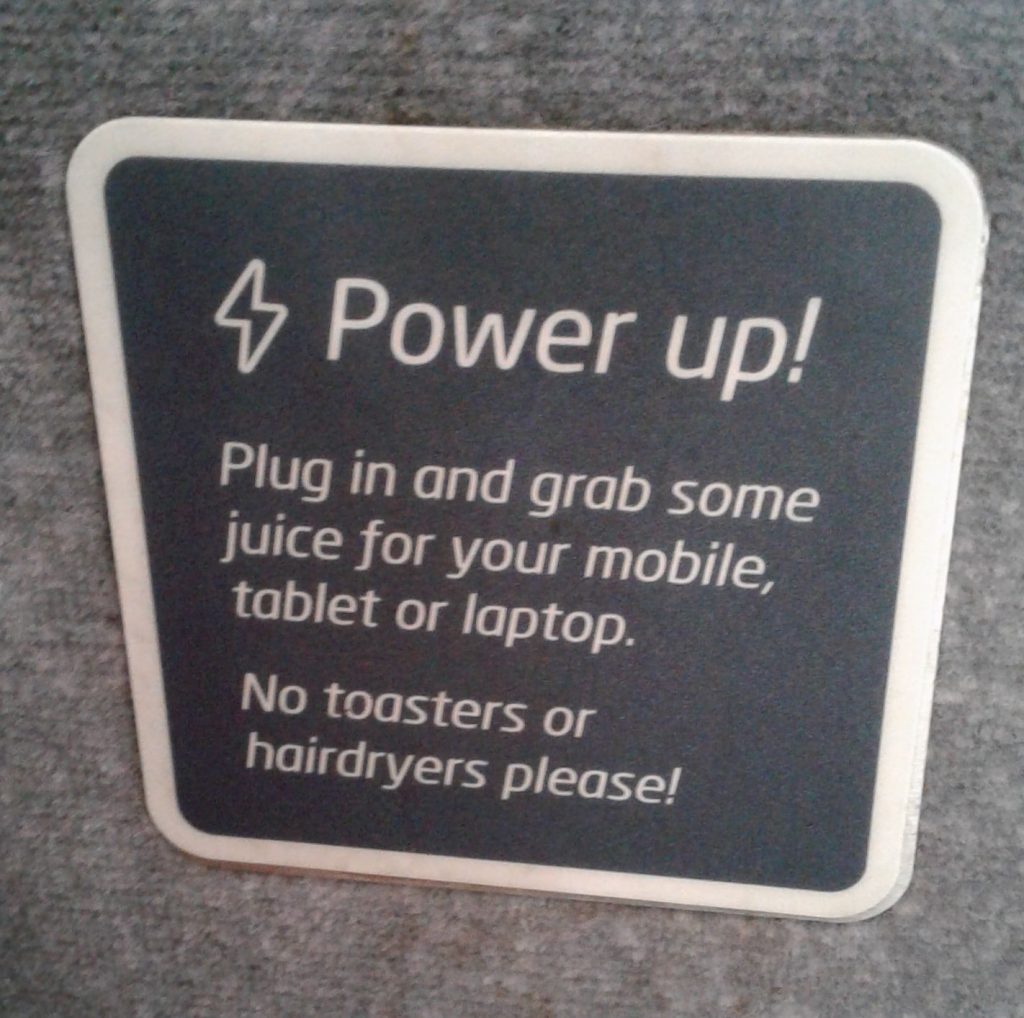
I also solemnly swear that I will suppress my urge to bring my toaster and plug it into the power outlet of a train. I will also dry my hair before I come on board. Seriously, though, how often does it have to happen to warrant a sign? I would reckon more than twice…
I certainly stared for ten minutes at the message from a former fellow student in my inbox and still couldn’t believe it. Hans Wilderotter had died, suddenly and unexpectedly. I think for me it would always have been suddenly and unexpectedly. He was the kind of human being I often think about but simply don’t think about the possibility of him not being there anymore.
While I am writing this, I have a vivid impression in my mind: He is arriving from somewhere, probably too late, fluttering trench coat and wavy hair, briefcase in hand, cigarillo in the corner of his mouth, and even before he is fully there, he already starts talking. It is probably the story why he is late. And probably it is either the eternal struggle against public transport or an exhibition project where something went wrong in unusual ways, perhaps expected, perhaps unexpected. And the story is so entertaining that a few sentences in you are already incapable of staying cross with him for the delay and are just listening intrigued, to what had happened.
Hans Wilderotter to me was so much more than just one of four professors in the Museum Studies program of the HTW Berlin. He was a mentor in the best possible sense. I think I never again met a person who knew so much about so many things. You could be interested in the most obscure topic, things far from his subject and experience and still, he certainly had read something about it or at least could associate it with something he already did an exhibition on or in some other way came into contact with. Perhaps much more important: he was interested in everything and always wanted to know more. For this, it didn’t matter if the person he was talking with was a longstanding director of a museum or a student in their second semester. He was always curious, “thirsty for knowledge” in the best sense and it was always the human being and its competence that counted, not the formal credentials or the rank in a bureaucratic hierarchy.
While I am writing this it gets difficult to separate the facts from the impact they had on my life. He was the supervisor for my thesis and despite the fact that he didn’t know anything about websites the discussions with him made the result much more precise and comprehensive than originally planned. Even today his structured approach and the way of asking the questions that are not at all obvious at first glance is shaping how I tackle things. Even as a student he brought me into one of his exhibition projects (of which there was always at least one running beside his lectures) as a project assistant and it is very likely that the fact it made me travel the farthest corners of the state of Brandenburg to wrestle with database problems played a role in me getting my current job. Years later, when he had to drop out of presenting at a conference at short notice he simply informed the organizers, “Kipp is working in that museum, she can do it”. That was me, being thrown into the absurd situation of giving a typical Wilderotter lecture about organizing exhibitions in a museum where my role was usually strictly confined to behind the scenes work.
From the wealth of memories I want to pick one that is showcasing what kind of human being Hans Wilderotter truly was:
The headquarters of aforementioned exhibition project was Potsdam and I lived basically at the other end of Berlin. Every once in a while I would drop him off at his place when we finished around the same time. I can still see him like yesterday, in the passenger seat beside me, jumping from association to association, from detailed planning at one venue to an analysis of the etymology of a certain term and back or further to the analysis of the character of one of our colleagues and suddenly he said: “And tell [name of colleague] tomorrow his right stoplight doesn’t work, it’s essential.” I had realized that one of the stoplights of the car in front of us didn’t work, but not that it was the car of a colleague. It was about the same time a budget freeze meant that invoices of freelancers weren’t paid. From some other topic coming he touched upon that fact and offered he could lend me money if I were in difficulties because of that. This trip home (and I am not sure if both was on the same trip or if my mind plays tricks on me) for me is Hans Wilderotter in a nutshell, the essence of what made him unique to me: alongside the nearly encyclopedic knowledge the incredible alertness to everything that went on around him, matched with a deep empathy for the people he worked with.
It will take a long time until I will have come to terms with the fact that he isn’t with us any longer. He lives on in countless memories, wise observations, witty comments, in many things I do every day in my job.
And when I am seeing him now in front of me, I see him with a slightly amused expression on his face and a mischievous twinkle in his eyes, just as if he wanted to say that it is unbelievable how someone can write so much muddleheaded stuff in such a short time and all of that only because he died.
I can very nearly hear him asking if there wasn’t something more worthwhile to do on a Sunday morning.
No, Wilderotter, there wasn’t. And I’d happily sacrifice a lot more of my Sunday mornings if it gave me the opportunity to talk to you just one more time.
May you rest in peace and if one of the religions with an afterlife is right, then I am very much looking forward to hear the story why you are late for the resurrection.
This article was written for and first published in the Summer 2025 Newsletter of the Registrars Committee Western Region: https://rcwr.org/newsletters/
Usually, you find me writing about the real-world messes in our collections. Crammed stores. Decaying garments. Surprise findings in abandoned offices of your predecessor. But today, I want to write about another kind of mess: the information that was recorded – or wasn’t recorded – in your database.
You don’t have a database? Then, this article will help you prepare for the time you are getting one. It may even help you in deciding what system to chose.
The Problem
Sometimes, the mess in your database is even bigger than the mess in your storage. Do any of those sound familiar to you?
The same information was entered in different fields, depending on who did it.
A lot of records are only partly filled and the information contradicts the paperwork.
Some objects have more than one record while others have none.
Data is entered inconsistently, so you have “pipe wrench”, “wrench, pipe”, “multigrip pliers”, and “water pump pliers” and they all refer to the same kind of tool.
Typos and inconsistent data entry make it impossible to get exact results when you search your database.
It is tempting to just correct those as you go, while you are working with the objects and I am not saying that this is a bad idea. But if you really want to make progress and getting your database into an overall better state you need a more strategic approach to it.
The problem: While you are silently fixing all the inconsistent data entries, someone else may be doing the next messy one. You first of all should determine how you want the fields to be used. You might think you have a clear idea about this, but have you, really? And have you put that into written form?
First Step: What should go where and how?
Your first step is not about fixing what is in there, it is about making sure that your database is used exactly the way you want it. For that you are creating a document that lists all the fields you have and how you want them to be used.
Be precise. “A description of the object” for the free text field “Description” will let you end up from vague entries like “Bridal gown” to a two-page description on the history of bridal gowns copied over from Wikipedia. So, formulate how you want your description to be.
Example: Object Description
“The first sentence should state what type of object it is, the main color, and important characteristics. Think of it as a way you would describe it to someone who has to look for it in the storage but doesn’t have a photo. This might be followed by a couple of sentences about the characteristics of the individual piece that makes it different from another object of the same type. Think of things like an unusual ornament, a tear, or a large stain. The purpose of this field is to make sure we can identify this individual object without doubt.”
Also make clear when information doesn’t belong in the “Description” but in other fields in your database, for example:
“Analysis of the object condition belongs in the “Condition” field. Websites about this type of object belong in the “Web links” field. Mentioning of this object in exhibition catalogs belong in the “Associated Catalogs” field. Mentioning in literature should go into the “Bibliography” field. Remarks on the provenance and previous owners go into the “Object history” field.”
Example: Terms from Controlled Vocabularies
If you are using a field where you want the entry to be taken from a controlled vocabulary, for some fields it might be enough to write “pick the correct classification from the drop-down menu”.
Others might be more complex so you need to add more guidance. “Only use terms from Nomenclature” might be at least accompanied with a link to the website https://page.nomenclature.info/ and a few examples.
If you want your information to be picked from an even more complex source, for example Getty’s Art & Architecture Thesaurus for the material, a “use only terms from the AAT” by far isn’t enough. “This term is about documenting what the object is made of. Therefore, it should be taken from the ‘materials by composition’ branch of the Materials facet of the AAT.” Provide examples, so, whoever is using your document in the future knows what your idea was and how to do a correct entry.
Guiding principle: But can I find it?
Your guiding principle when thinking about how to add your data is how you are going to search for it. This will depend on clean data entry on the one hand but also on which search functionalities your database offers. Wordy entries in free text fields often result in a lot of irrelevant search results. By keeping those entries concise and compartmentalizing information in different fields you can search more precisely – if your database offers the possibility to search for the information in those fields separately.
So, with all the fields you are writing down, always think about how “future you” will be able to look that information up. It will help a lot with making sure you are not missing something important.
Second Step: But does it work like that?
After you have written all that, put yourself to the test. Catalog a few objects. 10-20 objects are a good testing sample. Make sure that they are from a large variety of objects. Documenting 10 plates will get you nowhere. Documenting a plate, a dress, a toy, a tool, a radio, and a taxidermied badger will give you a lot of variety. Your collections policy will help you pick a good sample. All objects that could potentially end up in your collection should be easy to catalog with the guideline you are creating.
While cataloging, you will notice that you have missed some fields and some aren’t fitting for all cases. Perhaps you need to use different ones. Perhaps you need to add new ones if your database allows for it. Perhaps you just have to specify how to enter information in the same field differently for some object groups.
Adjust and share
Make adjustments to your document and/or your database so you can really catalog everything that might come into your collection. Once you are satisfied, share the document, that you might now call a “cataloging guideline” or “documentation help file” with everybody who uses the database, not just those who are doing the cataloging. It will help people who only use the database for searching know where they can find the relevant information.
But I don’t have a database
If you don’t have a database yet but just an assortment of excel spreadsheets and/or index cards, writing such a guideline and doing a few tests in an excel spreadsheet that contains the fields you have in mind will help you determine what your new system needs to be capable of. Furthermore, you can use this spreadsheet for documenting your collection now according to your guideline and later you have that data ready to import into your new system.
Now onward to tackle the mess!
Once you are at this point you have achieved something amazing: from now on, whatever is cataloged in your database will get a clean, easy to retrieve record. Sometimes, there might be slight adaptions to the guideline necessary, but by and large everybody knows how data should be entered and if you find it isn’t, you do have your document to point them to how it is done correctly. Introducing new colleagues, no matter if paid or volunteers, to cataloging in your institution will get much easier.
Now you can work on getting the rest of the database in better state.
What kind of mess do you have?
Not all messes are created equal. Sometimes the core of the records is okay, they only need some adjustments and corrections here and there. Others are so bad that the only thing you can do is to quarantine those records in an area of your database (for example by moving them to a separate department, marking them with a checkbox, or giving them a special classification like “legacy record”) where you can look them up as a reference but do new, clean records for all your objects.
Creating new records for old stuff
If the latter is your case, you now have your guideline to follow through. You might want to check back in your “legacy records” if there is any information you might have missed. Sometimes there are hints to donors you can’t find in the paperwork. Make sure your new record notes this as “according to old record #…” so it is clear where the information comes from and that it probably has to be verified. Some systems allow to link to the old record and it might be a smart idea to do that.
Improving existing records one step at a time
If you decide that your existing records aren’t too bad overall, they just need to be corrected here and there, you need to break down this task down into manageable steps. A lot of database messes were created because someone started the work with good intentions but then couldn’t follow through and someone else picked up without any idea what their predecessor did or had in mind.
Knowing that, you will of course create a document with your database improvement strategy so if you have to leave off for some reason whoever comes after you knows what you did and why you did it.
Often, it is easiest to focus on one single field and correct that throughout the database than trying to rectify all the fields in one record at once. The repetitiveness of the task helps with speeding it up. For example, take all the tools and make sure their records show the right term in the material thesaurus, usually “metal” or “wood”, sometimes both. Then move on to the household items and do the same. Or stay with the tools, but this time, you are rectifying the classifications, so the “gooseneck chisel”, “chisel, carving”, “gouge”, and “pick” can all be found under “chisel” and get sub-classifications depending on their use or form. In no time you will have become an expert in the different types of chisels, so you get much faster in classifying them.
Involving Interns and Volunteers
It is easy to see how some of this work can be delegated to dedicated volunteers or interns. If they have good attention to detail they should be well able to take over some of those corrections. And since they are only correcting one area of an object record in a defined set of objects at a time, the results are much easier to check than if you would have asked them to do a whole new record for an object.
Do paperwork and database match?
Just like you went through material and classification, one step will involve going through your paperwork and making sure that everything you have a Deed of Gift for is recorded as gift and everything you have an invoice for is recorded as purchase. Again, you work in steps that make sense, in this case perhaps you go folder by folder or year by year, depending how your files are organized.
You might end up with a lot of object records you don’t have paperwork for and on the other hand paperwork that doesn’t seem to match anything you find in your storage. Make sure your database has a field for noting that, too. And of course, what should be recorded how in it becomes part fo your cataloging guideline.
Ultimate Goal: The Treasure Trove
Your ultimate goal is that your database becomes your reliable friend. If everything else is messy, your database is the place where you have a tidy record that tells you what you know about the object – and sometimes what you don’t know. It will become your point of reference while working on improving your collection in the physical world.
I am in the process of translating the book into German and sometimes there are hiccups. In chapter 4, I talk about the difficulties of enforcing access policies for your storage area. A process which, as we all know, comes with all sorts of difficulties, the problem of taking the key from someone being a humiliating gesture in our Western culture being not the least of it.
In the English original, there is the sentence:
“Enforce the access policy with the three ps: persistence, patience, and politeness.”
Needless to say, such sentences don’t translate well. Usually you just rephrase them and let go of the idea that you can find three words starting with the same letter in the other language. However, I think I did find a way this morning:
“Halten Sie mit „Drei G“ an Ihren Zugangsbeschränkungen fest: mit Geradlinigkeit, Geduld und Gutem Benehmen.”
Finding three words starting with the letter G with the same meaning like the original (although the third one is cheating a bit, using two words) was already a big win. But the even bigger win was that this way I now have the double meaning of 3 G in it, alluding to the g-forces in physics.
I could of course take that analogy and run with it, saying that when we change longstanding processes and habits like we inevitably do when we start improving things in our collections, it means that we accelerate things and take people out of where they are used to go and expecting to go. And as we know from physics, if we accelerate things, a force is applied to the one being accelerated, which can have unpleasant side effects.
But I don’t want to overburden that little sentence. Instead, just imagine me giggling slightly when you come across it reading the book. 🙂
So, yesterday we took a backup of our TMS database. Today, we learn how to restore it. This is also a check you should be doing after having taken your first backup and also regularly after you have taken backups because like I have mentioned here otherwise you can’t be sure you have backed up anything. Or, like a friend of mine who deals with a lot of IT messes put it:
“I bought a book!” “Are there words inside it?” “Huh? Of course. I didn’t check, but there are always words inside a book, right?”
Before you haven’t checked, you just assume, you aren’t sure. And if there is one rule every collections professional knows by heart it is this: Never assume, always make sure!
Step 1: Again, log into the server you want the database to restore to and open Microsoft SQL Server Management Studio
Go to the folder “Databases”, right-click on it and select “Restore Database…”
Step 3: Chose your backup file
Up comes a rather bleak screen:
Go to “Device” and click on the three dots …
You get another rather bleak screen from which you choose “Add…”
You are getting a look at your file system from which you select the backup file you want to restore from. You might remember I cautioned you to store it in a place you can easily find it in Step 6 in in the previous article, right?
When you have found the right file, you click “OK”.
On the next screen you also click “OK”.
Step 4: Restore your database
Now you are on this screen again, but now it is populated with your chosen backup, including the date and time it would restore to:
You can see how my database “Leer” (yours might be called “TMS” or something else) is showing up both as the source and as the destination. If you really want to overwrite your current database this is fine, for example because something went horribly wrong with your current database and you want to restore it to an older version.
But if you just want to test if our backup file is okay, you don’t want to do that! Imagine something went wrong with the backup. We would be overwriting our totally fine current database with a corrupted backup! Big mistake!
So, for testing, instead of the “Leer” as destination I simply typed another name. I chose “TMSTEST”:
Then I clicked “OK”.
The database will now be restored to a new destination. If the backup file is okay and you have enough storage space you will get this screen after a while:
You can now click “OK”.
Step 5: Test your database
You should now see an additional database in your databases folder (mine shows up, of course, as “TMSTEST” because I called it that way):
If that worked fine, your backup file is okay. But just because I am a bit anal about my data, just to check, just to make sure, I run the mother of all TMS queries: “Select * From Objects”.
Only when it runs smoothly and the number of objects I get back matches my expectations, I am satisfied.
Housekeeping
Backup files are rather large. Which is logical, because they contain all your valuable data, right? So, after testing to make sure my backup is okay, I deleted that new database again by right-clicking on TMSTEST and choosing “Delete” so it doesn’t clog my server:
Also, because the backup files are so large, I tend to compress them before I move them to a different server. I use the software 7-Zip for it since it proved to be rather reliable (https://www.7-zip.org/). If you don’t have it on your server, you need to install it, first.
Go to your Windows Explorer and find your backup file. Right-click on it, choose “7-Zip” and select the option “Add to [whatever your backup is called].7z”.
You can now see how the backup is compressed. Wait until it is done (fetch a coffee or a tea, this might take a while, depending on the size of your database).
After it is finished, you will see a second file on your file system:
You will notice how much smaller the compressed file is. This is much easier to move to another server, unpack, and restore there, right?
Because I am paranoid I will move the .7z file to a cloud storage that I trust now and try if I can unpack it there without issues. If that is the case I can go back and delete the .bak file and just retain the smaller .7z file.
Take your backups, take them to a safe location, and take good care!
This is a step-by-step guide on how to backup your database if you are using a product of The Museum System (TMS) by Gallery Systems. If you use a different system it will work differently. Ask your vendor about it.
Step 1: Log into your database server and open Microsoft SQL Server Management Studio
You usually find it fastest if you start typing “SQL Server Management…” into the Windows search box.
Step 2: Enter your credentials
You will be prompted to enter your login credentials. If you are on NT Authentication usually all you have to do is click on “Connect”. If you have another form of authentication you will have to enter those login details. Your IT will tell you what to enter in that case.
Step 3: Find your database
In the tree hierarchy, open the folder “Databases” and find your database. It is usually called something like “TMS”. In my case it is called “Leer”.
Step 4: Navigate to the backup menu
Right click on your database, choose “Tasks” and then “Back Up…”
If that option is greyed out, you might not have the rights to do this. in which case you should talk to your IT so you get those rights.
Step 5: Chose your backup method
You will get to this screen:
Here you can choose if you want to do a full or differential backup (we talked about that here). You select that in the drop-down “Backup type”. We chose “Full” for this backup.
As a destination, usually “Disk” is fine, since you probably want to have the backup on your computer first and then transfer it to a cloud later.
Sometimes you will see a backup file already in the screen below that. If that’s the case, remove it, first.
Then click on “Add…”
Step 6: Add the file you want to back up to
By default, Microsoft suggest a rather cryptic sub-folder for your backups. I’d recommend adding a folder in a more prominent place that you can easily find and back up to there. You can see mine being “M:\Backups”.
Enter a file name for your backup. This can be the date you took it (Best Practice is to note the date in a year-month-day format so you can easily sort by date if you have multiple backup files) or a significant pointer to when you took it, for example “BeforeUpgradeTo995” if this is your backup before upgrading to a new version. Don’t forget to add “.bak” as a file ending, otherwise you might run into difficulties to restore it, later.
You can see that I called mine “AfterCI2025.bak” because it is the backup I took after adding a significant amount of information from our user conference.
Once you entered the name, hit “OK”.
Step 7: Take your backup
After that you just need to click on “OK” and your backup will be taken. If you have enough disc space in your chosen location, all is fine, otherwise it will throw an error message.
As collections professionals we are trained to think about security. We constantly make sure that nothing gets damaged and lost, may it be in our own storage or while on loan, perhaps traveling from continent to continent for a new exhibition. But when it comes to data security we often rely on our IT departments and database managers. In a changing world we need to add data security to our registrar’s toolkit because if we don’t care about it, perhaps no one will be left to care about it. So, I am planning on writing a series of short articles on that topic.
Now, I am not an IT expert by any means. I am basically pulling together what I have learned over the years, drawing from resources I have at hand, ready to stand corrected and update you if something I wrote could be done better, easier, and/or more secure. I am thinking in this day and age, any guidance and ideas on how to safeguard our intellectual heritage is better than doing nothing at all. Feel free to contribute with your own sources and ideas.
I am starting with what I feel most comfortable writing about: Backups.
How often should I back up my database?
This is a risk analysis: How serious will losing all your data since you backed up the last time be? In some cases, once a week can be sufficient if you are the only person who works with it, you have all your changes tracked in another medium (for example written notes on paper), and you don’t enter more than just a few records a day. But if multiple people enter and change data during the day? Well, once a day seems highly recommendable, then.
What is the difference between full backup and differential backup?
A full backup stores ALL data of your database. A differential backup only records the changes to the last time you did a full backup. Which one to use when is about analyzing the risks associated with it. A database can get compromised without you noticing right away. In this case it is good if you can revert back to a full backup of an earlier stage, before it became corrupted and then try to extract the data that was added at a later stage from the other backups.
What backup method should I choose and how many backups shall I retain?
There are no hard rules and usually it is best to talk to experienced users of the same collections management system and to the vendor about what makes sense in your use case.
My rule of thumb: If I know I am entering more than ten records each day and do a lot of updating of other records, I will go with a differential backup every day and a full backup once a week. I will keep the backup of the last five days and a full backup from each of the previous four weeks.
But this is tailored for the case where only I enter data and nobody else. If you have a lot of people entering data there are more options of something going wrong, therefore you will want to do backups more often. This is of course also a question of how much storage space you can afford, but then again, you have to factor in the costs of losing data and the hours it takes to re-enter it. Do a proper risk analysis for your institution, then set up a fitting backup routine.
Where shall I store my backup?
Storing your database backup on the same computer you took it is as good as having not stored it at all! When your computer is destroyed either physically pr by a virus, you will have lost both your original database AND your backup.
Best practice is to have three instances of your data:
the original
a backup on site
a backup offsite
A cloud storage might be a good idea for the latter. In this day and age, maybe even a cloud storage outside of your own country. That way, if you are forced to delete data from your database (if this sounds like a far-fetched idea, let me remind you of this https://www.theguardian.com/us-news/2025/mar/07/military-images-trump-dei) your data will still be somewhere safe and unchanged.
You can also use an external hard drive that you store somewhere safe, preferably outside of the town or city your original database is situated because if there is a catastrophe in this area, your data might still be safe somewhere else. It has the advantage that you pretty much can control where your data goes and that it can’t be hacked, but the disadvantage is that if something happens to that hard drive, the data is lost.
In comparison, a cloud usually has its own backup routines that make sure that your data is safe. Ask the provider about it. Also ask them about their security measures and what data they share with third parties. Only you should have access to your data, nobody else.
Heads up: Make sure your data is actually backed up!
Just because you have taken a backup doesn’t necessarily mean you have a working backup. Once you have created a backup file, try if you can restore it. Caution: Restore it to a separate space, don’t use it to restore your actual database because you risk damaging a working database with a corrupted backup. Check this regularly and don’t assume that just because you can see a backup file on your drive your data is actually fine.
Final thoughts on when to delete backups
As said before, it is good to retain some backups because not all problems are discovered right away and it might take weeks to discover them. This is about keeping your current data safe and retrievable.
But you also might want to preserve the state of your current research. In the future, you might want to come back and compare how facts were recorded in 2024 and how that changed going forward. Your past records may become sources for future scientists and historians. So, it might be a good idea to take a backup NOW and keep that backup in a safe space for the future.
In these past few weeks it seems that there were so many horrible things happening that just making a list of them feels overwhelming and exhausting. Some of the decisions of the current U.S. government have an impact on the global level, others hit people personally, some of whom are close friends. And then, there are those who seem to target the very core of our profession, like the shutting down of the Institute of Museum and Library Services (IMLS) and the termination of grants already awarded by the National Endowment of the Humanities (NEH).
It is hard not to lose all hope in this climate. And yet, aren’t we, as museum professionals, used to things not really looking pretty? Haven’t we battled budget and staff cuts before? Haven’t we brought uncomfortable truths in front of the eyes of our visitors and politicians before? Maybe the current crisis is not comparable to what we were confronted with before. But just as well, we are well trained in going against adversarial circumstances.
We have always done so with resilience, creativity, and, most of all, a sense of community. We might be spread out across the world and we might have spread ourselves thin by taking on too many responsibilities, but we are not alone. I have reached out to my network over the past few days to check in on some people, see how they are coping, and getting ideas of what can be done, because, in the end, focusing on what can’t be done never made anything better.
A ninja sitting at a desk, typing away on a laptop.
Turns out that John E. Simmons had already started collecting what can be done to prepare for what is coming at us in something we registrars love: A list.
I contributed a few of my thoughts to it and we also asked some more colleagues to add to it. What I am posting here today is by no means a comprehensive and finalized list of what to think about and what to do, but it is a start. Feel free to add more ideas in the comments section, just like we enhance it going forward.
What Can We Do?
1. Apply the lessons that museums learned from Covid
A museum should have a plan for suddenly shutting down or having to reduce staff for a prolonged long period of time.
The plan should include cross-training for all staff so that a reduced staff can keep the institution functioning and care for the collections. Every staff member should be trained to do tasks that are normally not part of their duties so that they can help in the event of a prolonged emergency.
The plan should include what the museum can do to remain a destination for visitors during a crisis. This might include regulating the number of visitors in the museum at the any one time during a pandemic, reducing or eliminating admission fees for visitors during a prolonged financial crisis, and how responsibilities could be handled by a reduced staff. It is worth noting that a recent study revealed that art museums that charge admission spend an average of $100 per visitor but attract smaller audiences than free museums, and that there are costs associated with collecting admission fees that may not be recovered by the fee. Details can be found at https://news.artnet.com/art-world/us-museums-visitors-report-2622358).
2. Prepare the collections for long-term, low maintenance storage
by preparing the most sustainable and passive storage environment possible:
Improve the effectiveness of the collection storage furniture, containers, and supports to protect the collections (e.g., replace gaskets on doors, eliminate acidic materials, reduce lighting and UV in storage).
Keep the collection in order (each object in its proper place in storage) at all times (do not allow a backlog of out-of-place objects to build up).
Improve environmental controls and environmental monitoring procedures.
Maintain storage environment equipment in good order (e.g. replace filters, service equipment regularly, replace aging HVAC systems).
3. Protect the databases
Make sure that you have a fully up-to-date, readable copy of all important museum databases stored somewhere outside of the building, preferably in a hard format as well as electronic.
Make sure that both on-site and off-site databases are protected so they cannot be accessed by unauthorized personnel. Renew passwords and other project on a frequent, regular basis.
If the institution is forced to close, and you have a good backup copy, consider removing databases from the museum servers to protect confidential information.
When possible look into storing backup copies of your databases that are not only readable in a proprietary format of one vendor (who might be forced to hand your sensitive data over or might go out of business). If you database allows for it, export your important data as SQL tables or as comma separated values (.csv). Excel formats such as xlsx, xls, or ods are fine, too.
When possible move your sensitive data to trusted servers outside the U.S. that don’t belong to U.S. based companies who might be forced to hand your sensitive data over or delete your data.
As a rule of thumb: make access to your data for your trusted staff as easy as possible, but make deleting data from your database hard by setting up a robust rights management and whenever possible enable procedures to revert to earlier data entry points.
4. Update the institutional emergency preparedness plan
to include procedures for coping with sudden, prolonged shutdowns of the building.
5. Stock up on critical supplies
6. Download anything needed from federal websites
(such as the NPS Museum Handbook and Conserve O Grams or IMLS reports) immediately, while the information is still available. Store this data in a safe place that is only accessible to authorized personnel and make deleting those resources as hard as possible.
7. Keep in mind that most serious problem going forward will probably not be the cuts in federal funding
to the NIH, NEA, NSF, IMLS, etc., because most of this money goes to projects which can be postponed or funded by other sources (such as donations). The most serious problem will be the lack of funds resulting from damage done to the economy due to a combination of the rising deficit, increasing unemployment (e.g., the mass reductions in the federal workforce and corresponding loss of jobs in sectors that serve the federal workforce), and decreased tax revenues due to tax cuts for the wealthy, tariffs on imports, and cuts to social services. In other words, the predicted problems with the US economy are far more likely to be a bigger problem for museums than the loss of federal grant funds.
8. Reach out to your community and build strong networks
Let your community know that you need their support now more than ever.
Let them know that most small museums in their immediate area do not get federal funds directly, but do get support from their state humanities councils. Membership for these museums is usually less than $30 a year and they put the money to good use.
If you have lost funding from IMLS or NEH, let your community know. Here’s an example from a small museum explaining exactly what was lost: “The termination of the NEH grant award and the loss of $25,000 are devastating for the Weston History & Culture Center. This funding was going to support our upcoming permanent exhibit…”
The people caring about your museum can write and phone their representatives to let them know they are not okay with what is happening right now.
Reach out to your colleagues in your area but also around the world. Local networks will make it easier to help each other out with supplies and hands-on tasks. Colleagues in other countries might be able to provide a safe space for your vulnerable data and might have had to deal with similar circumstances in the past, so might be able to contribute with knowledge and creative solutions.
Words of Cheer:
Museums existed long before the IMLS and other federal granting agencies, so they can survive this period, although many worthy projects and much research will be halted unless alternative funding can be found.
With preparation, museums can survive the coming crisis as they have survived other crises. There will be staff reductions and loss of opportunities, but with any luck, the situation will change within a few years.
Take a good look at your policies and procedures and investigate new laws and executive orders you are confronted with. Laws that are passed in a great hurry often contain contradictions and loopholes. Often asking for clarifications by authorities can slow processes down and work to your advantage. Often stalling a process in good faith can be much more effective than open opposition which puts you and your staff at risk.
Be prepared to be patient. Lawsuits and judicial decisions challenging the proposed changes will take time to go through the courts.
In the longer term, climate change and its effects on museum operations, the economy, and the behavior of the public is the greatest challenge to the future of museums, so the present crisis should be used to prepare for the future.
Best Advice:
If your institution does not have a plan for long-term survival during a financial crisis, the next pandemic, or climate change, get busy now to correct this deficit.
Snider, Julianne. 2024. The Wheel is Already Invented: Planning for the Next Crisis. Collections: A Journal for Museum and Archives Professionals 20(2):347-359, DOI: 10.1177/15501906241232309
Christopher J. Garthe (2023)—The Sustainable Museum. How Museums Contribute to the Great Transformation (Routledge)
Some more notes
Share this resource freely with anyone you think needs to see this, no need to ask for permission. Add what applies to your special case. Let us know what we should add. Download, save, print, circulate.
Registrar Trek is hosted on a server in Germany and following EU laws. I am currently looking through all the plug-ins I use to make sure none of them collects and shares any personal data with the U.S. Or, in fact, anybody. I always was mindful not to collect any personal information but will double-check again if everything is safe.
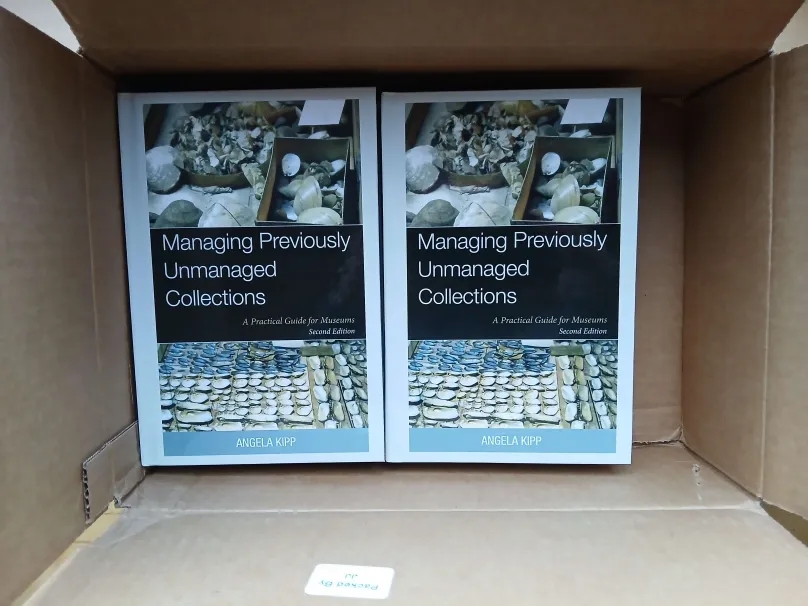
I finally got my author’s copies of Managing Previously Unmanaged Collections and I was notified that there is a problem with ordering the book from Amazon:
This is a fun story that developed when brainstorming Egypt Calling with Paul. In his story, a huge statue of Ramses II disappears. In mine, things are far less dramatic. It is just that life is very confusing if you find yourself alive, standing on a plinth in a museum. Especially if you haven’t been alive before.
I will occasionally post a chapter here since I think we all need a bit of distraction every now and then. And perhaps it makes us sympathize with the artworks in our exhibitions – and everybody else in there.
Chapter 1 – Boring
Boring.
That was what it was.
Standing on a plinth in the middle of the room, being lit by colorful lights and looked at by people was just boring.
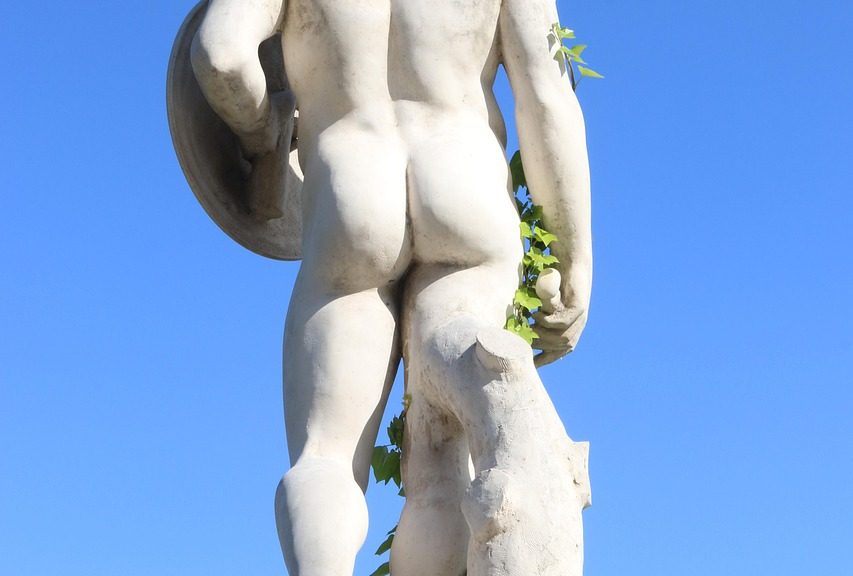
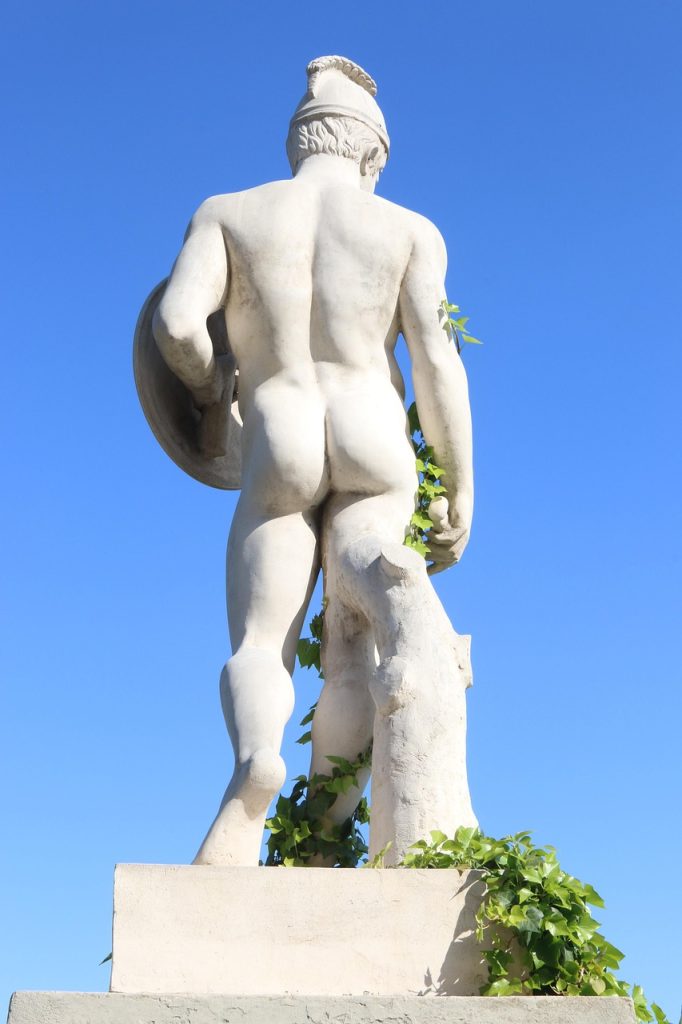
Image by Manon25s from Pixabay
It had taken him three times to realize it.
Three times of people leaving, the lights being switched off, the doors being locked, the doors being unlocked, the lights being switched on again, and the people coming back in.
But now, he knew it for sure:
This was boring.
Now the question was: what could he do about it?
He didn’t know much about himself. He knew that he was marble. The second kind of people said so.
As far as he had observed, there were three kinds of people:
There were those who came in and looked at him. Then, there were those who came in, barely looked at him, but then pointed with their fingers at him and told the looking kind of people stuff about him. And finally, there were those people who just stood or sat in a corner. They scowled at everybody and barked orders at the first kind of people.
Usually they shouted that people shouldn’t touch his butt.
Not that he minded that. At least people interacted with him. It was far better than just being stared at as if something was wrong with him.
Although…some of the looking kind of people not even really looked at him.
They turned their back on him and then, they held up small rectangle things that showed a small version of him and the faces of the people. People giggled when they did that. He didn’t understand what was funny about it.
People, in general, were very odd.
But he was digressing.
So, he was marble. He had no idea what that meant but it sounded good. Solid, somehow.
But what did it mean, being marble? Did it mean he couldn’t do anything but standing on a plinth in the middle of a room and being stared at?
From all he had seen when looking at himself on people’s little rectangle things, he looked a lot like people. Hands, feet, tummy, all was there. He was just larger.
8 feet.
That was what the pointing people always told the staring people. He looked at his right foot—which was easy to do since it was below him, directly in his line of sight—and did a rough estimate. If he imagined placing one foot in front of the other and doing that eight times… yes, yes, it could be that this was his height.
Wait.
Could he actually do that? Place one foot in front of the other?
For now, he had never tried to move.
Ever since he had become aware of himself—he didn’t know how many times the light had been turned off and on since then, but it had been a while—he just stood here and observed his surroundings. It hadn’t even occurred to him that he could actually move. Standing on a plinth just seemed like…the natural and decent thing to do.
But it was boring. He had established that. It was boring. And so, perhaps he should try something new?
Carefully he lifted the big toe of his right foot. It rose from the plinth without effort.
“Mom, Mom, the statue is wiggling its toe!” someone shouted.
It was one of those small people. Sometimes the big, staring people were accompanied by small versions of themselves. They were much more fun than the big ones. They ran around and laughed and touched things. And then the other, grim-looking people shouted at them and had serious words with some of the big people.
“Sure it did, dear. And now, come here, we want to see the installation in the next room,” a large one replied. Someone with long hair, a flowery dress, and an annoyed expression. Mom, he assumed.
“But, Mom! I saw it. Look!” The little person had come close.
He set his toe on the plinth again. It seemed it was at least something extraordinary to do and he didn’t want one of the grim-looking people come over and shout at him. He would try some more of this moving things when the lights were switched off again.
A frown of profound thoughts crinkled the little person’s forehead. Then they reached out with their tiny hand and touched his toe. Like always when people did that, it felt strange. Warm. Not at all uncomfortable. Just a bit…not like his toe usually felt.
“How many times have I told you not to touch the art?” Mom yelled, grabbed the hand of the little person and pulled them away.
Before they both disappeared through the door to the next room, the little one turned around once more, gave him another frown, and then, they smiled and winked at him.
And before he knew it, he moved one eyelid and winked back.
So, he was art.
He had assumed as much since somehow he heard that term a lot around here. He was marble and he was art. That at least was something he could cling to.
He contemplated what art could be and why people were not allowed to touch art although it felt nice. He did that until all people left the room, the doors were locked, and the lights went out.
Then, he resumed wiggling his toe. When he felt comfortable doing that, he removed his whole left foot from the plinth. It didn’t take any effort. He set it down again and lifted his right foot. That didn’t work.
He gave it a long thought why it was different. Perhaps because his weight rested on his right foot? He slowly put more weight on his left foot and then tried again.
That did it. Now he could lift his right foot.
Good. For some time he just did that. Lifted his right foot, set it down again, shifted his weight, lifted the left foot. Yes, that was like it. He could even imagine walking forward like people did. He needed to try!
He lifted his left foot and instead of setting it down again he took a big step forward.
The next thing he heard was a loud crash, he wasn’t standing upright anymore, and he had a very detailed view of the mosaic on the floor.
“Sorry,” he said to the multifaceted face of a woman riding a deer. For the first time heard how his voice sounded. And he realized that he could speak. It sounded a bit rough. Perhaps gravely? This was probably how marble sounded.
The woman on the deer, however, remained silent.
Perhaps she was still shocked or perhaps she just wasn’t the talkative type. And someone just falling onto you was for sure not the best way to make an introduction.
Besides, he had no idea what his name was so could hardly introduce himself.
He probably should focus on the more basic things first.
He cautiously shifted his limbs. Feet to stand on. Hands and arms to push upright and balance the body. It wasn’t very complicated, he just wasn’t used to it. He rose to his feet again and made a few steps. It was easy. Why had he fallen onto the floor in the first place?
He looked back at the plinth. Oh, of course. Not the same level. He had to pay attention to the height difference in things.
Nothing hurt, but he imagined that the grim-looking people were not in favor of him falling into things. He probably should avoid meeting those people altogether while he was walking around. If they freaked out at someone simply touching his butt they were probably not very fond of finding that butt not in its usual place.
But the grim-looking people that were so obsessed with his lower backside weren’t here, now, so he could do as he pleased.
He walked around the room until he felt confident on his feet. Then he approached the door.
“Caution. Alarm system active,” a big, friendly, green writing informed him.
He remembered that once an alarm had gone off because one of the little people had opened a wrong door. It was very loud. He hadn’t liked that at all, so he didn’t touch the door.
Instead, he wandered around the room. “Renaissance and Contemporary Art,” a big text panel said but when he started reading, it became confusing and boring so he decided it was written for someone else. Someone who wasn’t marble.
There was a lot of texts to read everywhere. It seemed all the things in the room had little labels with a lot of letters on them. He got curious and read the one on his own plinth.
Leonardo DiMontici
Reinvention of a naked Greek athlete as dreamed about on the 6th of January 1972
Marble, 7 feet 3 inches (2.2 meters) 1986
So, this was who he was?
Leonardo DiMontici?
Good to know. So, not only he had now confirmed he was marble, he also had a name. Leonardo. Sounded nice. And he wasn’t 8 feet tall, just 7 feet and a few inches. He wondered if he should be disappointed about that but couldn’t think of a reason. He also found nothing that looked like inches on his body, so he just memorized everything written on the label and moved on.
He tried to speak to a few other pieces which were probably also art, just not marble, but none of them seemed interested in a conversation. They didn’t react in any way although he always read the labels and addressed them with their names.
Perhaps he was the only art thing that could move and speak?
That sounded boring. And lonely.
He wondered if there was a way to leave the room without going through the door. He was really curious how the rest of this place looked and if perhaps in other rooms there were others like him.
Perhaps he could sneak out in the early morning, when the grim-looking people left the room to do whatever they had to do after they switched all the lights on?
That was a plan.
Very satisfied with himself he, Leonardo DiMontici, 7 feet 3 inches of marble art, climbed on his plinth again and resumed his original posture.
He just needed to stand and wait.
And marble art was very good at that.
A project to break down language barriers and connect registrars worldwide