All posts by RegistrarTrek

Museum professional, lover of all collections work, former collections manager of the TECHNOSEUM in Mannheim, Germany. Now Professional Services Specialist for Gallery Systems. Independent museum professional. Cat wrangler and #SciFi enthusiast. Views are my own. Of course, they are. I can't make anybody responsible for the garbage my brain produces!

In Search of Reporters for ERC 2016 in Vienna!

Dear readers,

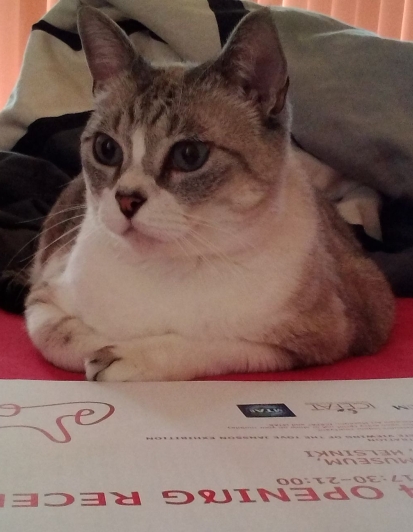
Totally unrelated cat content. But isn't she cute?
Registrar Cat wants YOU to volunteer. Well, kind of…

sometimes life gets in your way. Due to more important family duties I will not be able to attend the European Registrars Conference in Vienna (more info: http://www.erc2016.at/start.html) next month. As I initially planned to inform you all with session reports I am now looking for volunteers to step up. Who will attend and feels like writing something about the event? Or reporting on a single session that inspired him or her? Or a session that made him/her mad? These reports are all very welcome. Please leave a comment if you are willing to volunteer.

Thank you all very much!
Angela

A thing that can do things – Taking a look at the Arduino from the perspective of a collections specialist

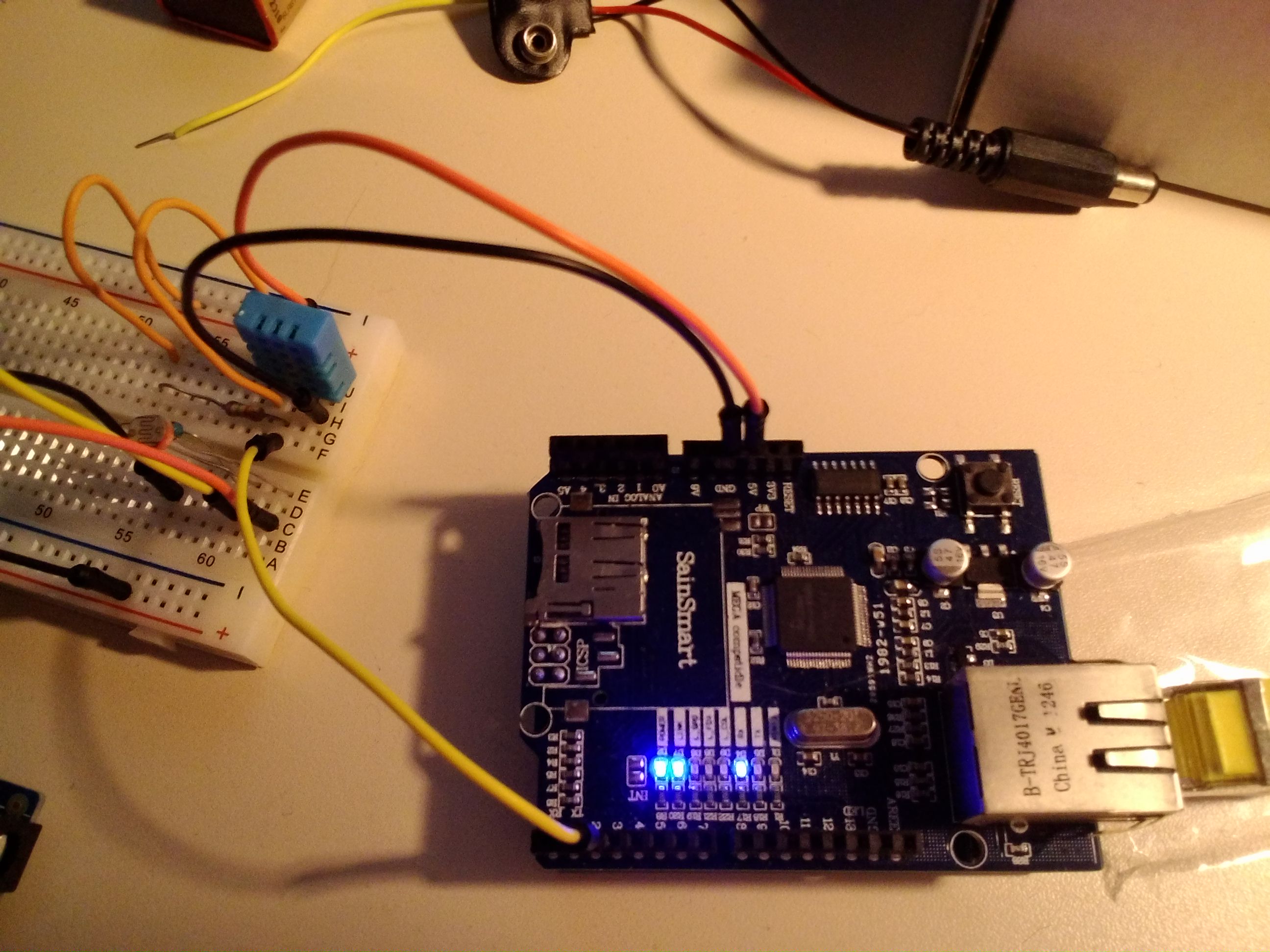
An Arduino with a LAN shield - a thing that can do MANY things
An Arduino with a LAN shield – a thing that can do MANY things
Being the collections manager for a Science and Technology Museum has a whole range of downsides. For example, you never, ever get big industrial storage halls so tight that dust and pests aren’t an issue, people think you are crazy when you insist on various security systems and archival packaging for “old junk” and one of your duties is to explain that, no, you don’t sell spare parts for vintage cars or old radios. But sometimes it has its advantages, for example that you are much closer to all those techy, nerdy things that happen “out there” (Because, yes, there IS a world outside of the museum, I know people who have been there).
One day a colleague showed me a little blue thing that was blinking frantically.

“What’s that?” I asked.
“An Arduino”, he replied.
“What’s an Arduino?”
“It’s an amazing little thing! It’s a thing that can do things. It can do everything!”

Basically, when he showed it to me all it could do was blink a little red LED. But as I was digging deeper I discovered that there is a whole community of makers out there who do amazing projects with that little thing. You can really do everything, from reading sensor data to steering an electric motor and everything in between. When I saw that someone had realized a game of Tetris inside of a pumpkin (https://www.youtube.com/watch?v=8PCp5xk-9Qo) I was sold. I needed such a thing.

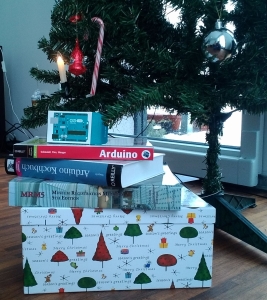
Actually, if you look sharp at the picture on the post for our second Registrar Trek Birthday 2015 you get the idea when I first made contact with this thing...
Actually, if you look sharp at the picture on the post for our second Registrar Trek Birthday 2015 you get the idea when I first made contact with this thing…
Granted, the moments when a registrar or collections manager is in urgent need of a tetris in a pumpkin are rather rare. But for a whole range of tasks it would be useful and – compared to a computer game in a pumpkin – not too hard to put into action.

How about an alarm when it’s much too bright in a gallery and someone should close those curtains? Or a data logger that writes temperature and humidity in your off-site storage to a SD card? If there is LAN or even WiFi available, it’s starting to get really interesting as you can monitor the climate via the internet and even get alerts on twitter or in your mail when someone turns on the light or a climate value exceeds a certain level.

The big advantage of the arduino is that you can do those projects yourself and at a reasonable price. It requires that you familiarize with the topic, but, compared to former times, you don’t have to be an expert in electronics to do it. The few necessary components are available via the internet and thanks to a large, world-wide community that is committed to the spirit of Open Source you find a solution or even complete code to nearly every problem which you can adapt to your own situation with a little thinking and a few changes.

The first thing that can do things that actually DOES things for the TECHNOSEUM: A data logger that records the climate in a certain area of our museum.
Recently I have experimented a lot with this “thing that can do things”, so I plan to use this blog to present some of my projects that have to do with museum work every now and then for you to have a look and maybe try yourself. Our readers who are not so much into technology will hopefully forgive me. One or the other might even feel inspired to have a closer look into the world of microcontrollers…

For a start I suggest the starter kits who contain not only an arduino but a whole bunch of useful accessories like resistors, sensors and LEDs so you can experiment right there and then. There’s nothing more frustrating than missing one little component when you start learning and who has a fully equipped electronics workshop at home? Usually those kits come with some instructions for simple experiments (if they don’t, you can find plenty of them on youtube) that I highly recommend to conduct. Along with a general understanding of the topic you explore what can be done, may it be a tetris in a pumpkin or a data logger.

And there is one thing I can promise: when you manage that a little red LED is blinking exactly how you planned it for the first time, you get a feeling like you just discovered new territory…

This post is also available in Russian translated by Helena Tomashevskaya.

High-Flying Project: Reconstructing the Junkers J1

Ever happened to you? You lose sight of a former colleague or fellow student and then, years later, you stumble upon an awesome project, just to discover that exactly this colleague is involved. When I learned that there will be a kickstarter campaign to reconstruct the first all-metall aircraft, the Junkers J1, I, as a technology enthusiast, was excited.

The Junkers J 1
The Junkers J1, undergoing flight preparations in late 1915 in Döberitz, Germany

Even more when I learned that Fabian, my fellow Museum Studies graduate and colleague from the days we developed the clay brick exhibition at the Deutsches Museum in Munich was involved. Of course I had to support the campaign, so here he introduces the project:

Dear Collegues,

we start on May 2nd, one of the largest support campaign for a museum project in Europe at Kickstarter.

It is one of the most important pioneer aircraft, the Junkers J1 that should be reconstructed in a 1:1 scale model. The J1 was the world’s first all-metal aircraft and it had its first flight 100 years ago. It was such an important masterpiece of aviation, that it was exhibited in the Deutsches Museum Munich. However, the plane was unfortunately completely destroyed by a World War II bombing raid.

Our campaign will to support the detailed reconstruction by the technical museum “Hugo Junkers” in Dessau. Please help us to make our campaign a success by posting the J1 Project page (www.facebook.com/j1project). Join in at our Kickstarter campaign (https://www.kickstarter.com/projects/j1-project/junkers-j1-recreating-the-worlds-first-all-metal-a). For every amount donated, we have come up with something very special: a limited Junkers J1 wristwatch, a J1 model plane, a postcard set with 24 facsimile designs, aviator glasses and more.

Only when many supporters participate in the crowdfunding campaign, we can finance this ambitious project and rebuild the Junkers J1 on the basis of the original plans.

Many Greetings from Munich

Fabian Knerr

junkers-j1-slider04

Waste Separation: What to do with old emails?

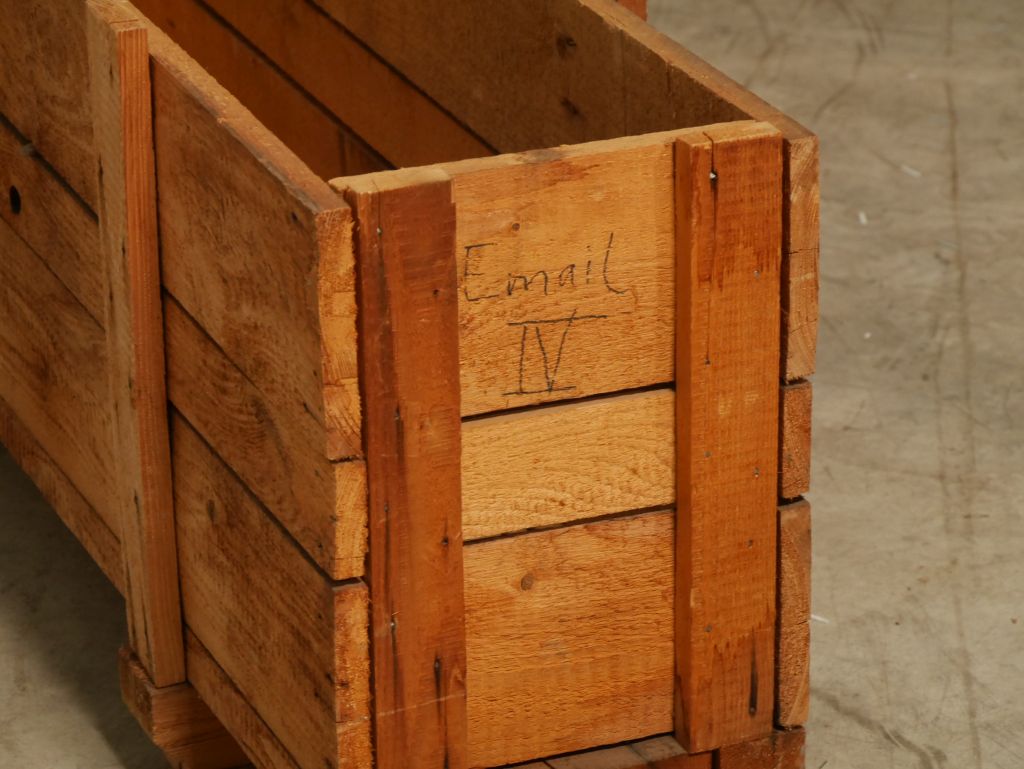
Oh, fear not, you who struggle with a crammed inbox. Just today a colleague sent me the ultimate answer to the question: “How to properly dispose of those spam mails, outdated telephone lists and irrelevant listserv postings?”

Email_1

Email_2

(In fact this crate was used to store a collection of enamel (German: “Email”) signs in the past who now have a new and better storage.)

Unmanaged Collections – Final Adjustments

desk

Maybe you wonder how the book project about managing unmanaged collections is going. Well, last week I got the proofs from the production editor so at the moment I spend much of my free time proof reading. I contacted all the contributors so they can check their real-world examples and photo attributions and add their corrections.

In addition I’m creating the index which is not as easy as I thought. My assumption was that I more of less type a search term, let the computer scan the document, note the pages where the search term does appear and that’s that. Now I realized it doesn’t work that way. My experience with museum documentation could have told me that it doesn’t work that way… Here’s why:

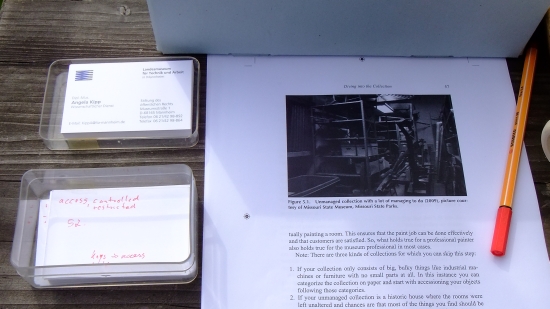
Let’s say someone wonders if there is something about “deaccessioning” in the book. Well, there are a lot of pages where I talk about making decisions what to keep in the collection and what not, but chances are I did not use the term “deaccessioning” on those pages. Of course, the computer would skip those pages. So, as I read through the page proofs I take notes of keywords I think would make sense in an index and write down the page numbers.

I do this on outdated business cards, which I haven’t thrown away because you never know when you need a set of small but sturdy cards of the same size. Well, now, about 10 years after they became outdated they finally found their new purpose. I sort the keywords in alphabetical order so when I come across a term I already noted I can find it quick and add the next page number. I decided to collect broad, write down whatever I think might be helpful instead of being too restrictive. I will decide on the terms that will finally make it to the index at the end of the process. While “deaccessioning”, “collections policy” or “cataloging” will definitely make it to the final index, I’m not that sure about “Grandmother’s Fixes“, “upper management, dealing with” or “numbers, spellbound by”.

What is really interesting is that these cards even now show somehing like a topography of that book. “Hazards” seems to be the most important topic, with 12 mentionings thus far and I’m only half way through. Well, let’s see if it will stay that way. Onward! I have to meet that deadline so this book can be out in May.

Angela

This post is also available in Russian translated by Helena Tomashevskaya.

Whooops – Little Registrar sent a note to you all, but shouldn’t have…

Dear Readers,

please accept my apologies that our faithful newsletter informed you about a post that was password protected. This was a mistake, as we are testing our new data logger at the moment and I needed a website to test if we all could have access to our climate dates from all over the world (or, in fact, from all our storages and offices). Didn’t have an idea that this would be sent out via our RSS feed just like any other blog post.

Well, anyway, to keep you in the loop: what is happening at the moment?

Over Christmas I was experimenting with arduino and other microcontroller boards. Of course, even if I try to do something just for fun, I end up doing something museum related. As I needed something to build, I built a data logger. And if it’s already built, why not take it to work with me?

There it glows... the experimentation zone at Christmas.
There it glows… the laboratory at Christmas.

At the moment one little prototype of the “Little Registrar” keeps a good watch over our climate in one of our offsite storages and sends its data to a website. And since this week this other little fellow records the climate in a storage room at our museum and logs it to a SD-Card:

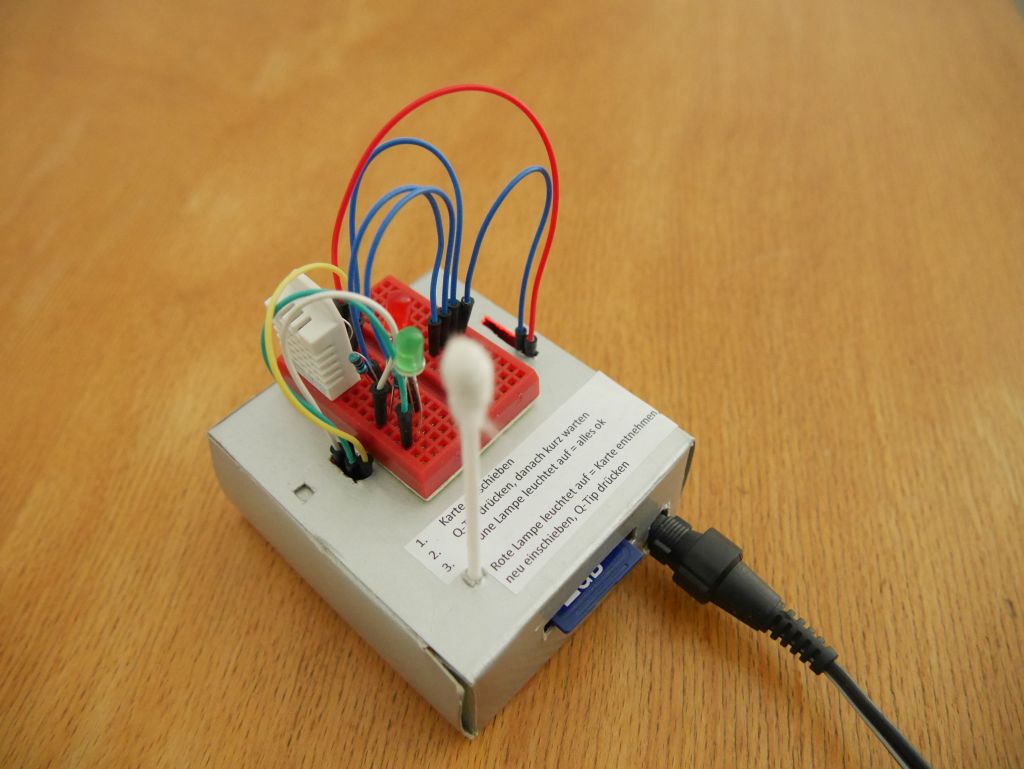
DatLog_2

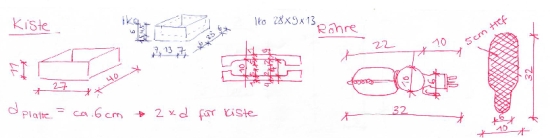
As you see by the q-tip that serves as the restart button this is all in the prototyping stage at the moment. In fact, the “Q-tip Registrar” was a quick answer to an urgency call by our conservators. Assembled with parts I still had at hand, including an old cardboard box, a screw anchor, some ethafoam and, yeah, a q-tip.

Those who follow @RegistrarTrek on twitter know that I promised to write what we did and how and I will do, as soon as we passed the prototyping stage (and stopped creating e-mail bombs).

Have a great weekend, all!
Angela

This post is also available in Russian translated by Helena Tomashevskaya.

What happened September 2nd? A registrar’s climate mystery
Part 4 – Alternative Solutions

I hope you enjoyed our little climate mystery. A lot of our readers did and submitted possible solutions. Two people came up with the right solution in this case:
Geert Bellens suspected immediately that the logger was brought into another room and was right about this place:

”If someone was breathing close to the logger, the temperature would rise at 16:30, but humidity also. If a heat source was involved (local heater, lamp,..) I would expect rising temperatures, and lower humidity, but no that drastically.
I would think someone took the datalogger to another room (warmer, dryer) and then maybe outside in the car for a night, to put it back the 3th September…?”

And Michael Hall did a complete analysis that was accurate to the point:

”I would suggest that the logger was actually removed from it’s original location. The changes in humidity are being driven by the changes in temperature. Looking at the conditions before and after the fluctuations the conditions are fairly stable. The sudden change in temperature could be caused by someone accidentally putting the logger into their bag that has come from a warmer environment, walked out of the building allowing the temperature to cool, then got in a car,driven home with the air con on, got home at about 17:30, the car is left in the evening sunlight allowing the car to warm up before the sun disappears giving a gradual cool down overnight. At 07:30 next morning, the person drives into work, realises they have taken the logger home and puts it back in situ.“

Although those were the right solutions in our case, there were other solutions that are well worth considering when YOUR logger shows an odd graph like ours:

Christian Baars: “The weather was mild during early September 2013, with daytime temperature at around 24 deg C. However, your T changes are too rapid to be caused by normal daily fluctuations. The RH changes in this case are counter correlated with your T changes, which suggests that something affected T but confirms you have no independent RH control. As you say there is no HVAC an equipment malfunction can be excluded. Something lead to the steady then rapid T increase, then slow drop during the night, followed by rapid normalisation of conditions. Do you have central heating in the building which came on, the store got too warm, someone opened a window in the evening of the 2nd which was left open over night then closed in the morning of the 3rd?”

Kathy Karkut: ”Potentially something was dropped over the data logger such as a box or bubble pack, etc. and the readings are for a very small contained space surrounding the DL. The next time someone was near the DL they removed the covering.“

Chris Au: ”My first avenue of inquiry would be to confirm the integrity of the datalogger; was the data compromised in its collection, interpretation, storage or transmission?
Secondly, was there any other evidence of the T and RH fluctuation?
Thirdly, what are the items in storage? Could anything there be a cause?
Perhaps there would be clues in those answers.“

Hugh Glover: ”A staff member did something dry as they left for home and undid it when they arrived in the morning; not sure what they did though!”

Paul McAuley: ”I agree with Kathy Karkut, something has fallen over the datalogger unit creating a microclimate – a sheet of bubble wrap or tissue – or some creature has interfered with the sensor – or maybe there is a ghost in the machine…”

Pat: ”There was marked solar flare activity from Sept 1 to Sept 3 2013. Could that have had anything to do with disrupting the datalogger readings?“

The most interesting alternative solution, and something I really hadn’t thought about so far came from Doug Nishimura. We take it for granted that we – or the building and our technical appliances – control the climate conditions. However, sometimes it’s the other way round. The objects control the climate:

”I was going to comment that the places where temperature and relative humidity go up or down together (at least briefly) looks like the objects controlling the conditions. We’ve seen this in a historic house in which the attic went up and down in temperature with day and night. In the day, temperature would rise accompanied sometimes by a small dip in RH followed by a sharp rise in RH before plunging. As temperature peaked and started dropping, we might see a little upward spike in RH but followed by a sharp drop in RH as temperature fell before rising back up. This was the wood in the attic releasing water vapor as temperature went up (off-setting the expected drop in RH as temperature rose) and the adsorption of water back into the wood as the temperature fell again. We more recently ran into in a warehouse full of ceramic pottery pieces from archaeological digs. The clay was also adsorbing water as temperature went down and releasing as the pottery pieces warmed up.
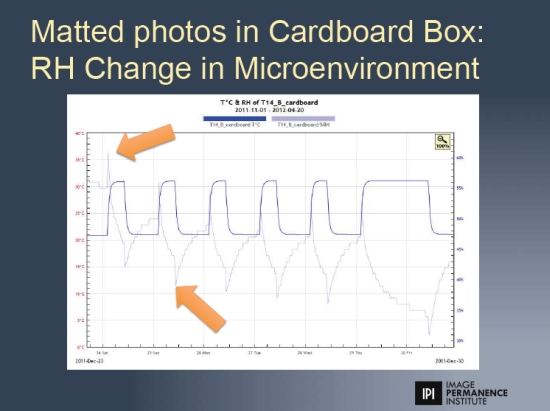
IPM_Slide

I’ve included a pdf slide of on an experiment my colleague, Jean-Louis, did with sensors in a box of matted photographs. He actually had a sensor inside the stack, inside the box on top of, or beside the stack and outside the box. The large arrows point out the first points that show the effect of the material on the RH inside the box. So you see as the temperature goes up, the humidity sharply follows it up before talking a long slower slide towards equilibrium. When the temperature goes down, we get a sharp drop in RH followed by the long slow slide towards equilibrium. As we poked into data that people uploaded to eClimateNotebook, we noticed this pattern appearing surprisingly often and we figured out that if you start from an empty room with non-hygroscopic walls, the environment is what it is. We start adding objects into the room and the room controls the objects. Eventually you reach a point where the ratio of hygroscopic materials to free air in the room is just high enough that the objects start to control the room. We don’t really see it so much in temperature, although I point out that a ream of common office copy paper (and American copy paper is 8.5 X 11 inches or 215.9 mm X 279.4 mm and one ream is 5 pounds or 2268 grams) takes the same amount of heat in or out to change one Celsius degree as 3.64 cubic meters of dry air. Possibly the effect doesn’t show-up because of the slow thermal conductivity of paper, but it’s an example of what can happen.“

Keep watching your climate data, folks!

This post is also available in Russian translated by Helena Tomashevskaya.

What happened September 2nd? A registrar’s climate mystery
Part 3 – The Solution

what_happened
“Looks like trouser pocket” said my colleague.

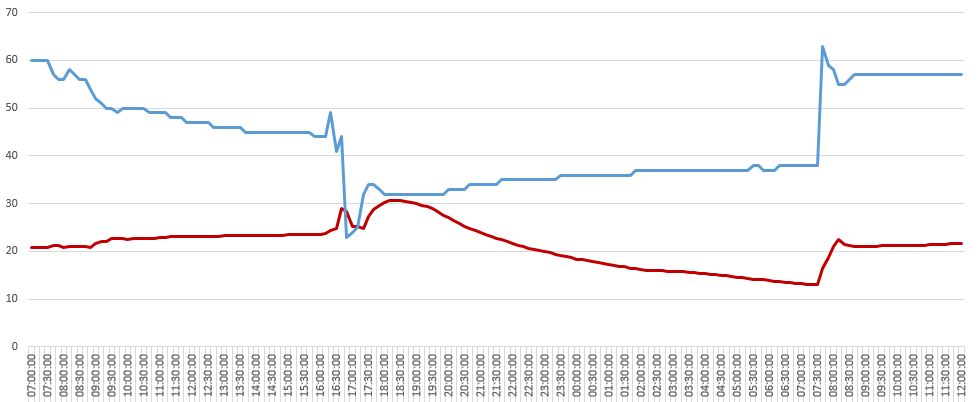
It wasn’t a trouser pocket, but it was the right lead. What we got here was definitely a people pattern. A storage area of the size at hand can’t change humidity by 20 % within 10 minutes if it is not to really catastrophic circumstances. It couldn’t be something that happened in the storage, it was something that happened to the logger.

Here’s the whole story:

The data from our data loggers is downloaded to a laptop at the beginning of each month, preferably on the first day of a month. September 1, 2013 was a Sunday, so September 2nd was the date for collecting the data.

On September 2nd about half past four p.m. our conservator responsible for the loggers called me to say that he just couldn’t make it to download the data on this day. But as we had a staff meeting on the next day and I was already at the offsite storage now, he asked if I could simply fetch the logger and bring it to the museum the next day.

Well, of course I could. I immediately took the logger and put it in my car so I wouldn’t forget it at closing time. While I was finishing my work at the offsite storage you can see how the poor logger lies in my car that was parked in the bright sun. About 20 minutes later I closed the storage and hit the road. As it was hot in the car, I rolled down the windows, resulting in a temperature decrease to a pleasant 25 °C (77 °F). At half past five I parked my car at home, again in the bright sun of a lovely, mild September evening. It was one of those last warm September evenings, where you can sit in front of the house with a cool drink and enjoy the warm rays of the setting sun. Apparently, it was far less pleasant inside of the car, hitting 30 °C (86 °F).

The next morning I got back into my car which had cooled down to 13 °C (55,4 °F) during the night. I was freezing, so I turned on the heating. When I found a parking lot in front of our museum at 8:10 the car was quite comfortably warm at 22,5 °C (72,5 °F). I took the logger and brought it to our conservator, so from now on the logger logged the regulated climate inside of our museum.

Hope you enjoyed our little real-world riddle.

The Start
The Hint

This post is also available in Russian translated by Helena Tomashevskaya.