Museum professional, lover of all collections work, former collections manager of the TECHNOSEUM in Mannheim, Germany. Now Professional Services Specialist for Gallery Systems. Independent museum professional.
Cat wrangler and #SciFi enthusiast.
Views are my own. Of course, they are. I can't make anybody responsible for the garbage my brain produces!
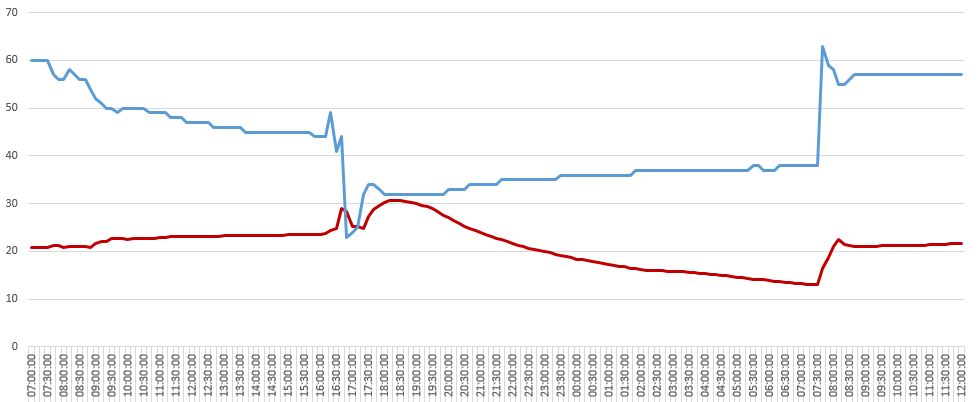
I had a look at the graph. It looked like a pretty normal day in this area until about 16:40. We have a slow increase in temperature from about 21 degrees to 25 degrees Celsius (69,8 to 77 degrees Fahrenheit) and a drop in humidity from 60% to under 50%. Nothing odd for this less-than-ideal hall in the changing season of a German autumn. If you take a look at the weather dates of said day from the nearby weather station you can see that our inside correspondents with the outside: http://archiv.mannheim-wetter.info/2013/pcws/20130902.gif (thick green line for temperature, thin purple line for humidity).
Then, after 16:40 things got odd. We see a sudden increase in temperature up to 29 °C (84 °F) and a drop from 44% to 23% within only 10 minutes. If this weren’t odd enough, only 20 minutes later we see the temperature dropping back again to 25 °C (77 °F) and humidity slowly increasing to 32%. At 17:30 we see again an increase in temperature, climbing up to over 30 °C (86 °F) and staying as high until 19:00 to slowly, slowly start decreasing over the next few hours, reaching 13 °C (55,4 °F) at half past seven the next morning. Then, suddenly, the temperature increases, again in an unusual way, reaching 16 °C (60,8 °F) at 7:40, nearly 19 °C (66,2 °F) at 7:50, peaking to 22,5 °C (72,5 °F) at 8:10 to become quite stable again at 21 °C (69,8) and 57% relative humidity.
Again and again I looked at the data and discussed it with colleagues. Then, a colleague mumbled “Looks like trouser pocket.”
Suddenly I could see the whole story when looking at the graph. Can you?
I received a call from our conservation trainee. She was in the process of analyzing the climate from one of our offsite storage areas for 2013 and discovered something really, really odd. She sent me the data and asked if I could make sense of what happened on September 2 and 3 in the said year. Please see the graph below, showing the temperature in degrees Celsius (red line) and relative humidity in percentage (blue line) between September 2, 7 a.m. and noon on September 3. Can you make sense of what you see?
The data logger is a portable digital logger powered by batteries in the middle of a large storage area without HVAC that is approximately 2,000 square meters (about 21,500 square feet) and 5 meters (16.4 feet) high. In the next part we will discuss the graph and I will tell you the hint from a colleague that finally brought the solution.
This may seem a weird way to start an article written for registrars, but many years ago, I attended a day of clown school. It was a pretty unique experience, and (little did I know at the time) it was also an experience would turn out to have something in common with working as a registrar! Be you clown or registrar, the art of juggling is an important part of the job. For a registrar working with loans, for example, juggling is required to ensure that the demands of both the lender and their institution are satisfied to a standard that will enable the loan to proceed. When it comes to university museums, however, there is a whole extra level of complexity to these loan negotiations. University museums commonly undertake intra-institutional loans to all sorts of locations around their own university. Your items may still be ‘on-site’, but how much influence can you actually maintain over your loans in these circumstances? Juggling balls can all too quickly become chainsaws when you realise that there are many competing demands to manage in this environment, some of which are out of your control. The requirements of collections care and preservation, for example, can struggle to make themselves heard against the demands of institutional expectations, history and politics. Where do you draw the line on loan requirements in these circumstances? Is there, in fact, a line? Or is it a tightrope, perhaps? This was the very interesting subject which formed the basis for a fascinating session on the morning of Day 2 of the 2015 ARCS Conference in New Orleans.
ARCS 2015: Session on On-Campus Loans (picture by Greg Hunter)The session included presentations from three different speakers. Nicole Linderman from Harvard Art Museums, Trevor Weight from Brigham Young University (BYU), and Sonja Reid from the University of Texas (UT) all spoke to us about the challenges of loans within their university. Nicole kicked things off by putting on her metaphorical Stetson to take us through the ‘Wild West’ of campus loans, outlining circumstances which were subsequently shown to be similarly evident at all three institutions. All of the speakers indicated that collection care had taken a back seat in many cases at their universities. At Harvard, tradition was seen as substantially more important than collection care, as evident in the fact that many of the institution’s works had been displayed in a particular location since time immemorial and consideration had never been given to potential display change or object preservation. In addition, many new loans were still occurring despite an object movement related moratorium being in place, underlining the disregard being given to collection care. At BYU, loan agreements were often disregarded to such an extent that people who had objects on display in their offices/halls would consider the objects to be ‘theirs’, and would often take them with them when they moved offices or even take them home! UT noted a problem common to all three institutions in that loan agreements for collection items were being made with people within the institution who were not museum trained, meaning that they did not understand the purpose of loan agreements and often did not see the necessity of following them.
In all three locations, then, something needed to be done to remedy the situation. As Trevor put it, the approach needed to be a three step process – Change It, Sell It and Enforce It. In each case, change meant the development of a robust new loans policy. The emphasis was on policy rather than comprehensive loan agreements because of the internal nature of the loans and the lack of expertise held by those borrowing the works. Good polices, therefore, needed to be developed and key university figures needed to be convinced of the usefulness such policies in order for them to succeed.
The universities in question all had similar ideas, but there were differences in their approaches to change due to their different circumstances. At Harvard, a yearly contract document was implemented for loans – previously, many loans had not been documented at all. At UT, loan agreements for such loans were actually decommissioned as they simply weren’t enforceable. University policy dictated that one campus entity could not sue another even if such an agreement was breached, meaning their usefulness was very limited.
A very important factor in instituting change at all three universities was education. This was what Trevor called ‘selling it’ – if people better understood the need for such policies, they would be more likely to follow them. What better place to learn than a university, after all? At Harvard, Nicole took the opportunities presented by a physical inventory of the collection to personally meet and talk to numerous stakeholders to discuss the new policy. It’s not always easy to get the ear of important people, but accessing their private office to look at artworks can provide you with great opportunities! Nicole used this chance to the utmost, educating stakeholders about the importance of shade, air conditioning and other associated factors to the preservation of the artwork while undertaking her inventory. Trevor also started his revolution by explaining the situation to borrowers. As part of this, Trevor offered anyone willing to do so the chance to replace their display items with prints, which could be of any object in the collection. This was what Trevor called a ‘game changer’, as it gave borrowers a great incentive to implement change by offering them much greater choice. At UT, the new loan policy is still in draft form, but Sonja has flagged the need for a personal review of the loan policy with each borrower in order to ensure they are fully aware of their responsibilities at all stages of the loan – before, during, and after.
Both Nicole and Trevor reported that results have been encouraging since the implementation of their new policy. Nicole’s comprehensive new policy, which covers loan approval processes, installation, annual contracts and reviews, facility reports, inventory, light sensitivity, security, glazing, hardware, and even the recall of works, has gained significant acceptance within Harvard. At BYU, the situation has greatly approved. The requirements of collections care are much more widely acknowledged, and BYU’s print program has meant that the number of original artworks in display has significantly reduced. The success of BYU’s new approach was illustrated by the example of no less than the university president, who declined the return of a painting to his office after it had been on loan elsewhere and kept a print on display instead. If the new policy at UT is approved, Sonja is hopeful that her university will be similar results.
All three speakers did a great job at showing us just what a good registrar can do. Confronted with very difficult situations in which to manage the care of their collections, Nicole, Trevor and Sonja have all made enormous strides in helping to ensure that their collections are well cared for and preserved for many years to come. It was inspiring stuff to hear, and I was so glad I was able to be there to hear it. Chainsaw juggling? That’s nothing – give me university juggling any day!
Greg Hunteris the Registrar of the National Sports Museum at the Melbourne Cricket Club in Melbourne, Australia. He is a member of both the Australasian Registrars Committee (ARC) and the Association of Registrars and Collections Specialists (ARCS), and received a travel stipend to attend the 2015 ARCS Conference. He loves learning about museums, and enjoys reading, writing, and playing guitar in his spare time, though ‘playing’ is perhaps a very generous description of his attempts in that particular field.
Was it already a year ago we raised our glasses to celebrate the second birthday of our project? Time passes so quickly! It’s been a turbulent and busy year, I guess for all of us. For me as the administrator it was especially packed: in my day job as the collections manager of the TECHNOSEUM there was much to do with managing taking over a large collection of broadcasting equipment and finding space for it in an already crowded storage area. At night and on the weekends I was busy writing about managing unmanaged collections. One of my cats was hit by a car and badly injured but fortunately is recovering and nearly back to normal. Of course, the departure of Derek as an author was a big loss, too. Well, this is a weak try to apologize for not being as active as in previous years in finding new contributors and topics for this project. I hope in 2016 I will have more time again to keep watching our profession and dig out more stories.
Anyway, we had some great stories: the most read post with the most active contributors was “How NOT to number objects“. We had many readers asking to have a follow-up on current best practice in object marking. If someone feels like writing something about that, even if it is just for one group of objects, this would be a great new series, helping people who are unsure, especially after this post! Nearly as popular was the post “Put a lid on it” by Anne T. Lane and the real-world examination of the damage light does on post-it notes by Judith Haemmerle. We saw some great new books being published, the forth edition of Basic Condition Reporting, Nomenclature 4.0 and The Rights and Reproductions Handbook were presented here. We also started a new series, “Failures in Figures“.
Will write something about this, soon.The topic of unmanaged collections was strong this year and even when the book is published I want to keep it as a focus, because I think those stories from the trenches really help those struggling with their own collections. The European Registrars Conference is in Vienna this year (Yay to our colleagues from the Austrian Registrars Committee!) And I hope I will be able to attend and write a report. There are still some promised reports from ARCS in New Orleans, hopefully coming soon!
As more and more of our readers coming here with mobile devices I hope I will find the time to adapt our layout to be more mobile friendly or find alternative solutions for this issue.
So much for a lookout on 2016, keep following us and keep wearing those gloves!
I’ve found this amazing video showing how “Merry Christmas and a Happy New Year” is said in sign language in English, Russian, Dutch, Chinese, Australian, Japanese, Finnish, Austrian, Hungarian, Swedish, French, American and German:
In the spirit of this video, let’s overcome all barriers! The whole Registrar Trek Team wishes you a merry Christmas and a happy, healthy and successful New Year 2016!
We collections professionals are a creative bunch. Because of our great passion, we do not let limited resources get in the way of our commitment to preserve our collections and make them accessible to our community. Tonnes of innovative ideas on how to store different types of objects are developed in museums, libraries and archives all the time. Sadly, these amazing ideas are rarely shared with the rest of the world. In your collection storage area, there are ideas that could benefit others who may be facing similar challenges as you.
If you work with collections, at some point, you have found solutions that you or your colleagues are particularly proud of, no matter how simple and modest it may be. You have found new ways to optimize space, to re-use existing materials and to make sensible use of resources. This is your opportunity to share your ideas with colleagues around the world and to learn from theirs.
Send us one or two photos of your storage solution with a short descriptive sentence that tells us:
The type of object
The materials used or re-used to create your storage solution
Why this system is better than before
There are several options for sharing your photos:
Here are some examples:
“We adapted a shelving unit to store our collection of oars and spears. We are able to use up less shelf space than before. We’ve gained more room for other objects.”
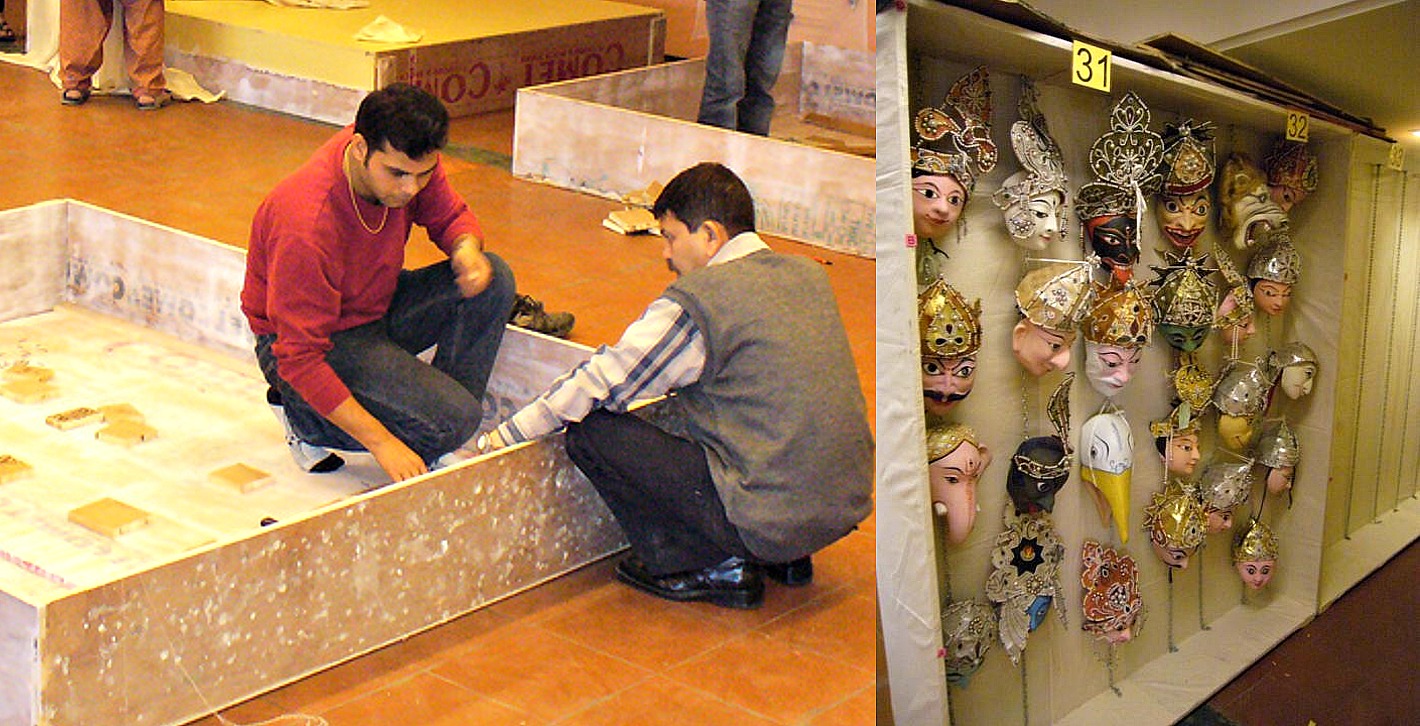
“We re-used large wooden crates. We fixed secured chains on the crates to hang the masks. Now they are off the floor, so we will no longer risk stepping on them.”
“We created compartments in a box with cardboard folded in zigzags. Now we can take each pen easily. Also, they don’t rub against each other.”
In part 3 of our series we took a look at what part of our human nature causes the errors we’ve discovered in part 1. But they are not the only reason. Procedures and technology play a big part in this.
1. Number of steps towards location change
Whenever I compare notes with colleagues in all honesty, we come up with almost the same observation: however exact and detail-oriented we tend to be, about 10% of the time we just get it wrong. Most of the time we confuse numbers, but there is the whole range of errors we discovered in part 1. That almost none of those mistakes make it into our data bases is due to cross-checkig procedures we impose on ourselves. For example, after we have written down a number, we compare it again with the number on the object or we work together with a colleague.
If there is a high risk of confusing numbers whenever we write them down, it is totally logical that the more often we have to do this in the process, the more likely we get it wrong. It’s just as logical that the number of possible mistakes increases the more people are involved in the process and the more time passes between the original location change and having it secured in the data base.
The worst location change process I ever encountered looked the following:
The collection manager noted the location change on a piece of paper at the offsite storage.
The collection manager or one of his/her assistants composed an email with the location change and sent it to the documentation team when he/she got to a computer with web access.
A team member of the documentation team made the location change in the data base.
Obviously, there are three times the accession number and location is noted which means where you can get it wrong. Along with the “normal” confusion of numbers, there is the possibility to read a handwritten number wrong. In addition to those writing or typing mistakes there is the additional possibility that the location is entered wrong, because the final change in the data base is done by someone who isn’t familiar with the location numbering system in the storage. While the collections manager would probably realize that he/she can’t have put a grammophone needle on a heavy duty rack, this detail escapes the documentalist in his/her office.
What can be done about it:
Limit the steps it takes to make the actual location change to a minimum. Ideally you have data base access in all storage areas that allows immediate location change.
Anyone who actually changes locations of objects has to have the possibility to do location changes in the data base.
If more than one staff member is involved, make sure there is a feedback loop when the location has been changed, so the original changer of object location has a chance to check for accuracy.
Technology like barcoding, if proper implemented and working, reduces confusion of numbers to zero (Read the examples of the National Galleries of Scotland and the TECHNOSEUM.
2. Complicated numbering systems
This is not really a surprise, but seldom someone thinks about it: if your location numbering system and your accession number is confusingly complicated, you increase the likeliness of mistakes to happen. Accession numbers that follow the logic “year of accession/number of object that year/parts number” are far more easy to remember and to write correctly than an accession number that tries to convey a multitude of information like “number of department/number for material/year of accessioning/number that indicates if loan, education collection or permanent collection/number of object/parts number” 1. Unlike computers, humans just aren’t good at remembering numbers and even if it’s just a brief moment between looking at the number and writing it down, there is a memory process involved. One Mr. Miller came to the conclusion that the human brain can hold 7 items at the same time in 1956 2. I don’t doubt that there are really brainy colleagues who can remember much more, but I found this rather accurate. One reason why the three-part numbering system is easier to remember than other numbering systems is that one part of it, the year of accession, is telling people something. As a human being you don’t read 1977 as 1-9-7-7, you read it as the year Elvis died or your daughter was born. That’s probably why I seldom discovered that someone got the year of an accession number wrong and when it happens, it’s mostly because there were numerous other accession numbers with that year to take down, so when one item comes from another year, your brain just copied and pasted what it had read several times before (remember what I said abut concentration in part 3!) or that the digits in the year are notorious to be confused when written on paper like 5 and 6 or, in some terrible handwriting 8, 9 and/or 0. So, one could say that the first part of the three parts system is just one bit to remember, not 4. The next part contains 3 or 4 digits, which is possible to remember, as well as parts numbers, as long as they are not too many. A 1988.1243.001 is easier to remember than a 1988.1243.193, simply because the first one meaas that you have to remember 6 bits (1 year + 4 digits + 1 digit) while in the second example it’s 8 bits (1 year + 4 digits + 3 digits).
What can be done about it:
Choose a numbering system the human brain can remember.
Keep it simple. Don’t expect the accession number to include ALL the information. It is totally sufficient if the accession number makes it possible to distinguish one object from another, similar one. All other infomation can be drawn from the data base or an accompanying inventory card.
Avoid whenever possible the necessity of memorizing numbers.
Mark your location codes clear and readable on every location unit. Just because the system seems obvious and logical to you it isn’t for the next colleague who has to deal with it. Yes, I’m looking at you, collections managers! If you choose not to label each shelf of a shelving unit, don’t expect anybody to know which is “shelf a” and which is “shelf e”.
3. Responsibilities
With every person responsible for location changes the likeliness of mistakes to happen increases. And the more involved, the harder to track where something went wrong. Also, with each person on the team that is involved with object handling, the variety of mistakes increases. That might be a little hard to comprehend, so let’s make an example: Our valiant collections manager X is very detail-oriented but has a serious quirk: she tends to confuse left and right. As locations on the shelf boards are separated by “left”, “center” and “right” she sometimes confuses those, too. The curator Y is often taken away by the sheer beauty of his objects and tends to forget from which shelf he has taken an artifact. As he is at the same time convinced that he exactly knows what he is doing, he often puts the object back on some other shelf. Conservator Z is marvelous with treating artifacts but terrible with numbers. When writing three accession numbers on a box she sure gets at least one number wrong. Each of those quirks looked upon seperately are easy to mend: depending on who has handled the object last, you just know that you have either to search on the opposite side of the shelf (handled by X), the shelfs in the vicinity of the original location (handled by Y) or play around with certain possibilities of number confusions (handled by Z). As soon as you don’t know who handled the object last, you have to take all possible mistakes into consideration, leading to more invested working time in discovering the object.
What can be done about it:
Limit the number of people responsible (and allowed) to handle objects and make location changes.
Track every location change not only with date and reason, but also with who actually did it.
In larger institutions: Make sure you assign and communicate responsibilities clearly. For example: who is making the location change, the giving or the receiving party? If the collections manager sends an object to the conservation lab, the curator or to the photographer, the collections manager is responsible for the location change. If a conservator sends an object to the photographer, the conservator is responsible for the location change. If the photographer sends an object back to storage, the photographer is resposible for the location change.
This was the last part on location tracking in our series “Failures in Figures”. I’m sure that there are other points to consider which I forgot to mention. I’m looking forward to your comments, additions and ideas! I’m also looking for new suggestions on what we should examine in “Failures in Figures”.
Best wishes Angela
Don’t laugh at that, I actually worked for one institution that had a very similar accession numbering system, including a “.1.” right in the middle that none of the people currently on staff could explain, it just had always been there and they never encountered any other digit there. ↩
Miller, George A., The Magical Number 7, Plus or Minus Two: Some Limits on Our Capacity for Processing Information, Psychological Review, 1956, p. 81-97 ↩
At the beginning of this year I asked you all if you were willing to join me in the journey of writing a book about managing previously unmanaged collections. And you did. Many of you were willing to support the project with stories, photos, comments, thoughts and encouraging remarks.
So today, I can proudly announce that I have handed in the manuscript and you can already find the book announced in the ”Essential New Books for Museum Professionals“ by Rowman & Littlefield on page 7.
Last week our colleagues in the U.S. celebrated Thanksgiving and in Germany we have a similar tradition of saying thank you at the end of the harvesting season, celebrating the ”Erntedankfest“. Today, it is my time to say thank you to all of you who contributed to the project! Thank you for investing your time, your knowledge and your thoughts!
Especially, I want to take the opportunity to thank my personal ”board of advisers“. If you are writing a book, you have to be aware of many pitfalls. But even if you aware of them in general, you sometimes need a second pair of eyes to spot them.
Pitfall #1: I know what I’m writing about!
Of course you know what you are writing about, otherwise you wouldn’t write the book. But your writing is shaped by your personal experience. You need someone who is as deep into your profession as yourself to help you see where you are missing important points or where your advise to the reader could backfire, given special circumstances you haven’t thought about. And you need this someone to discuss conundrums and definition questions with, because not everything is as clear and logical as you think it is, a fact that you only realize when you start writing about it.
For my book, my friend and colleague Darlene Bialowski, Principal of Darlene Bialowski Art Services, and a former Chair of the Registrars Committee of the American Alliance of Museums, who herself has seen a great many unmanaged collections, took this very time consuming job. She really read every chapter at least twice, sometimes more often, made suggestions and we discussed many aspects via email. Until today I don’t know how she crammed all of this into her already tight schedule, but I’m eternally grateful that she did. Thank you so much, Darlene!
Pitfall #2: A registrar’s way is not necessarily the best way!
If you are working in a profession you become extremely focused on the aspects that are most important in your everyday work. This lets you miss some aspects which are equally important if you look at the big picture. To help you see them, you need someone from a profession closely related to your own profession, but not from the same profession.
I’m grateful that Susan L. Maltby, Conservator at Maltby & Associates Inc., took the responsibility to read the manuscript from a conservator’s perspective and enriched it with many practical ideas as well as pointing me to some parts of the text where I missed either that artifacts could be damaged or health hazards I hadn’t thought about. Thank you so much, Sue!
Pitfall #3: What are you talking about?
My book is aimed at those who have never dealt with an unmanaged collection. Preferably people who have had a basic training in collections care and preventive conservation, but I also wanted the book to be usable as a guide for those who have never been in touch with the collections profession. But how could I be sure that someone who never cared for a collection understands what I’m writing about? I needed someone with no connection to the whole field of collections care who had the imaginative ability to put him- or herself into the shoes of someone who is confronted with the task of managing an unmanaged collection the first time.
Well, it turns out I have a friend who has the imaginative power to put himself in the shoes of a 19th century firemen on a steamship or a soldier fighting at Bull Run in the Civil War, so I asked Paul N. Pallansch of Up-Close Realism, Silver Spring, if he was willing to put himself into the shoes of a newly minted collections manager confronted with a chaotic unmanaged collection and only my book to help him. I’m glad he said yes, and I was quite relived when he wrote back that he had his doubts when he read my original question but now, after he read it, he thinks he could do it if he looks all the things up he doesn’t know about collections care. That’s exactly what I wanted the reader to think and feel like after reading. Thank you so much, Paul.
The manuscript goes now through the editing process now and I’ll keep you posted on the further progress of this project. As it looks now, ”Managing Previously Unmanaged Collections – A Practical Guide for Museums“ (Link to publisher’s catalog with pre-order option) will be available early next year.
There are no words for what happened in Paris last weekend. Instead, let us remain silent for a moment and commemorate the innocent victims that were brutally killed while enjoying their night out at a concert, a café or a restaurant in one of the most beautiful and cultural significant capitals of Europe. Let us also commemorate all those who are killed around the world every day by terrorist attacks and those who suffer and die fleeing from terrorism.
The Registrar Trek Team
This post is also available in Italian, translated by Marzia Loddo.
In part 2 I left you with the question why so many mistakes happen, why we discovered an error rate of 21,91 % in our example. Well, you may have guessed it, while sometimes sloppyness CAN be the reason, it seldom is. Let’s take a look at common reasons and what can be done:
1. Working in a haste
We all know the last minute requests, when an object is needed NOW. This happens often before great openings or other time-critical events when the collections manager is swamped with a number of tasks anyway and this increases the likeliness of something going wrong with location changes. If the collections manager retrieves the object him- or herself the most likely thing to happen are confused numbers in the accession number that lead to a wrong location change. The reason is that despite his or her usual accuracy the number is scribbled on a piece of paper in a haste and without noting other things like title or name. When he or she does the location change in the data base he or she might not check the data base entry as accurately as he or she would normally do, because of the time pressure.
If some other staff member retrieves the object he or she might forget to note the location change at all, because, other than the collections manager, location changes are not among his or her daily duties and he or she doesn’t carry the weight of searching for lost objects, so it is rather easy to forget to do it. It is also very likely that the location change of other objects are not noted, i.e. when objects need to be removed to retrieve the wanted object and are not put back to their original location.
What can be done about it:
Establish clear deadlines for object retrieval for in-house projects. While it takes some effort to enforce it and will take constant reminders, it saves a lot of search time and reduces stress. Insider tip: working with positive reinforcement like giving kudos to curators who deliver their object lists early and stick to them can help a lot.
Establish clear deadlines for external requests like loans.
Limit the number of staff that is allowed to retrieve objects.
2. Multitasking
While it is quite normal that collections managers wear many hats in their museums multitasking doesn’t mix well with tasks that need a high amount of focus like making location changes. It’s nearly inevitable that mistakes happen if you do location changes, make data base changes, check emails, answer the phone and give instructions to staff members all at the same time.
What can be done about it:
Make it a custom that you are not available if you do location changes. Turn email off and give your phone to a colleague. If it’s necessary that you are available for emergencies, have a special phone for emergencies that people can call only if it is a REAL emergency. Insider tip: If you think you are too important to be not available make this simple experiment: take random two hours or a working day and note who tried to reach you and why. Then take a look at the requests and try to spot those which really were so urgent that you had to react within this time frame and which would have been unproblematic if you just noticed them two hours later and reacted then. I bet that most if not all requests fall into the second category and there are even some requests that were solved another way within these two hours.
3. Concentration
A human being is not able to be fully focused 8 hours a day. While this is somehow logical, it is often forgotten. Especially collections people often think that they are the exception from the rule and they remember everything and are concentrated all the time. Well, this isn’t true. Location changes need extrem attention to detail and if you get tired you will inevitably make mistakes. And because you are not fully concentrated, chances are you don’t even realize them.
What can be done about it:
Don’t schedule a whole working day for location changes. Cut it down to a reasonable time frame like an hour or two. Even within this short time frame, take some breaks and stop if you realize that you are not fully focused and your mind goes astray.
Whenever possible, do location changes with a second person, especially if you have to do a lot of them. This generally reduces the amount of mistakes and you can watch each other. Often, you won’t realize that you are not concentrated. That’s the very nature of distraction. But normally, a second person working with you will realize it and can say “I guess we need a break.”
And there’s more to it…
These are just the reasons for the mistakes that have to do with our very own human nature. There are more reasons that have to do with procedures and technology. We’ll take a look at them in our next part.
A project to break down language barriers and connect registrars worldwide
 This may seem a weird way to start an article written for registrars, but many years ago, I attended a day of clown school. It was a pretty unique experience, and (little did I know at the time) it was also an experience would turn out to have something in common with working as a registrar! Be you clown or registrar, the art of juggling is an important part of the job. For a registrar working with loans, for example, juggling is required to ensure that the demands of both the lender and their institution are satisfied to a standard that will enable the loan to proceed. When it comes to university museums, however, there is a whole extra level of complexity to these loan negotiations. University museums commonly undertake intra-institutional loans to all sorts of locations around their own university. Your items may still be ‘on-site’, but how much influence can you actually maintain over your loans in these circumstances? Juggling balls can all too quickly become chainsaws when you realise that there are many competing demands to manage in this environment, some of which are out of your control. The requirements of collections care and preservation, for example, can struggle to make themselves heard against the demands of institutional expectations, history and politics. Where do you draw the line on loan requirements in these circumstances? Is there, in fact, a line? Or is it a tightrope, perhaps? This was the very interesting subject which formed the basis for a fascinating session on the morning of Day 2 of the 2015 ARCS Conference in New Orleans.
 Was it already a year ago we raised our glasses to celebrate the