Category Archives: Stories

What happened September 2nd? A registrar’s climate mystery
Part 1

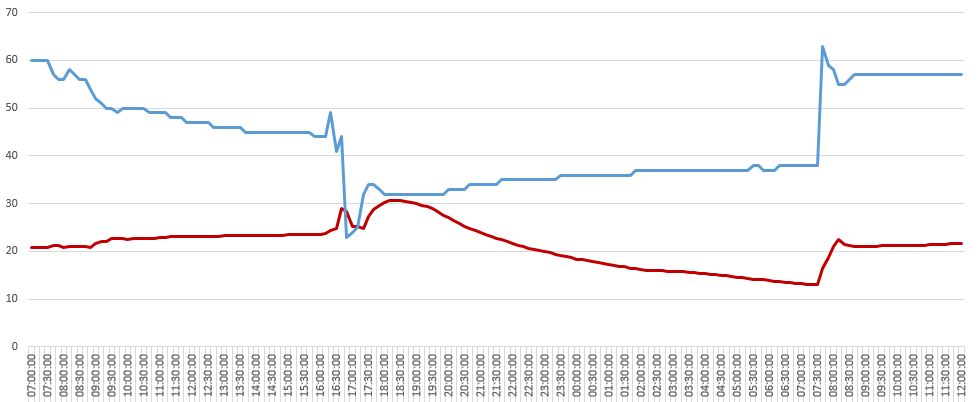
I received a call from our conservation trainee. She was in the process of analyzing the climate from one of our offsite storage areas for 2013 and discovered something really, really odd. She sent me the data and asked if I could make sense of what happened on September 2 and 3 in the said year. Please see the graph below, showing the temperature in degrees Celsius (red line) and relative humidity in percentage (blue line) between September 2, 7 a.m. and noon on September 3. Can you make sense of what you see?

what_happened

The data logger is a portable digital logger powered by batteries in the middle of a large storage area without HVAC that is approximately 2,000 square meters (about 21,500 square feet) and 5 meters (16.4 feet) high. In the next part we will discuss the graph and I will tell you the hint from a colleague that finally brought the solution.

What do you think happened in those 29 hours?

A Hint
The Solution

Full spreadsheet of data

This post is also available in Russian translated by Helena Tomashevskaya.

How NOT to number objects

It all started on an early Friday morning when I opened a box and found a cast iron plate with its accession number as well as object title and year or production written down on a post-it and the post it secured all around with adhesive tape. I found this both horrific and hilarious, so I shared my experience with my colleagues at the RCAAM listserv (http://www.rcaam.org/Listserv). Apparently, I was not alone. Here are the experiences our colleagues shared:

  • I remember working on an object where the accession number was painted over the original manufacturer’s label.
  • That sounds like the types of things I witnessed when I first started at my job! My predecessors didn’t know how to accession anything or where to write the numbers. Some of the beautiful frames have the accession numbers written on all 4 sides in giant sharpie letters. It is horrific!
  • And then there was the fine 19th century linen handkerchief with the number written in 1/2” high characters in red nail polish directly on the fabric. Still makes me teary-eyed to think about that one.
  • 1880’s playing cards with white paint and ink numbers
  • I actually saw a director of collections where I used to work write an accession number with a large black sharpie on a cardboard hat box!!!
  • Sharpie marker on unglazed ceramics…
  • Another example of stapling the tag to the textile
    Another example of stapling the tag to the textile
    Stapling the tag to fur collar instead of sewing in the tag.
  • Sharpie on Duct tape wrapped around 19th century leather-bound books (to prevent them from opening).
  • Wow – you had the fancy Sharpies. In my museum previous staff had to make do with the inferior Marks-A-Lot brand for marking cardboard and silk.
  • I’ve got red oil paint on unglazed ceramics. Does size count? The numbers are about 3/4″ tall…
  • How about paper tags written in pencil that’s completely faded after less than five years?
  • Many of our older paintings are victims of the old “red nail polish” method….
  • One place I worked had numbers written in sharpie marker on nearly every object in the collection. In addition, the number written object often did not match what was listed in the Accession Book, e.g. different year.
  • Many of the documents in our archive are labeled with a layer of clear or white acryloid, then the number written with an archival pen, then sealed with another layer acryloid… it still puzzles me every time.
  • The university administration used to keep track of “items” by assigning property numbers, sometimes with metal plates on the objects. Fortunately, we no longer do this. Yes, we are learning…and we are a learning institution.
  • At a museum I worked at years ago I had a parchment land document from the 1770s numbered on the front, in large letters, in blue ballpoint pen. And the person made sure they pressed really hard, and went over the numbers many times to make sure it was really on there.
  • I found a box stuffed with artifacts. Some in (too large) plastic bags, and one pair of boot moccs (not old, very, very modern). Someone wrote on the plastic bag with sharpie, didn’t let it dry and put all bags and unprotected moccs in the box…well the sharpie ink rubbed off on the moccs. Backwards object number at the top.
  • I have seen a lot of ink in books, well paper in general. And just not numbering at all….
  • We see things constantly that were done 50 or more years ago and it just makes us shake our heads a bit. Here are two of my favorites.

    1. With metal tools, I’ve seen pieces where someone ground away a noticeable amount of metal (enough that it changes the shape of the artifact) to make it smooth, then used a rotary tool to incise the numbers into the surface.

    2. You know the plastic tape that you emboss numbers into with a little hand punch? I’ve seen that directly stuck onto artifacts and on top of that, stapled into the surface on each end. The adhesive is so strong that it can’t seem to be removed without risk of damage, so I usually just leave it when I see it.

    You find some interesting things with a 100+ year old collection!

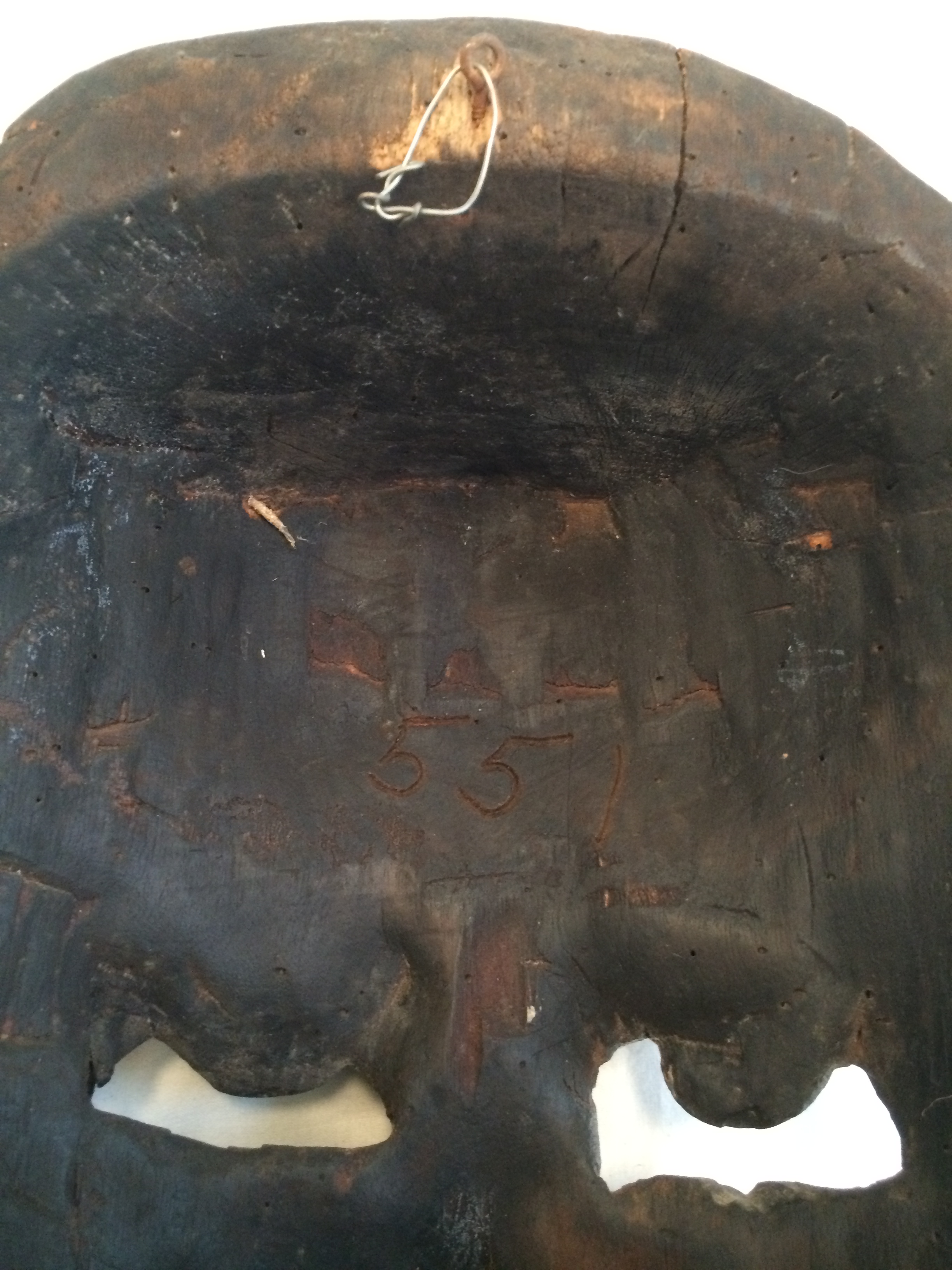
  • How about carved inside a wood mask? I can say this was not done by anyone claiming to be a museum professional. It was done by the donor in an effort to keep an inventory of the collection. As you can see from the photo, hanging hardware was included for no extra charge. Lucky me!
    How about carved inside a wood mask? I can say this was not done by anyone claiming to be a museum professional. It was done by the donor in an effort to keep an inventory of the collection. As you can see from the photo, hanging hardware was included for no extra charge. Lucky me!
    Our office of inventory control for the university still assigns property numbers, but a long time ago someone explained to them that actually putting them on the art would damage it. Now they just send us the tags which I place in the object file.

    When I first got here I found it amusing that when inventory control did a random inventory of the museum they didn’t want to see the object, just the tag. In the past few years this has changed and they now want to see both. I am so appreciative that they really seem to care about our collection and want to make sure we’re taking care of it.

    As funny as all of these things are, we should remember that at some point people thought they were doing the right thing with their marking. I wonder what future registrars will be saying about us in 50 years…

  • This is not related to numbering objects specifically but…we received a donation of books, photographs, and other ephemera from a donor many years ago that are now a part of our archive. I suppose it was done to identify who owned the work and/or for posterity but the donor stamped everything with an Ex Libris ink stamp that also includes her name. Most of the works have been stamped multiple times in different places (front, back, inside cover). And in many cases (a pet peeve of mine) the stamp is upside down…
  • We ran into a similar situation at the Thomas Wolfe Memorial in Asheville, but with signatures. Thomas Wolfe owned several books that are in the collection and signed them on the flyleaf. After his death, one of his sisters went through the books and wrote “Tom wrote this” and drew an arrow to his signature.
  • I’ve got 45 year-old ball-point pen on masking tape fossilized onto hundreds of pieces accessioned in the early 1970s…
  • At The Farmers’ Museum in Cooperstown, New York, some industrious soul in the 1940s used a pot of red paint and a small brush to place accession numbers on many three-dimensional objects. Because of the ancient staff person’s lack of skill in that endeavor, he or she has traditionally been identified as the Red Blobber. Finding the number on the object is never a problem, but differentiating a 5 from a 6 or an 8 or a 9 (ad nauseum) can be impossible.
  • I also recall a tale from the late Caroline Keck, regarding numbers painted on hundreds of archaeological metal items that were being catalogued and placed in climate-controlled storage. The rapid drying of the corrosion layers caused almost all the objects to shed their outer layers… along with the numbers.
  • I worked somewhere once where most of the objects had been numbered multiple times, with a variety of numbering systems in a variety of sizes and materials. We used to play “can you see it now” and hold up the items to see how far away one could read the numbers…
  • Great topic and could be a chapter of a book. This is my personal favorite. If the black 1.5″ lettering isn’t legible the White 1.5 lettering should be. Whatever they used as a clear coat has so far resisted any attempt at removal. I have thought of sand blasting but I think the metal might disappear before the clear coat did (only a little bit of gallows humor here).
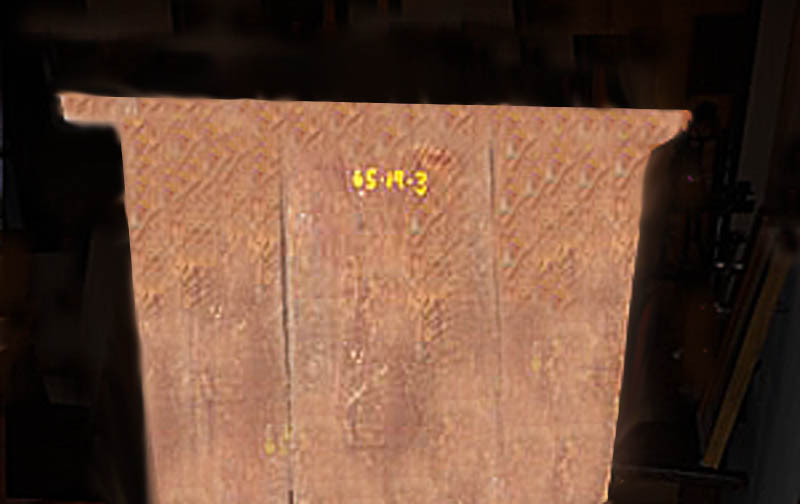
  • The plague of Mad Number-ers also scourged the woodlands. We have evidence like the above parti-colored markings. On some objects the number is also etched, sometimes with an etching tool, sometimes with a sharpened nail.
  • Cupboard
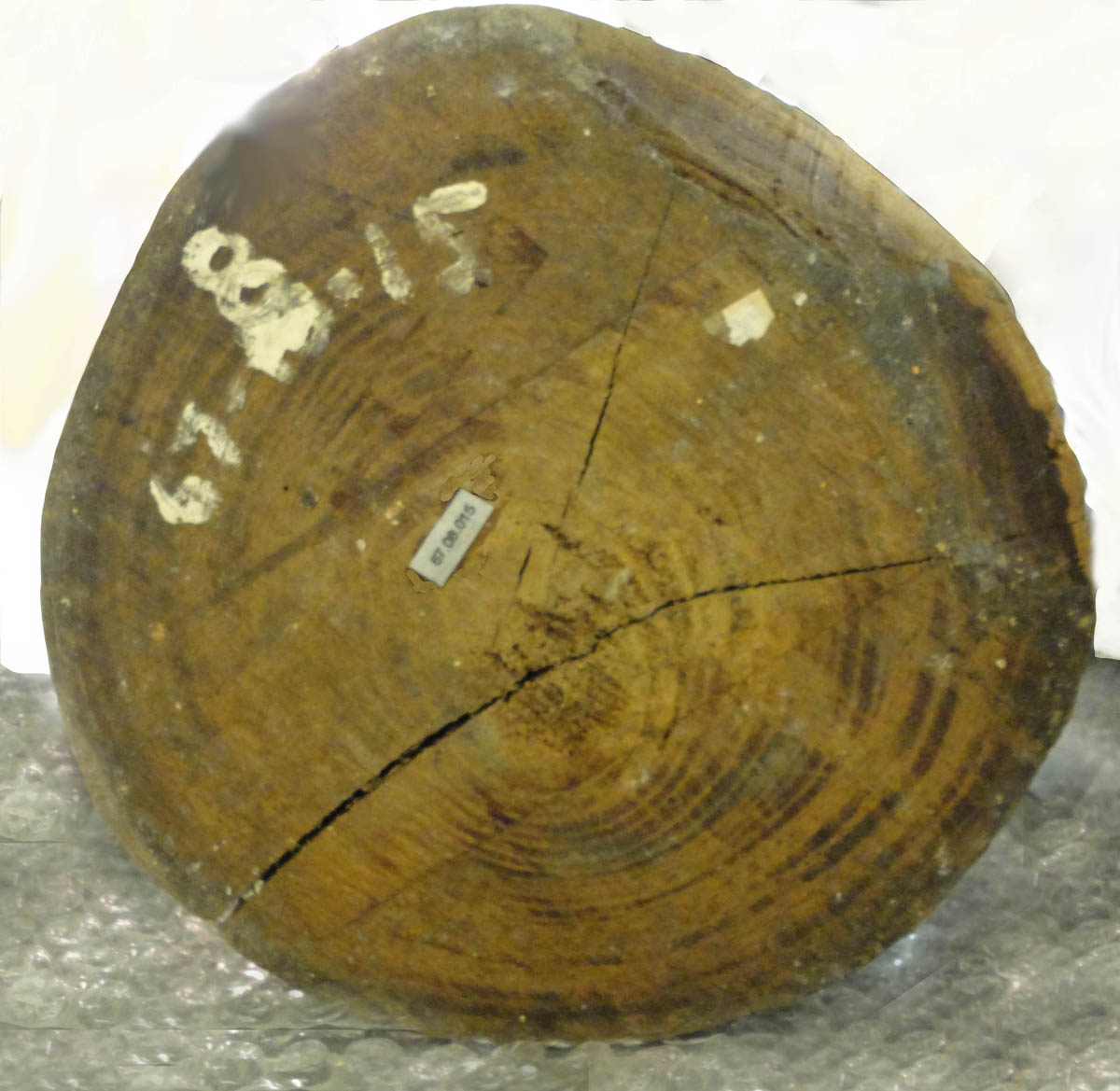
    Someone, long, long ago, must have found a sale on house paint. Several of our objects look like the pics I am attaching.  The second shows the bottom of a totem, you can see my little number in the center, as well as the yellow painted number I found on it. I just had to re-number it myself to indicate my disgust at the first method. At least they could have gotten the number right the first time (you'll see it is marked out and rewritten, as if one go-round with paint wasn't enough - sheesh!!).
    Someone, long, long ago, must have found a sale on house paint. Several of our objects look like the pics I am attaching.
    The second shows the bottom of a totem, you can see my little number in the center, as well as the yellow painted number I found on it. I just had to re-number it myself to indicate my disgust at the first method. At least they could have gotten the number right the first time (you’ll see it is marked out and rewritten, as if one go-round with paint wasn’t enough – sheesh!!).
    Good to know we’re amongst friends! Here are some of our past sins…sharpie, red nail polish method, yellow nail polish method, metal etching, metal stamping, ball point on paper artifacts, white out (literally numbers painted on with white out), multiple numbering systems labeled on an artifact, stapling tags into textiles, masking tape labels, metal tagging…numbers of various shapes and sizes…I think we may even have some neon painted
    numbers…sigh.
  • I am so, so pleased that my institution is not the only one that has a history of using those old plastic label makers! Our intrepid predecessors were apparently afraid that we would be unable to identify the purpose of the artifacts in the future, and so they gave us plastic adhesive labels with things on them like “Wooden Bowl” and “Butter Mold.” Right on the front of the artifacts. Those poor bowls didn’t stand a chance.
  • Actually, I forgot one of the most diabolical numbering applications. Years ago, a previous NC State Historic Sites curator instructed staff at historic sites to write accession numbers on adhesive labels and put them on the objects. Through the years, the labels have dried up, fallen off of many of the artifacts, and then dutiful staff swept them up and disposed of them. Not only do we now have a sticky shadow of where the label was, we’ve been hard-pressed matching records and artifacts–thanks to poor measurements and descriptions. But that’s another story. [sigh]
  • Before I started to work here we had a former director who had the staff use silver fingernail polish as a base with the accession number written on with a red Sharpie pen. This was followed with a topcoat of clear fingernail polish. Over the years these numbers have faded so much they are almost impossible to read. Or, if it wasn’t silver fingernail polish it was White Out.

    This same director also liked to take the eraser on the end of an ink pen (remember those?) and “clean” a spot on coins before marking them with a number.

    One more – when the collection was still at the college a retired professor became the director. He decided everything needed to be clearly marked. He would paint a large white blob on the artifact and use India ink to put on a number followed by shellac that often ran down the artifact. This was usually in the most conspicuous and prominent place on the front of the artifact and the size never varied. It was always HUGE! Sometimes he added two or three more examples of the same exact number to the piece. We have a beautiful polychrome Zuni Pueblo pot that has a number painted on over some of the designs. The shellac then ran all the way down the sides of the pot.
    Oh the humanity!

And the winner is…

Three days after my original cry came an answer we all declared as the ultimate winner:
“At a previous institution, a human skull with the accession number dutifully written in black pen across the middle of the forehead sometime during the previous century. And this was an individual that we repatriated.”

There is such a thing as too much documentation!

via pixabay, openvectorgraphicsThis may come as a shock to Rupert Shepherd and all the other folks who support the #MuseumDocumentation campaign on twitter. In fact, it was a shock for me, too. I have to elaborate a little bit to explain this:

It’s really, really hot in Southern Germany with temperatures reaching up to 40 degrees Celsius / 104 degrees Fahrenheit. Until three weeks ago I would have stated with confidence that this doesn’t bother a dyed-in-the-wool museum professional. That my brain started humming “In the Summertime” by Mungo Cherry or some other summer hit of the last 40 years whenever I seriously tried to think something through should have given me a hint that the heat had an effect. But as I already wrote a while ago a registrar’s mind is a wicked thing, so I didn’t give it a second thought.

Then it happened. I sent a chapter of my upcoming book about managing unmanaged collections to a friend who offered to cram reading and commenting on my writing efforts into her already tight schedule. She’s always very polite with her comments, so this time she suggested that maybe I should think about replacing the word “documentation” or “document” in a few instances in the following paragraph:

“As you see by these examples, your documentation strategy will look different every time, because the foundation of a good documentation strategy is to consider all circumstances that play a role in this process. It is also important to recognize that ”documentation strategy“ doesn’t mean to define a certain set of fields you will fill in your data base and totally ignore that there is other useful information contained in the objects that is worth being documented. A ”documentation strategy“ is seldom one single step after which all the documentation is done but more likely a set of steps where you first document what needs to be documented immediately and define later circumstances under which you will add further documentation. Be careful to define these ”later circumstances“, as they have the tendency of translating into ”never“ if not properly defined. In Example X it is the moment the online data base is online and the proper documentation is done by the volunteers (and preferably checked by a museum professional), in Example Y it is the time directly after the move. Preferably the order in which the objects will be documented after the move is already laid out in the documentation strategy.”

Yes, I managed to write “documentation” or “to document” 12 times in a paragraph with just 200 words! Apparently, it doesn’t make things clearer which is what documentation normally should do. I really shouldn’t write this stuff when the temperature is above 30 degrees Celsius (86 °F)…

I hope you all keep cool at those temperatures and manage your job well! Enjoy the summer!

Angela

Postscript: Oh no! Here it comes again! Alalalalalong…

This post is also available in Russian translated by Helena Tomashevskaya.

Creative Crate Recycling

Some say museum people are natural hunter-gatherers. While this may be true, it’s also true that museums always lack storage space. That’s especially a tough one for the collections manager: while the thrifty side of his or her personality wants to keep everything in case it is needed someday in the future, the logistic side tells him or her that you just can’t keep everything because you will run out of moving space, soon.

A common issue are special built crates. Made for a special purpose, i.e. letting a certain object or set of objects travel to a distant location, they are clogging space after completion of this task. Too bulky or unsuitable for longterm storage and no matter how hard you try, it seems that there is never a travel request for an object with exactly those dimensions…

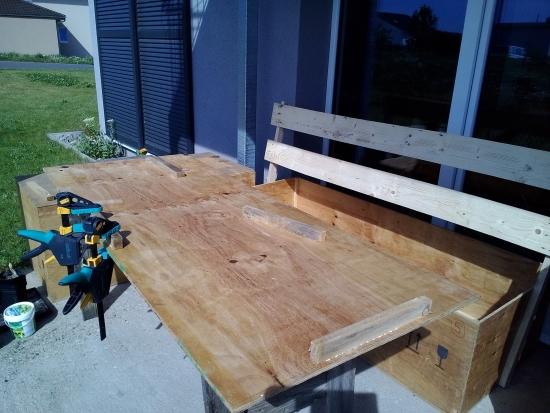
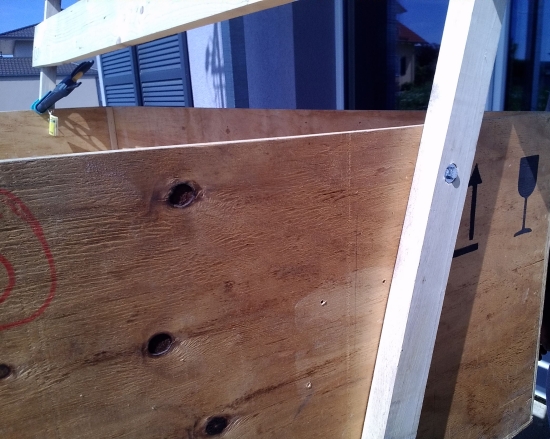
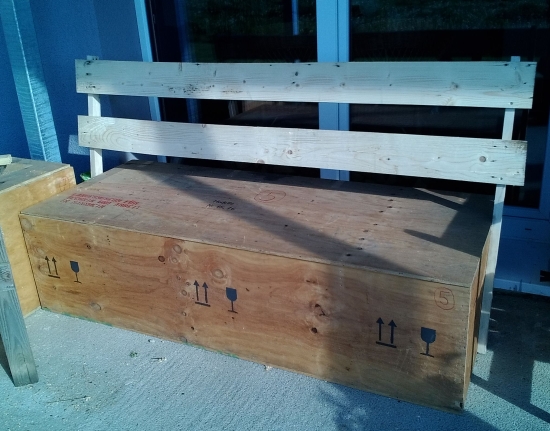
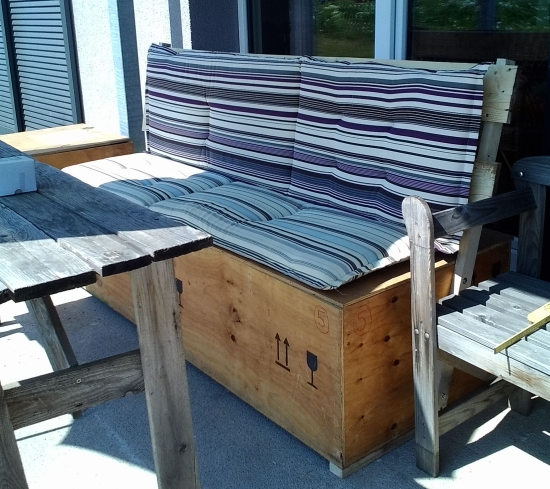
There are many possibilities what can be done with used crates. Offer them to other museums is a great one, for example. Here’s another that is quite comfy: A bench made from a crate originally built for a couple of model ships.

bench2

bench3

bench1

bench

Off the Shelf: Pair o’ Docs

Communication about objects, no matter what they are, is made easier if all parties know exactly what is meant by the names of those objects. I offer to you the following scenario:

flowerThe Extremely Amateur Garden Club is having its annual meeting and plant swap. A group of members is gathered around a robust pot of something green and lacy and hairy covered with deep purple flowers. Mrs. Soapwort exclaims, “Why, I remember those from my grandmother’s garden. That’s a Hairy Purplecup!” Mr. Thymus rubs his jaw and grumbles, “No, no, my brother used to raise those commercially. They’re Lake Lucy Laceleafs, anybody knows that!” “Laceleaves,” mutters his wife, who used to teach English. “Actually, when I was a kid, my mother made tea out of the leaves and called it False Chamomile.” At that point, they all decide to consult Dr. Plantaverde, the University extension agent. “You’re all right,” he says. “Those are all common names for jargonius confusus, or Common Aliasleaf. It probably has other names in other parts of the world, and some of those names could easily refer to more than one plant. However, if you wanted to specify this particular plant anywhere in the world, its two part scientific name would identify it unmistakably.”

The expert was using a type of controlled vocabulary; in this case, the system of binomial nomenclature we all learned about in high school science classes. It allows scientists all over the world, no matter what language they speak, to know exactly what type of plant of animal is meant by jargonius confusus. Let’s go now to our museum. A donor has given us a collection of furniture, bottles and instruments from a doctor’s office. I have no idea what a lot of these things are called. Fortunately, our family doctor is also a long time friend. I call him in to provide proper medical terminology instead of the “chrome-plated thingy with a long wire sticking out of it with a little ball on the end” that is all I know to call it. He brings with him a retired doctor friend who practiced with just the types of instruments that came with this donation. The two have a great time examining the collection. I notice that, sometimes, one of them calls an item by one name and the other calls it something different. Usually they come to some sort of agreement, so I’m reasonably sure that the term I am writing down in the inventory is the equivalent of the scientific name for our potted purplecup.

That’s not the end of it, though. Most museums, in order to facilitate communication about artifacts, make use of their own controlled vocabularies. In the case of museums that collect man made objects, many use a book called Nomenclature1, in which the author has classified artifacts according to the way they are used. There are ten categories, such as Furnishings or Tools and Equipment for Communication, under which are numerous sub-categories such as Bedding and Floor Coverings, or Written Communication Tools & Equipment. If you look under each of these sub-categories, you will find a list of words. These are the names that you are allowed to use for artifacts in this sub-category. In this way, if I call up a museum and ask to borrow a dining chair, they will know not to send me a hall chair. If I ask for a sofa, they will know not to send me something that only has an arm at one end. However, problems arise when the only name you know to call something isn’t in the book. Sometimes you have to find the closest approximation and then put the name you want to use in the description. Now, in the best of all possible worlds, Nomenclature would come with definitions. Since it doesn’t, I often have to resort to a dictionary, or to the Getty’s Art & Architecture Thesaurus2, a wonderful on-line vocabulary that includes definitions. Or, in a pinch, I can rely on my pair o’ docs.

Anne T. Lane

  1. Nomenclature is a controlled vocabulary for the classification of cultural objects invented and first published by Robert G. Chenhall in 1978. Refined ever since it is a standard work for classifying cultural artifacts in U.S. museums. Version 4.0 was published recently:
    Paul Bourcier, Heather Dunn and The Nomenclature Task Force (ed.): Nomenclature 4.0 for Museum Cataloging, Robert G. Chenhall’s System for Classifying Cultural Objects, 4th Edition, Lanham: Rowman & Littlefield Publishers /AASLH 2015
  2. The Getty Vocabularies including the Art & Architecture Thesaurus can be found and used free of charge here: http://www.getty.edu/research/tools/vocabularies/

Unmanaged Collections: Grandmother’s Fixes

Picture by Mimirebelle via pixabayWhen working with an unmanaged collection you are usually confronted with a number of issues that harm your collection: climate conditions, pests, leaking roofs, dripping water pipes, cracks in the wall… While those issues should be top priority on your list of things that need to be fixed professionally it will take some time to get the funding. In the meanwhile your collection suffers every day. That’s the time and the place for something I call ”Grandmother’s Fixes“.

We all know that grandmothers are great at fixing problems, may it be a broken vase, finger or heart. Grandmothers have gained a lot of experience in carrying a family through rough times of scarce resources. The “Grandmother’s Fixes” are about improving things right there and then with your own hands and with stuff that is available and costs little to no money. Of course, you shouldn’t try to fix a broken vase with superglue like your real grandmother would. The grandmother I have in mind is an ideal grandmother, an easy to imagine superhero with the superpowers of common sense and creativity. Very old, very wise and very caring. ”Grandmother“ with a capital ”G“ on her apron, that’s her.

My favorite “Grandmother’s Fix” was done for a collection stored in a huge industrial hall. About 50% of the roof consisted of windows which made it a bright place to work but also very unsuitable for collection storage. A note made with pen on paper faded so much that it was unreadable after only 6 months in this hall! The “Grandmother’s Fix” to that was incredibly simple: the windows were painted over. This was done in just a few days, cost only a few buckets of paint and reduced light levels significantly. The long-term solution was moving the collection to a more suitable storage area a few years later, but the fix reduced stress imposed on the collection immediately.

What was your favorite “Grandmother’s Fix” in collections care?

This post is also available in Russian translated by Helena Tomashevskaya.

What took you so long?

A week in the life of a collections manager

One of the delicate glass slides
I love my job, really. To be responsible that every artifact is at the right place, at the right time when it is needed is a wonderful duty, so is the challenge to keep them safe for future generations. However, there’s one thing that bothers me and I know bothers many colleagues in the field of collections care, may they be collections managers, registrars, curators, conservators, documentalists or data base managers. It’s the question “Why does this take so long?” or “Why isn’t that task finished, yet?” It bothers me so much that I swore to myself if I run into a good example, I’ll write a blog post about it. Well, last week was a very good example.

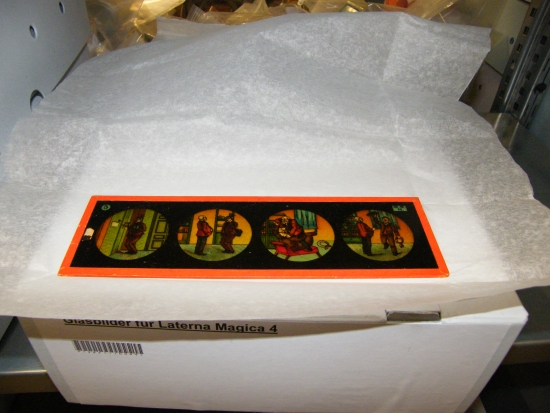
Glass slides wrapped in acid-free tissue
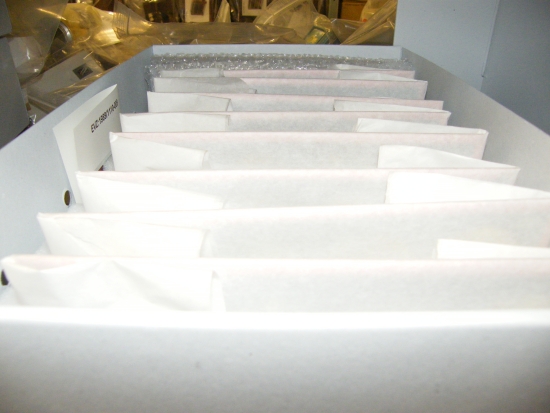
One of the very first things I discovered on this early Monday morning was a very heavy box, roughly the size of a shoebox. Inside were dozens of glass slides like they were used for a ”Laterna Magica“ or magic lantern back in the 19th century. Some were in their original boxes, some piled on one another without any support. Some of the slides already suffered damage because of the poor storage conditions. Repacking them was inevitable. I spent the rest of my Monday doing some research and inventing a better storage for them.

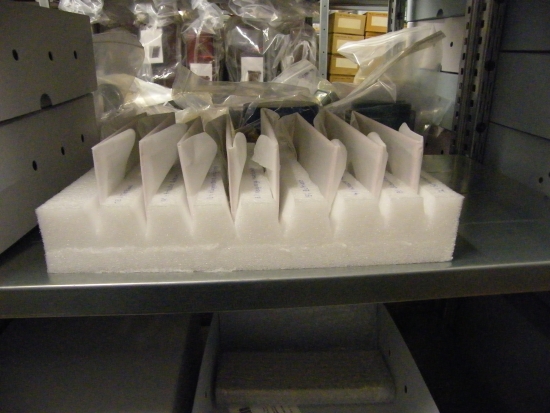
Fitting ethafoam block with cut in supports
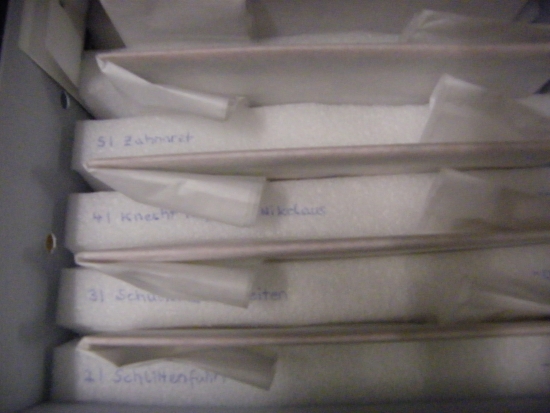
I figured out that wrapping them in acid-free tissue paper was a good start. However, to store them they should have a home where they couldn’t move and get damaged. It should be easy to find the slide one is looking for and take it out without having to touch other slides. I took an ethafoam block, cut it the size of an archival box and cut into it supports for the slides. That way the slides can be carried around safely, can’t slip inside the box and everyone can find a needed slide fast.

Every support has written what slide you'll find inside
Every support has written what slide you’ll find inside
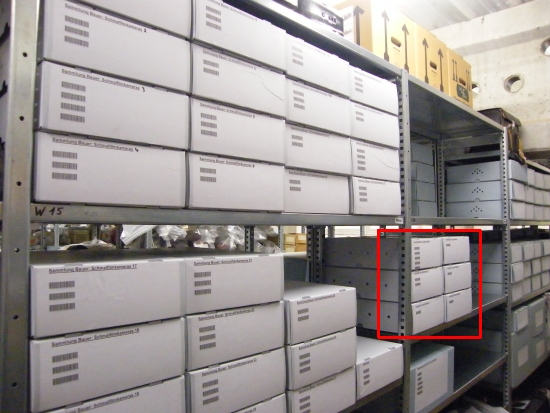
I assigned the task of building boxes for the remaining slides to my student assistant on Tuesday. First of all because I had other things to do and secondly because I’m not a good box builder while she does awesome artifact homes (see ”Storage Solutions: A Home for the Barcode Scanner“). I focused on finding a place for the slides. They should find a home where our collection of photography and camera equipment is stored. But, like many other museums, we have space issues. With the new packaging the slides would need the place of six archival boxes which I didn’t have in this row of shelves. Finally I figured out if I repacked the collection of narrow film cameras into archival boxes so I could stack them I could gain about 3 free shelf boards.

Shelves with repacked narrow film cameras and the six boxes with glass slides (marked red). You can also catch a glimpse of the now empty shelf boards.
Well, it’s not as easy as it sounds. We are changing our location tracking system from pure manual to barcoding. To push the project forward we established the policy that every item we have in hand gets its new object label with barcode. This is especially a good policy because many of our old objects labels have polyvinyl chloride sleeves we want to get rid of.
I got 118 narrow film cameras to repack, so I printed out 118 new object labels, cut them, folded them and assigned them to their respective camera. Of course, every new archival box needed a label so we know what’s inside. They had to be printed, cut and attached as well. Sitting on another shelf means getting a new location entry in the data base – and of course the archival boxes got new distinct identifiers that needed to be in the data base, too.

So, you can easily imagine what I did Tuesday to Friday. Of course I performed some other tasks, too (read Anne T. Lane’s ”Off the Shelf – A Day in the Life of a Collections Manager“ for more) and after the six boxes with glass slides were located I still had two and a half shelf boards of newly created space for the next camera equipment that comes in. But if you don’t look at the bigger picture you could sum my working week up to: I relocated a box of glass slides.

Angela Kipp

Unmanaged Collections: Worst First Impressions

alttext As I announced recently I’m looking for real world examples for my book about managing unmanaged collections. The first chapters will have much to do with the process of getting an overview of what items the collection consists of, defining priorities and developing a strategy to tackle them.

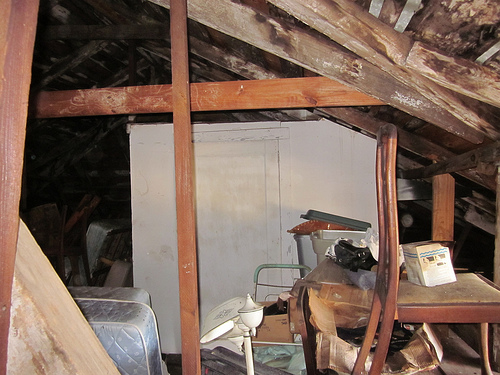
I think maybe the worst moment is the first time you see the collection. It’s the moment you get the first idea of how much work it will be and how many issues you will have to face. What was your worst first impression? I think mine was a collection of vintage cars and agricultural machinery crammed into a shed in a way you could barely walk and sometimes had to crawl over a few things to get deeper into the collection. All the objects were rusty, a considerable amount of windshields were smashed and the fact that this place was inhabited by mice, martens and pigeons was sadly all too obvious. To make matters worse, there were some more delicate objects carelessly crammed in between the bigger objects and I found something that turned out to be a lady’s dress under a plow.

What was your worst first impression when you worked with an unmanaged collection?

Off the shelf – Put a lid on it

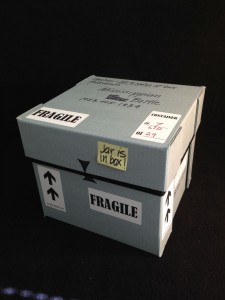
lotus_closedLet’s say you buy a widget that comes in a box. This protective container might have on it colorful pictures of what is inside, instructions for setup and use, and barcodes by which the manufacturer, the shipper and the store keep track of inventory and price. Once the box’s usefulness is over, you flatten it and send it to the recyclers.

Think ahead, say, fifty years. You give the widget that was in the box to a museum. What does the museum do? Put it in a box. This box serves purposes very similar to the original one, and sometimes even has the ubiquitous barcode on it. There are important differences, however, between the original packaging and the new housing. The old box might have served as short-term physical protection to save the widget from damage during shipping and storage, but it was almost certainly made of materials that would have done long-term damage to the poor widget. Acidic paper and cardboard, foam that offgasses harmful chemicals, perhaps plastics that deteriorate and form sticky films that mar the finish. Adhesives that break down and migrate from tapes and seams onto the contents.
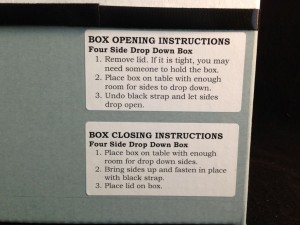
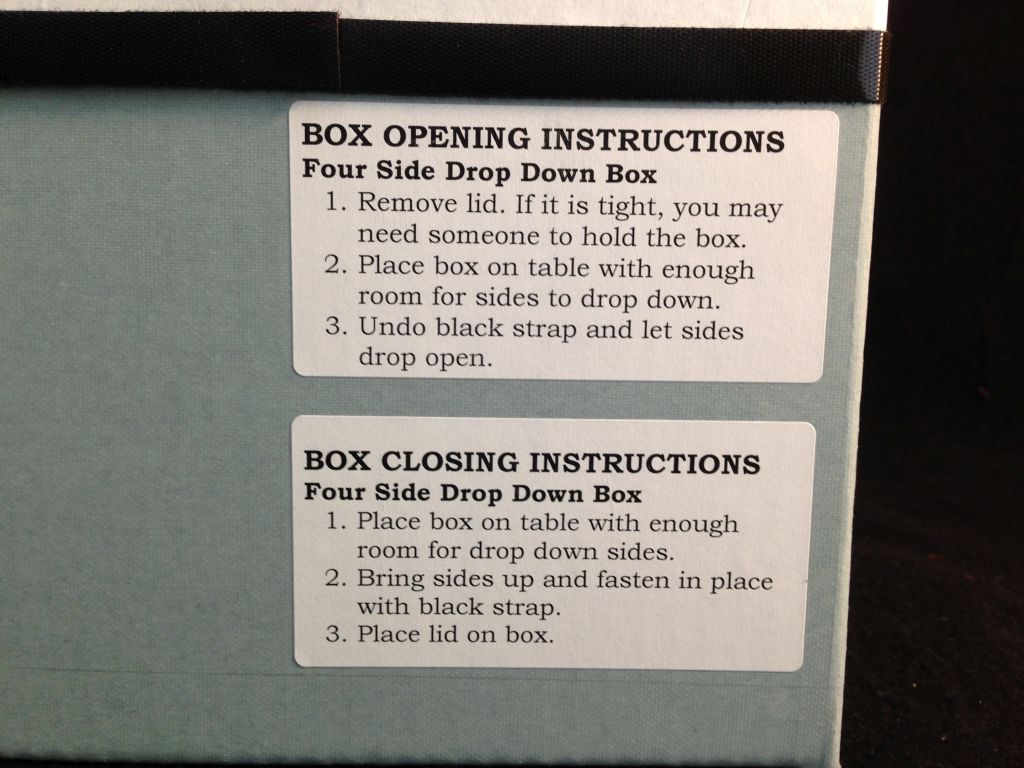
lotus_adviceThe new box is made of specially manufactured acid-free cardboard, buffered against acid migration. It is made without adhesives. Internal trays or supports may be made of inert foams, undyed and unprocessed cotton or polyester fabrics or fibers, or crumpled acid-free tissue paper. The box is labeled with the widget’s number and description, sometimes even a digital photograph of the it so you don’t have to open the box to see what’s inside. If necessary, instructions for opening up the box and taking the widget out safely are included.
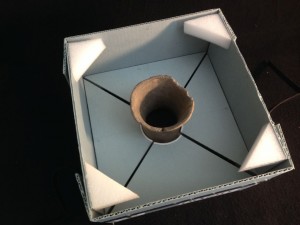
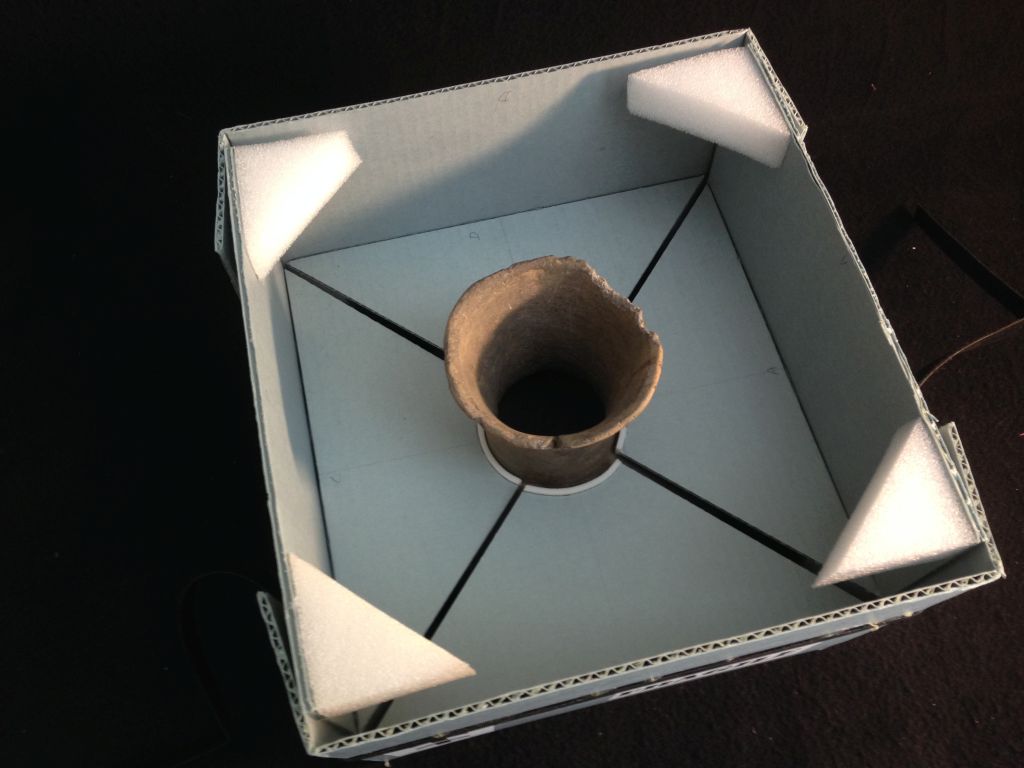
lotus_open1Many objects in the museum’s collection are able simply to sit on shelves or in drawers, and a great many others are put into commercially available acid-free boxes with minimal padding or support. Some items, though, are too fragile, or odd-shaped, to fit in ready-made housing. That’s where the box-maker comes in. I use simple tools – a knife and cutting mat and a glue gun. My arsenal of materials includes acid-free cardboard and card stock, foam in sheets and blocks and rods, archival double-sided tape, muslin and cotton tying tape, as well as the acid-free tissue.
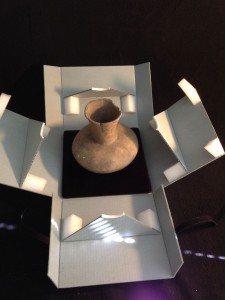
lotus_open2Laying out a box involves measuring the object and figuring out the best way for it to sit, working out how much extra space to include for padding and supports, and figuring out how to get it into and out of the box with the least amount of handling. Sometimes the item is nestled into a cushion of polyester fiberfill, sometimes it is tied to its supports, sometimes it is blocked in with removable foam blocks, complete with numbers and instructions. How do you figure out what to use? Experience, and for me, an ability to imagine myself as the object, able to detect any stresses or weak points that need to be taken care of.

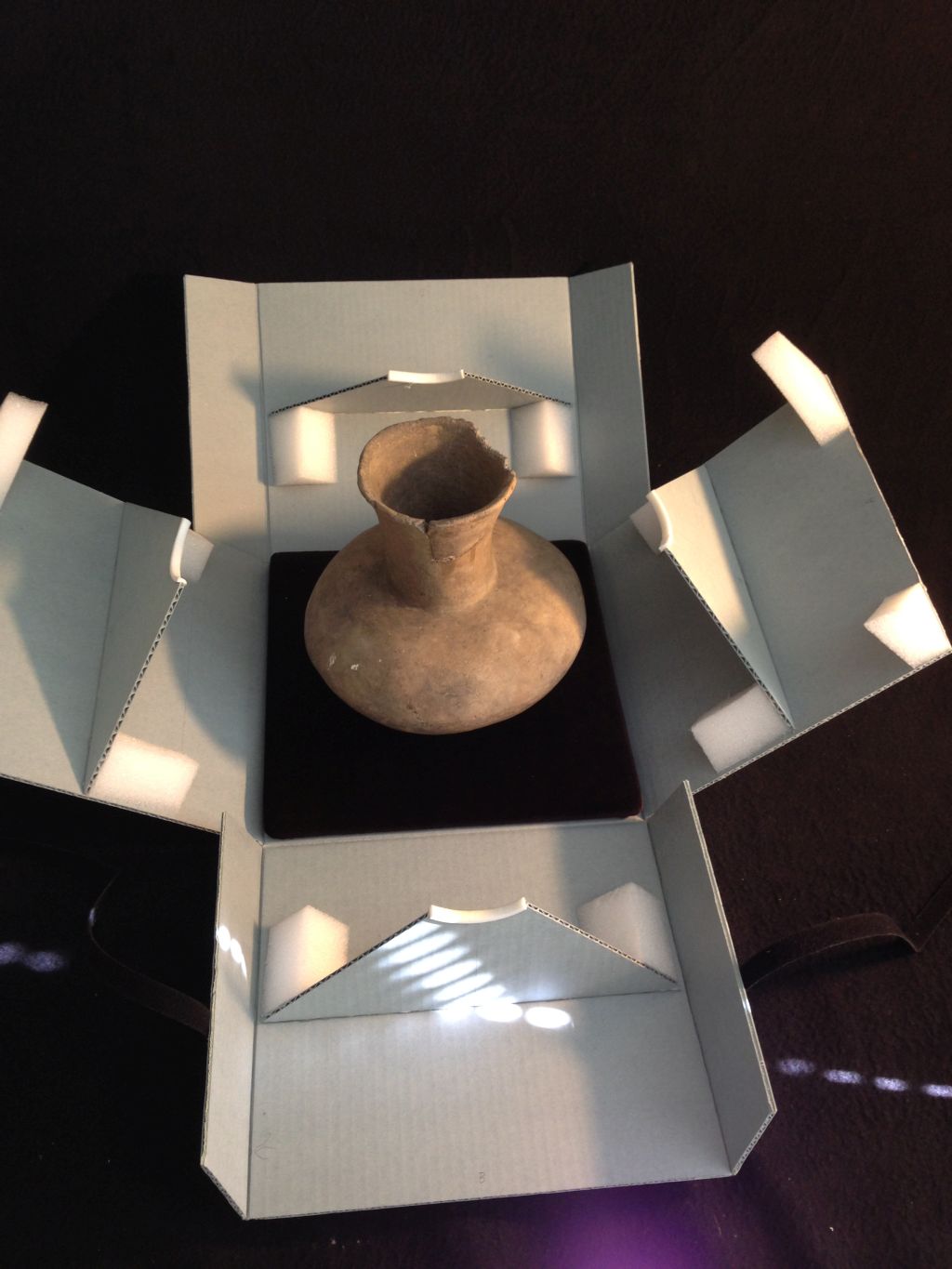
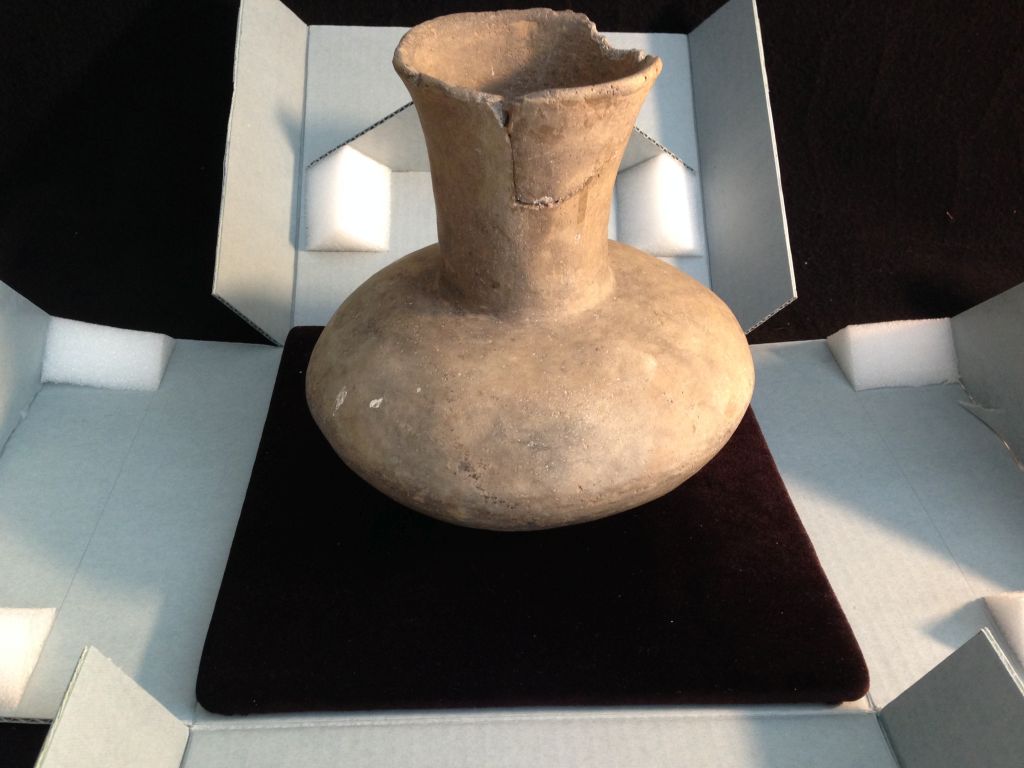
The box illustrated here is of the type known as a lotus box. It has four drop-down sides, allowing the Native American jar to be seen without lifting it out. The lid holds the sides together when the box is closed up. I am currently involved in designing a similar type of box for an artifact belonging to the Levine Museum. It will have a tray and only one drop-down side, with internal foam blocks that will allow two objects to travel safely one inside the other. I have also been asked to teach a box-making workshop this summer for the North Carolina Preservation Consortium.
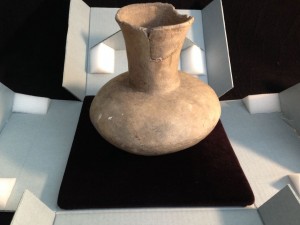
lotus_open3Containers have fascinated me since I was a kid. I always have saved boxes and tins and bottles. I used to sit in geometry class and design tiny fold-up boxes on my graph paper. Graduating to designing housing for museum objects was a very natural progression, and this is still my favorite part of the job of Collections Manager.
There’s a bomb in my collection!

Most assume that working in collections management is relatively harmless. I’d say that’s true most of the time. But then again, there are those days… read the story of Julie Blood, Collections and Exhibit Manager at the San Joaquin County Historical Society & Museum in Lodi, California:

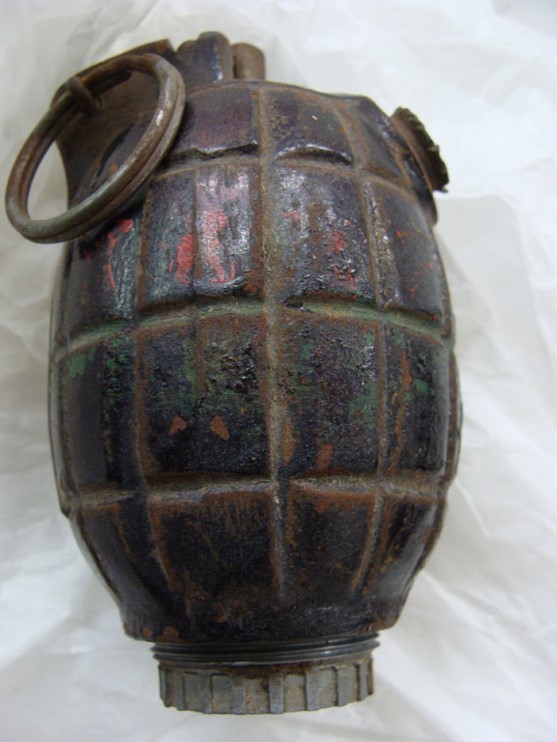
Hand Grenade
Hand Grenade
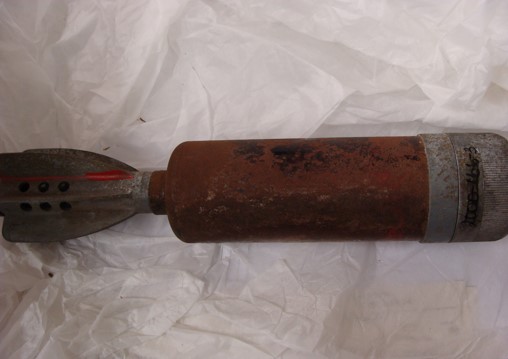
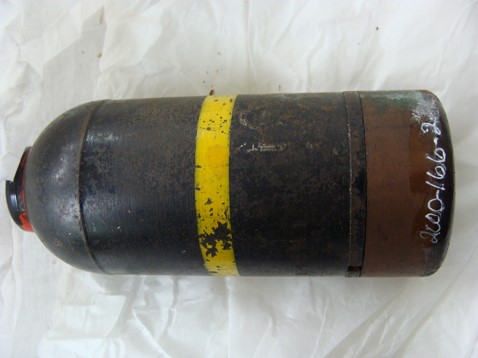
It was back in August 2009. I had been working at the San Joaquin County Historical Society & Museum for about 8 months when a volunteer and I came across a box marked “ammunition”. It was a late Friday afternoon. We opened it up to find World War II era hand grenade (with pin and not secured!), a Japanese mortar round, and a canister that we assume based on the markings on it to be picric acid.

When this collection was first received by the museum in 2000, many of the potential objects were inspected by the San Joaquin County Sheriff’s Department and removed and detonated because they were deemed unsafe. For reasons unknown the current artifacts were either not inspected or deemed to be safe by the Sheriff’s Department. To this day I have no idea how or why these objects made it into the collection.

Japanese Mortar Round
So Monday morning, I contacted the Sheriff’s Department and a deputy came to have a look at them immediately, but apparently, military equipment was not his area of expertise either and I was waiting for him to pull the pin or something, it was kind of scary… Finally he talked to his supervisor and they contacted the local Air Force base. They sent their ordnance team to the museum to pick up the objects, which we immediately deaccessioned.
Canister
Canister

I can tell you that sometimes ignorance is bliss because that was the longest weekend ever for me. I have since used these items as a teaching moment to point out to our docents, volunteers, and student tour groups about the hazards you sometimes find working in a museum. I hope to God that I never find anything like this again, that’s for sure. It gave us a really good scare!

Julie Blood