Museum professional, lover of all collections work, former collections manager of the TECHNOSEUM in Mannheim, Germany. Now Professional Services Specialist for Gallery Systems. Independent museum professional.
Cat wrangler and #SciFi enthusiast.
Views are my own. Of course, they are. I can't make anybody responsible for the garbage my brain produces!
When working with an unmanaged collection you are usually confronted with a number of issues that harm your collection: climate conditions, pests, leaking roofs, dripping water pipes, cracks in the wall… While those issues should be top priority on your list of things that need to be fixed professionally it will take some time to get the funding. In the meanwhile your collection suffers every day. That’s the time and the place for something I call ”Grandmother’s Fixes“.
We all know that grandmothers are great at fixing problems, may it be a broken vase, finger or heart. Grandmothers have gained a lot of experience in carrying a family through rough times of scarce resources. The “Grandmother’s Fixes” are about improving things right there and then with your own hands and with stuff that is available and costs little to no money. Of course, you shouldn’t try to fix a broken vase with superglue like your real grandmother would. The grandmother I have in mind is an ideal grandmother, an easy to imagine superhero with the superpowers of common sense and creativity. Very old, very wise and very caring. ”Grandmother“ with a capital ”G“ on her apron, that’s her.
My favorite “Grandmother’s Fix” was done for a collection stored in a huge industrial hall. About 50% of the roof consisted of windows which made it a bright place to work but also very unsuitable for collection storage. A note made with pen on paper faded so much that it was unreadable after only 6 months in this hall! The “Grandmother’s Fix” to that was incredibly simple: the windows were painted over. This was done in just a few days, cost only a few buckets of paint and reduced light levels significantly. The long-term solution was moving the collection to a more suitable storage area a few years later, but the fix reduced stress imposed on the collection immediately.
What was your favorite “Grandmother’s Fix” in collections care?
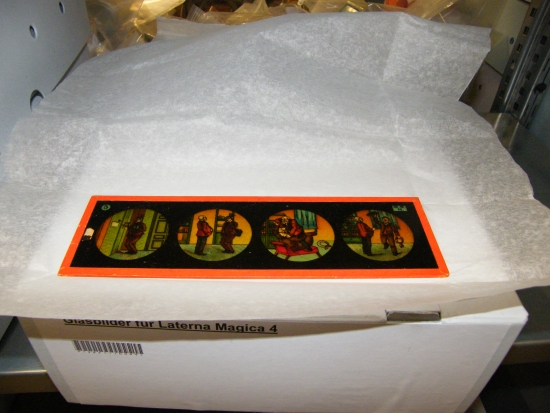
One of the delicate glass slidesI love my job, really. To be responsible that every artifact is at the right place, at the right time when it is needed is a wonderful duty, so is the challenge to keep them safe for future generations. However, there’s one thing that bothers me and I know bothers many colleagues in the field of collections care, may they be collections managers, registrars, curators, conservators, documentalists or data base managers. It’s the question “Why does this take so long?” or “Why isn’t that task finished, yet?” It bothers me so much that I swore to myself if I run into a good example, I’ll write a blog post about it. Well, last week was a very good example.
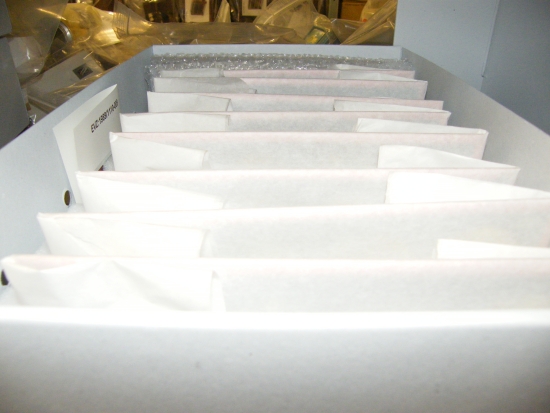
Glass slides wrapped in acid-free tissueOne of the very first things I discovered on this early Monday morning was a very heavy box, roughly the size of a shoebox. Inside were dozens of glass slides like they were used for a ”Laterna Magica“ or magic lantern back in the 19th century. Some were in their original boxes, some piled on one another without any support. Some of the slides already suffered damage because of the poor storage conditions. Repacking them was inevitable. I spent the rest of my Monday doing some research and inventing a better storage for them.
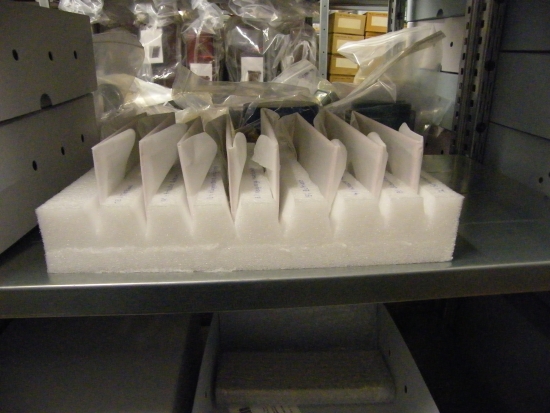
Fitting ethafoam block with cut in supportsI figured out that wrapping them in acid-free tissue paper was a good start. However, to store them they should have a home where they couldn’t move and get damaged. It should be easy to find the slide one is looking for and take it out without having to touch other slides. I took an ethafoam block, cut it the size of an archival box and cut into it supports for the slides. That way the slides can be carried around safely, can’t slip inside the box and everyone can find a needed slide fast.
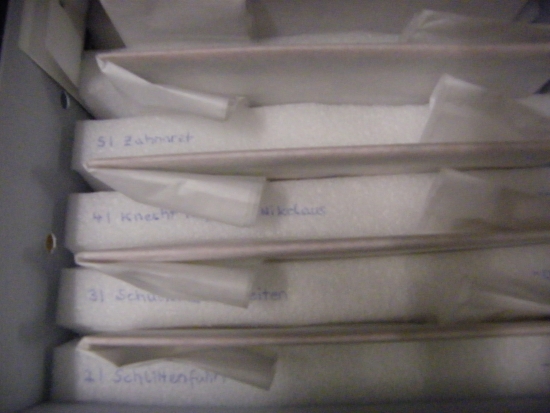
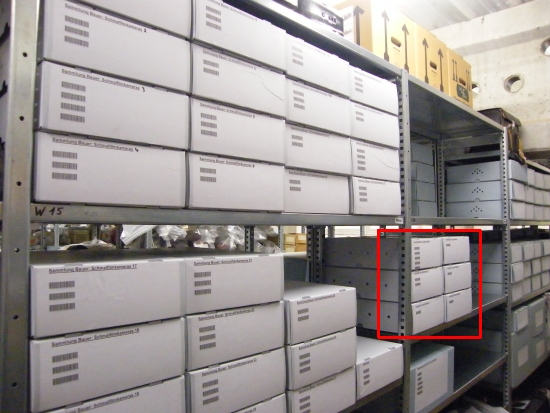
Every support has written what slide you’ll find insideI assigned the task of building boxes for the remaining slides to my student assistant on Tuesday. First of all because I had other things to do and secondly because I’m not a good box builder while she does awesome artifact homes (see ”Storage Solutions: A Home for the Barcode Scanner“). I focused on finding a place for the slides. They should find a home where our collection of photography and camera equipment is stored. But, like many other museums, we have space issues. With the new packaging the slides would need the place of six archival boxes which I didn’t have in this row of shelves. Finally I figured out if I repacked the collection of narrow film cameras into archival boxes so I could stack them I could gain about 3 free shelf boards.
Shelves with repacked narrow film cameras and the six boxes with glass slides (marked red). You can also catch a glimpse of the now empty shelf boards.Well, it’s not as easy as it sounds. We are changing our location tracking system from pure manual to barcoding. To push the project forward we established the policy that every item we have in hand gets its new object label with barcode. This is especially a good policy because many of our old objects labels have polyvinyl chloride sleeves we want to get rid of.
I got 118 narrow film cameras to repack, so I printed out 118 new object labels, cut them, folded them and assigned them to their respective camera. Of course, every new archival box needed a label so we know what’s inside. They had to be printed, cut and attached as well. Sitting on another shelf means getting a new location entry in the data base – and of course the archival boxes got new distinct identifiers that needed to be in the data base, too.
So, you can easily imagine what I did Tuesday to Friday. Of course I performed some other tasks, too (read Anne T. Lane’s ”Off the Shelf – A Day in the Life of a Collections Manager“ for more) and after the six boxes with glass slides were located I still had two and a half shelf boards of newly created space for the next camera equipment that comes in. But if you don’t look at the bigger picture you could sum my working week up to: I relocated a box of glass slides.
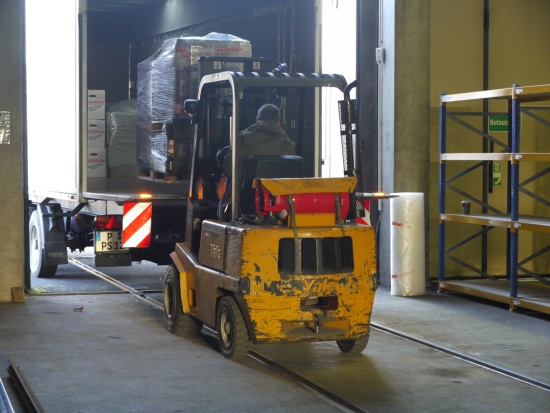
The forklift is indispensible in our storage facility. TECHNOSEUM, picture Bernd KießlingAdmittedly, when colleagues from art museums take in collections, you could go green with envy. Rembrandt, Goya, Cranach… While our AEG K2 Magnetophon is rarer than a Blue Mauritius, there aren’t many people who get really excited about it. And whether the Mona Lisa or our “Eschenau” steam locomotive brings a gleam to more children’s eyes is debatable. Technology fans must confess, though, that the names of technical devices are often short on glamour.
From Berlin to Mannheim
The delivery of the objects from the Deutsche Rundfunk (German Broadcasting) archives has made up for some of that. In recent weeks, we unloaded about 1,500 devices from the former German Broadcasting Museum from various trucks and moved them to our collections storage facility. Of course we had to confirm that everything that came from Berlin had safely made it to Mannheim. During the verification process, we suddenly felt a little like our colleagues at the art museums—or maybe more like tour operators and recording officials.
A Rembrandt of Our Own
Our colleagues in the storage facility know exactly where each television is located 1 TECHNOSEUM, picture Bernd Kießling.Sachsenwerk and Rafena in Radeberg gave their television sets artistic names such as Rembrandt, Dürer, and Cranach. Philips, on the other hand, stuck with cryptic designations like “23TD321A,” but their nicknames read like a “Who’s Who?” of art history: Raffael, Leonardo, Michelangelo, Tizian, Bellini, Goya, and another Rembrandt, though this one from 1962. Blaupunkt imagined itself in southern vacation paradises, with names like “Toskana” (Tuscany) and “Sevilla” (Seville). Graetz went all noble with “Landgraf” (Landgrave) and “Markgraf” (Margrave). Nordmende sent a “Diplomat” into the field, Philips a “Mediator,” and the marketing team at Loewe even decided on an “Optimat.” VEB Fernsehgerätewerke Staßfurt (Stassfurt Television Works) struck out on a different path, where Ines, Marion, and Sibylle provide good sound and picture quality. And if they don’t, who could seriously hold it against an appliance with such a pretty name?
Those of us in the Collections Department cannot allow ourselves to be taken in by the fancy names, however. In the upcoming months, our task will be to examine, sort, and register the collection. Then we’ll have to pack the objects in such a way manner that they come to no harm for the next few decades yet are still available at any time: the “Zauberspiegel” (Magic Mirror) as well as the “Bildmeister” (Image Master), “Lady,” and her “Kornett” (Cornet)—and a “Rembrandt” or two, of course.
Angela Kipp
Translated from German into English by Cindy Opitz.
Disclaimer: Neither I nor the other colleagues are responsible for the stacking of up to three TV sets, the paletts arrived that way. We put it in order immediately. ↩
As I announced recently I’m looking for real world examples for my book about managing unmanaged collections. The first chapters will have much to do with the process of getting an overview of what items the collection consists of, defining priorities and developing a strategy to tackle them.
I think maybe the worst moment is the first time you see the collection. It’s the moment you get the first idea of how much work it will be and how many issues you will have to face. What was your worst first impression? I think mine was a collection of vintage cars and agricultural machinery crammed into a shed in a way you could barely walk and sometimes had to crawl over a few things to get deeper into the collection. All the objects were rusty, a considerable amount of windshields were smashed and the fact that this place was inhabited by mice, martens and pigeons was sadly all too obvious. To make matters worse, there were some more delicate objects carelessly crammed in between the bigger objects and I found something that turned out to be a lady’s dress under a plow.
What was your worst first impression when you worked with an unmanaged collection?
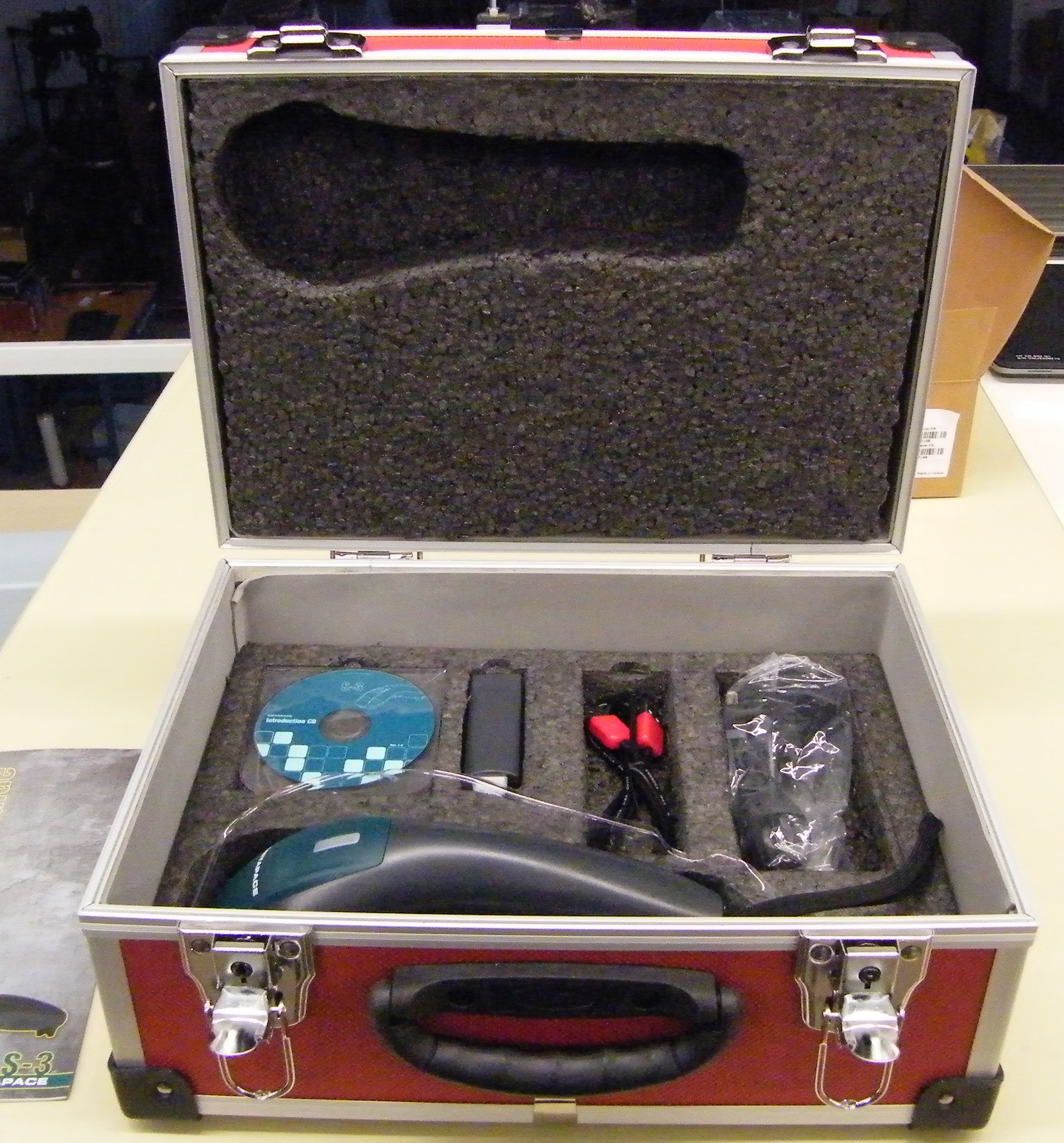
Motivated by the experiences of Sheila Perry (See “If it moves, barcode it“) we are at the moment in the process of implementing barcoding in our collections management at the TECHNOSEUM. We need the scanners portable and protected from all the dangers the storage of a science museum hold. We bought standard aluminium cases in red, so we can easily spot them in the storage (the color already proved useful for clipboards and cutters). Then I handed the task to think of a good protection for scanner and accessoires to my student assistant, Linda. Here is the first beauty she created:
The material is a black polypropylene foam we use for creating mounts in exhibitions. Can you see she even carved little fingerholes so one can remove all the acccesoires like the USB stick easily? Definitely the best housed tool we have at the moment! Now, Linda entered serial production as we have some more scanners…
For the last three years we’ve seen a growing number of faithful readers who not only read, but also contribute by sharing the articles, writing comments and sparking conversation with their peers. Some even wrote stories and articles for this blog. That’s great!
Today, I want to share with you a new project I’m working on and I ask you to join.
In my working life I’ve stumbled upon one conundrum of our profession time and again: there are really great books and online resources about best practice in collections management – the wonderful 5th Edition of Museum Registration Methods readily comes to mind, but of course there are much more. You read what is best for the artifacts, how to treat them, document them, store them… These books are written from the perspective of ”best practices“ and as we all strive to reach the best for our collections, that’s a good thing. Only that the starting position is often all but ”best practice“. Take Antony Aristovoulou ‘s story ”Match-ball for the Registrar“ as a prime example: being contracted for relocating and registering a collection of tennis artifacts and discover that all is stored in one giant shipping container and you have to start from scratch, including sourcing locations and material.
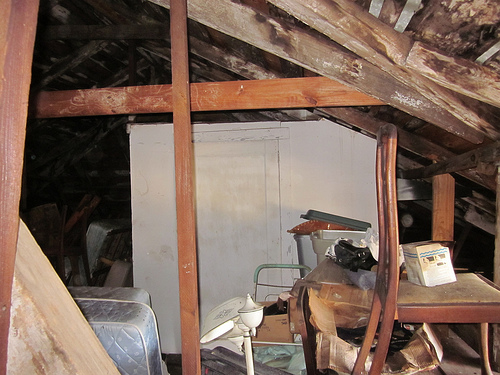
All too often, especially for small and middle sized museums with historical, agricultural and/or science and technology collections there is a gap between what is written in books and the real world. Reading about best practices is great and necessary, but standing in an old shed with a leaking roof and heaps of rusty things that were euphemistically called an agricultural collection in your contract you are miles away from taking your acid-free cardboard and start building a custom box for a single artifact.
To make a long story short: I’m about to write a practical guide to manage previously unmanaged collections. This book will be written with the worst case scenario in mind, starting with nothing than a collection in peril and working step-by-step towards improving the situation 1. It will be written for the practitioner in the field who has to deal with all possible and impossible circumstances while trying to get her/his collection managed. Especially it will be written for people who are thrown into this situation without having it done before – may it be job starters or colleagues who have only worked in larger and/or well organized institutions so far.
This is where you, the readers, come in. This book will be much better and encouraging with real world examples. Sure, everyone loves to be the best practice example but what I’ll need here are examples of how difficulties were tackled and how issues were resolved. How collections that were in peril were brought to a better stage. Maybe still far away from being ”best practice“ but still much better than before. I’m collecting all kinds of worst case examples, brought in from veteran museum professionals young and old who have encountered unbelievable situations in collections management (I’ve seen a main sewage pipe right above the shelves of an archive, so, the possibilities are endless…).
Every now and then I will present you some aspects I’m writing about here on this blog and will ask for your experiences and thoughts. It would be great if you would be willing to share them. I promise that I won’t abuse your willingness to share and will always check if the way I want to use some of those examples in the book is acceptable for the original author and her/his institution.
Janice Klein and I have written a short article about ”Tackling Uncatalogued Collections“ in the March/April 2015 edition of the ”museum“ magazine of the American Alliance of Museums (p. 59-63), here you will find some additional ideas and the general direction of this project, although being uncatalogued is just one of the issues of an unmanaged collection. ↩
Over 3 years ago, the Southeastern Registrars Association (SERA), decided to update their book, Basic Condition Reporting: A Handbook. The third edition had been published in 1998 and had not been updated since. The goal of the book has always been to create a common framework for professionals when conducting condition reports. It is intended to be a reference tool for experienced collections professionals and a training tool for those new to the field.
Over time, the popularity of the book had grown. SERA started getting an increasing number of orders both within the country and overseas. This meant that the SERA Treasurer had to carry a bunch of books to the post office on a weekly or bi-weekly basis. This made the treasurer’s position one that volunteers often wanted to avoid.
When we began looking at the fourth edition of Basic Condition Reporting the board started looking at the book from a new perspective. Could we get a publishing partner? How much work would that be? Would we lose money? We decided to find out but first we needed a book.
Our first step was to contact all of the authors from the previous edition and see if they wanted to update their chapters. Less than half wanted to take on the project so the search for new authors began. This was easy at first, but as we got closer to contacting publishers we had a number of authors or editors drop out of the project. That meant that we were back to square one and we had to recruit more authors. At times it felt like herding cats!
We gave the authors the choice of either completely re-writing the chapter or updating the existing chapter and giving the previous author credit as a co-author. We also asked the authors to update the chapters by adding photographs and giving the book a whole new look. After two and a half years, we finally had something to take to publishers to see if we could find a publishing partner.
No, we didn’t have every chapter in hand but we felt that we soon would. We approached Rowman & Littlefield, the company that owns Alta Mira Press, to see if they would be interested. Within two days we had a publishing partner.
That was when we had to get serious about getting the remaining chapters turned in for editing. The process of emailing and calling people began and then disaster struck! One of our authors disappeared! We couldn’t reach them by phone or email and we had to have a chapter. We reached out once again to the previous authors and asked if we could reprint the chapter. We were saved! They agreed and the project could move forward.
After three years of managing this project, I am happy to announce that Basic Condition Reporting: A Handbook, Fourth Edition will be available on February 27, 2015. The new edition has over 70 new illustrations depicting different types of damage and sample condition report forms for many different material types. It also features updated and expanded chapters on a variety of material types including: archaeological artifacts, basketry, ceramics, glass, ethnographic artifacts, furniture, metals, natural history specimens, paintings, paper, photographs, sculpture, skins and leather, and textiles. The book also features a new chapter on condition reporting for loans. We hope you will find the book as useful as we do!
Deborah Rose Van Horn is the registrar at the Kentucky Historical Society and together with Heather Culligan and Corinne Midgett editor of the fourth edition of “Basic Condition Reporting: A Handbook”.
by Judith Haemmerle, Executive Director
Digital Game Museum, Santa Clara, California
In our startup video game museum, everything is done by volunteers on a ridiculously limited budget. So it’s always a balance between collections care and – well, everything else. My biggest anxiety last year was light damage.
We removed half the fluorescent bulbs in the collections area and covered the remaining ones with UV shields; not too expensive, and it was work that was easy to get done. But the big expanse of glass in the room where we install our exhibits remained unprotected. No one was willing to tackle the exacting job of applying UV film, and having it done was far too costly, especially in a facility we were renting short term. We put in a display of items of interest but easily replaceable, and I worried about light. Then one day, our past stepped in to help.
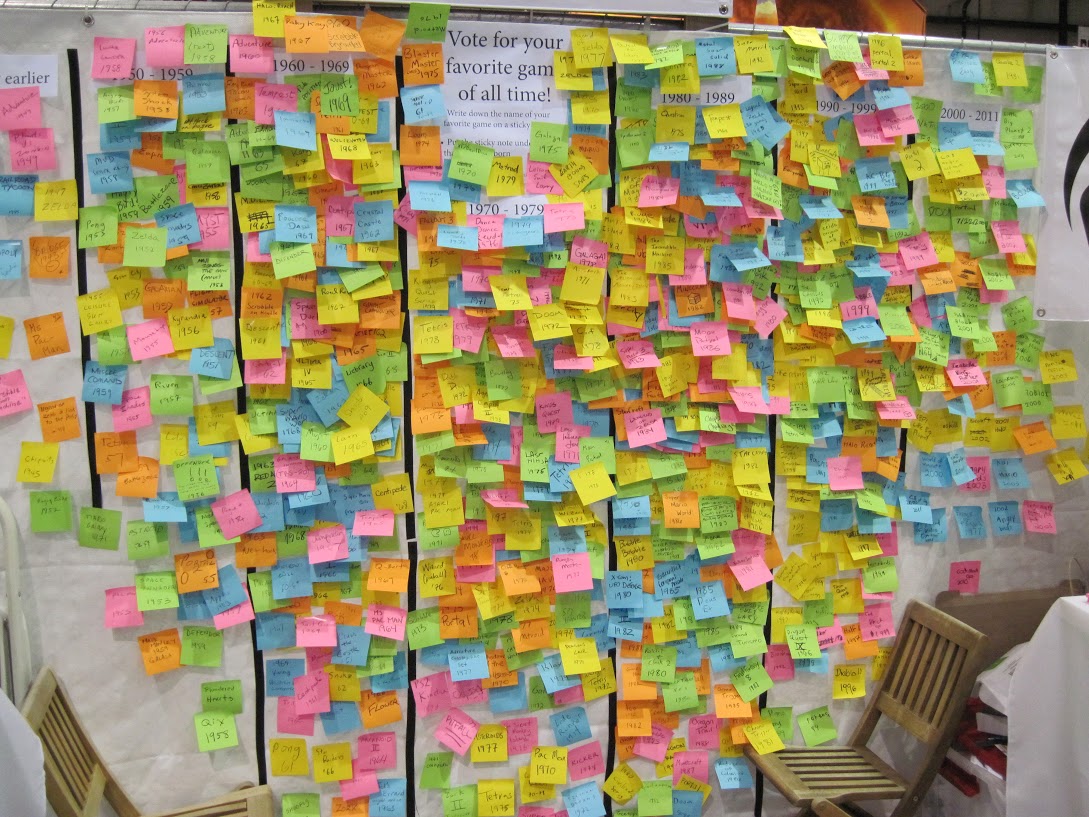
The first public event we did involved a 10’x10′ space that would be difficult to tempt visitors into, so we stopped every passerby we could and had them write the name of their favorite video game on a colored Post-it note, plus the year they were born in. This was, of course, completely for fun and not real research, but there were some interesting things we found nonetheless. 1 We put the notes on the back wall grouped by decade, and it proved to be eye catching display. And we added hundreds of people to our new mailing list, so it was a very effective strategy.
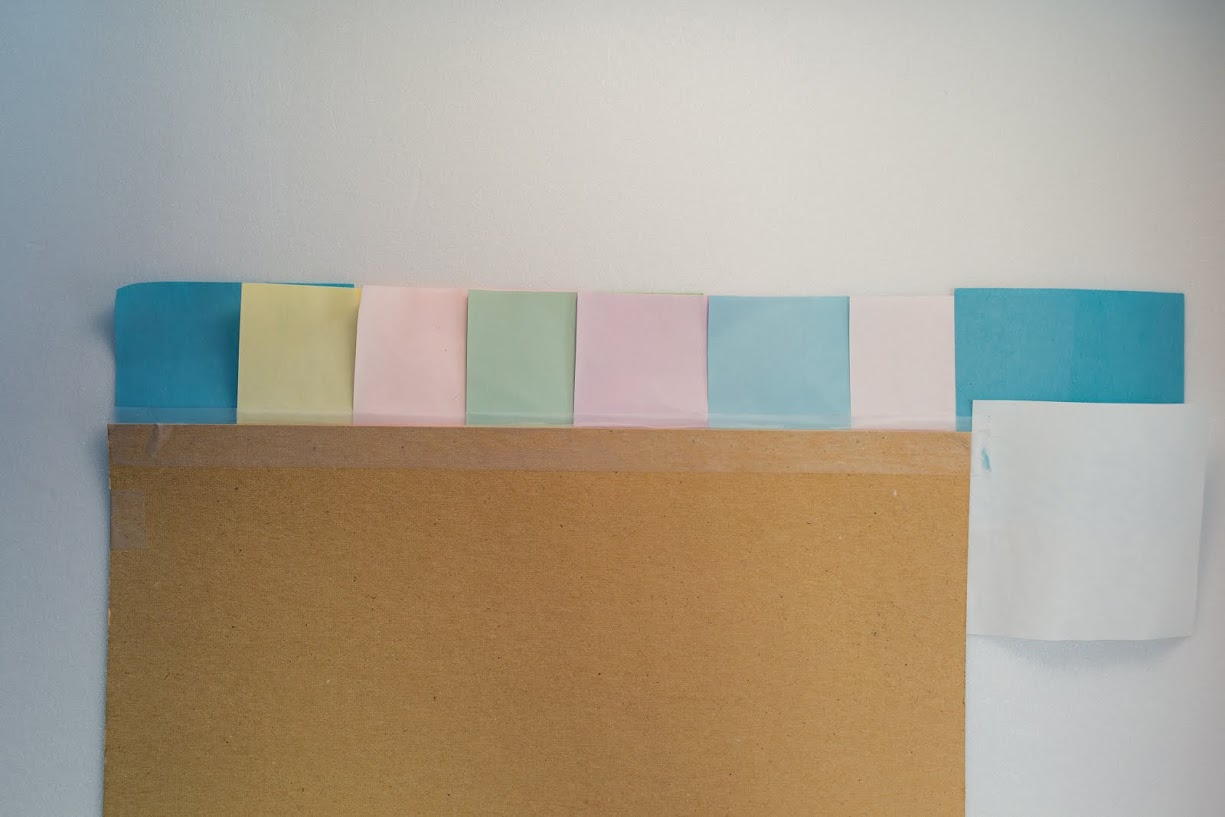
The Post-it wall, photo by Brian Quan
There were piles of leftover Post-it notes; we bought a lot of them to get a good selection of colors. And one day, while worrying about light, I took a sheet of cardboard from the back of a pad of notebook paper and lined up the different colored Post-its so that they would be half behind the cardboard and half exposed. I also overlapped them for no particular reason. And then I hung it in the window.
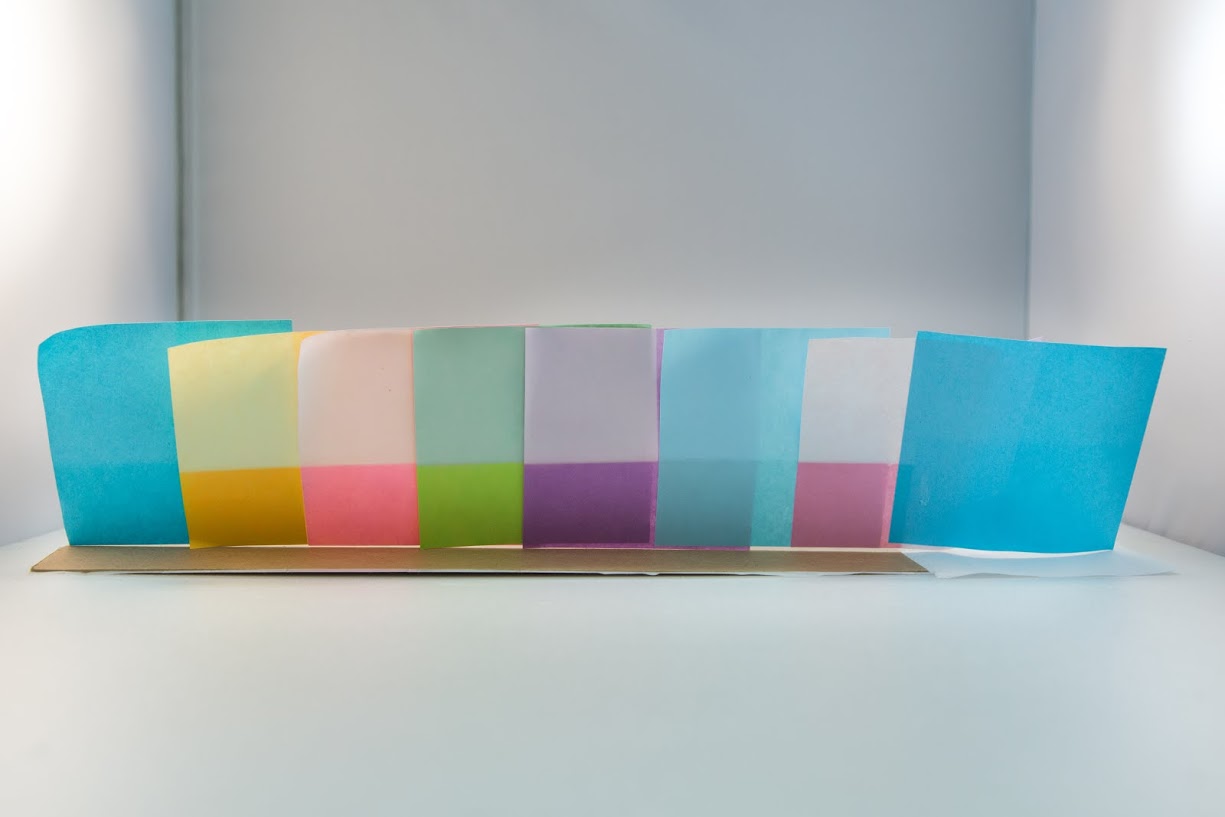
Months went by. I don’t know how many, because I forgot to date it. I’d guess six or eight. We finally bought shielding, even though no one wanted to install it, and I took down the Post-it note color fade tester and asked our photographer to take some pictures of it. The photos that follow show the before and afters.
Post-its from the outside, photo by Brian Quan
The photo above is what it looked like from the outside of the window when I took it down. The photo below is what it looked like when we flipped back the notes to compare the part protected by the cardboard with the part in the sun.
Faded Post-its, photo by Brian Quan
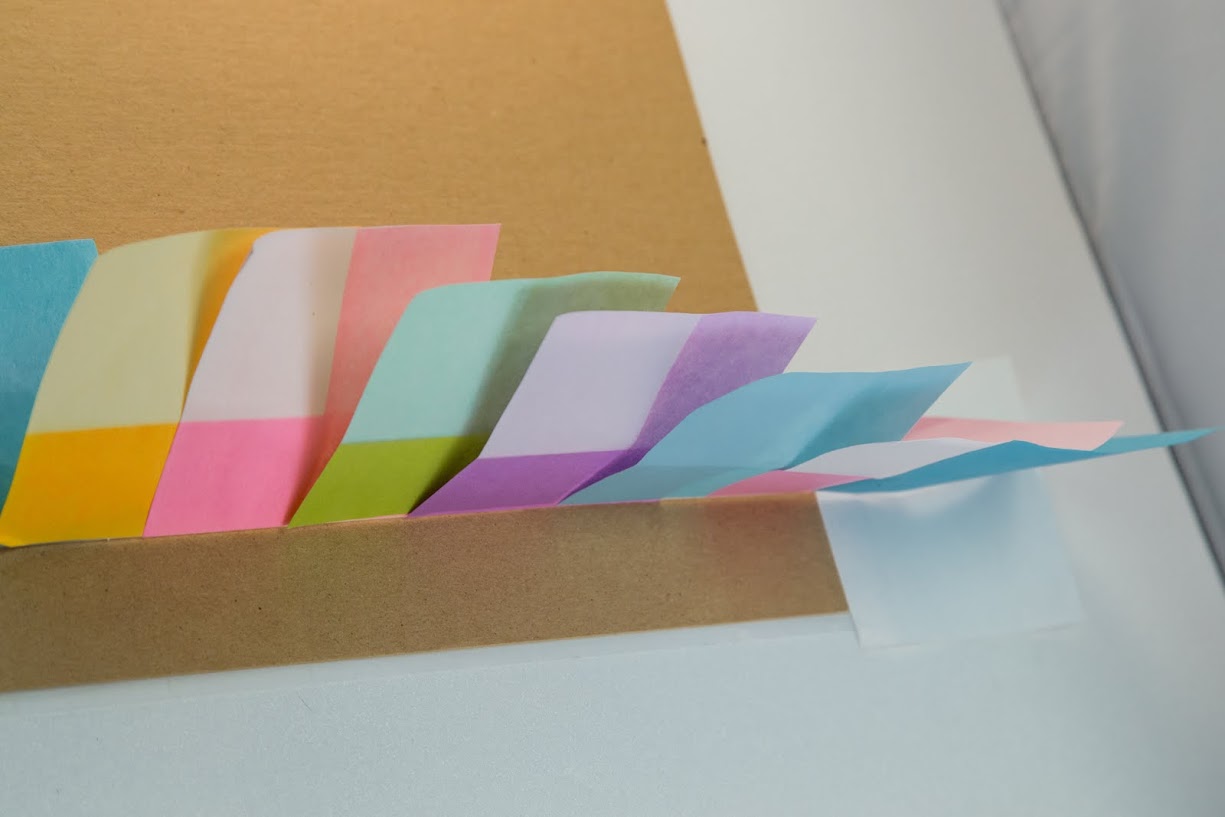
The contrast between the original colors and the part exposed to sunlight is striking, and this is the back of the notes; the fading went right through to the back. The different colors that overlapped even reacted together, so that the orange lying on the blue not only faded to yellow, it also picked up a greenish tinge from the blue. Some of the pink and fuchsia are faded almost to white; those were two different colors when we started: a plain pink and a bright fuchsia.
Overlapping Post-its, photo by Brian Quan
I showed it to the volunteers, and the window shielding went up quickly! We keep the Post-it fade tester in the museum and show it to visitors when explaining the importance of conservation and collections care. Sometimes, the simplest materials can solve your biggest problems.
First, the game chosen by the oldest (over 60) and the youngest (5) participants was the same game – Angry Birds! Second, the decade of people born in the 1960s chose a lot of arcade games. There weren’t any before then, and they fell off sharply after 1970. For those of you who like raw data, it’s available here. ↩
This is a special Tuesday. Today, we celebrate the retirement of my former professor Hans Wilderotter and this means that an era comes to an end. Now, I could take a nostalgic review because back in 1998 when I took museum studies this degree program was rather young, at least in Western Germany, the first graduates had just left the University of Applied Sciences “Fachhochschule für Technik und Wirtschaft” in Berlin. Many things were still in progress and it would be easy to glorify the good old days as a student, which would have presumably as little to do with reality as all the other good old school, post-war or any other days.
But there are things I took away from my studies, far from the professional aspects. Facts are just a small part of the taught contents, no matter if it’s a school, university or workplace. A more significant impact has the personality of the one who teaches on those who are learning. Said in a minor modification of Karl Valentin’s 1 remark: “Teaching people is useless, they will imitate you, anyway.” In spite of yourself you adopt certain quirks and idioms, adopt a certain way of seeing things or ways of solving problems. And if one of those adopted strategies lead to success, you are tempted to credit this to your own cleverness and experience. But if you are really honest and listen closely you hear the voice of a mentor. For some it is a Smith or a Miller, for me it’s an Einholz or a Wilderotter.
What they say in detail, I won’t reveal here. But I want to say “Thank You!” at this point. First of all of course to Professor Sibylle Einholz, who went into a well-deserved retirement last year, and to Professor Wilderotter. But also to all those around the world who took up the responsibility to teach people and who are passionately committed to it. That’s not only professors. There are teachers, trainers, masters or simply colleagues who pass on their knowledge and know-how. What separates you from the rest is the enthusiasm and passion for your profession as well as for the mentoring of others. How great your impact is will be realized by your students and mentorees much later – and it is likely that you’ll never know.
I wish to those who fill the shoes of my professors in the museum studies program in Berlin the same enthusiasm and courage, the same energy and eagerness to experiment but also the mental balance and endurance of their predecessors.
And of course, I wish all who have the possibility to take part in tonight’s celebration a great party and much fun!
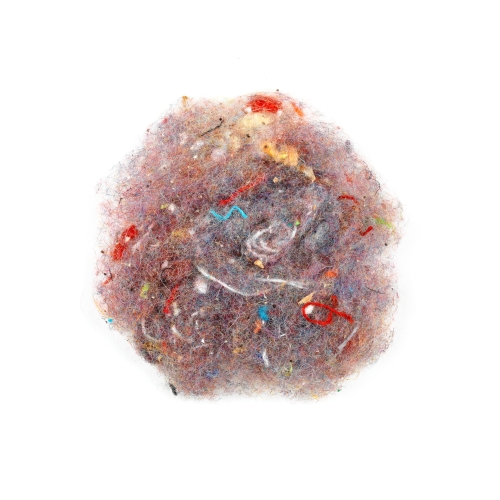
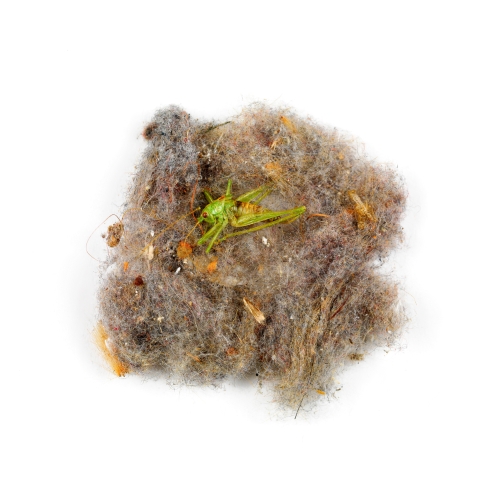
Dust from a museum of natural history (c) Klaus PichlerDay in, day out collections staff is fighting against dust. We wrap artwork, dinosaurs, cars and coffee makers, sometimes we even put old cardboard boxes into new archival boxes. We do everything to keep our arch enemy, the mighty dust, away from our artifacts. And while we brush, wipe and vacuum I bet it never occurred to one of us that this evildoer could have an aesthetic aspect.
But photographer Klaus Pichler, whom we already know from his series “Skeletons in the Closet”, has now captured this aesthetic aspect of dust. Fascinated by the difference between the dust from a natural history museum and a fashion shop I asked him how he got the idea:
Klaus Pichler:
“The idea for this project came by coincidence: I moved from my old apartment and while I was clearing the space I realized the dust in the living room was red and the one in the bedroom was blue. This astonished me and I couldn’t get it out of my mind, so I decided to look into it and to study dust systematically, especially the notorious “dust bunnies”, agglomerations of dust. Right from the start it was my plan to create an archive of dust that should contain dust from a wide range of areas from our society and that all dust samples should be photographed. To decide on which places to collect dust I took the model of the basic living needs (reside, work, recreation, traffic,…) and used it to decide roughly the weighting of the places that should be included in this project. And then the time had come: I went dust hunting!
Dust from a fashion shop (c) Klaus PichlerI guess you can imagine the reactions I got when I (without advanced notification, I like to add!) showed up in different shops, apartments, museums, schools, restaurants, etc. I was interested in and asked them permission to search for dust. Especially, as I didn’t go much into detail why I was doing this, but as soon as I got the permission began crawling on all fours, searching for dust bunnies. For many people confronted with my wish it was surely one of the stranger requests in their professional life…
The dust samples I discovered (I tried to collect different samples in every room but always kept only one) went to my dust archive. I cataloged them with consistent categories (date, place, address, description, catalog number) and archived them in numbered petri dishes. Every time I had 25 new samples I made a photo session where I photographed them all at the same conditions with a high-resolution macro camera. The results of my activities as a collector can be found in the book “Dust” that is out now.”
What is it that fascinates you about dust which is for most of us – especially registrars – only an annoyance?
Klaus Pichler: Dust from an art museum (c) Klaus Pichler“When I started this project I expected that there would be a certain range of dust but by the best stretch of my imagination I didn’t anticipate what I discovered then: every dust was different and not a bit of the monochrome dust I expected. Quite the contrary, the different dust bunnies often had a rich coloring, some in one primary color, some mixed in color, some harmonic, some dissonant in terms of color. This was matched by the irritating variety of ingredients – from fibers and hairs to parts that pointed to the purpose of the room the dust was formed in. Pieces of popcorn in cinema dust, dead insects in the dust from the entomology department of the natural history museum, breadcrumbs in the dust from the bakery. Sometimes it’s nearly possible to decide where the dust comes from by looking at the ingredients and the color of the dust, because every room produces an unique kind of dust due to it’s design and purpose. For me all of this was extremely fascinating.
That’s why I’d like to give you this little piece of advice: Next time you are sweeping dust, take a moment and a strong flashlight, guide the beam to the dust bunnies and dive into the fascinating world of dust.”
Thank you for the opportunity to see our dust with different eyes!
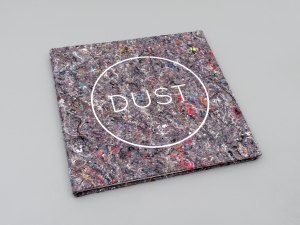
The book “Dust”:
Hardcover wrapped with 2mm textile and flocked ‘Dust’ logo, handmade, 30x30cm (open: 30x60cm), 102 pages (4 pages transparent paper, 98 pages uncoated paper), 45 images. Including a folded poster, 50x70cm, printed on uncoated paper.
First edition, 2015. Limited to 450 hand numbered and signed copies.
Can be ordered via the author’s website: http://kpic.at/images/4497
A project to break down language barriers and connect registrars worldwide
 When working with an unmanaged collection you are usually confronted with a number of issues that harm your collection: climate conditions, pests, leaking roofs, dripping water pipes, cracks in the wall… While those issues should be top priority on your list of things that need to be fixed professionally it will take some time to get the funding. In the meanwhile your collection suffers every day. That’s the time and the place for something I call ”Grandmother’s Fixes“.