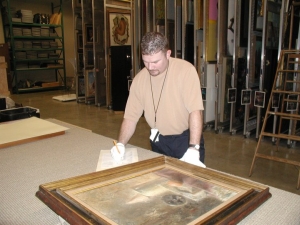
Well Trekkers it is great to write to you once again after seeing the world premier of Art and Craft at the Tribeca Film Festival! The film is great and is going to make history with this whole Landis deal. As I said in the film ‘he messed with the wrong registrar’! Cool thing is gang, Art and Craft will hit the big screen in theaters in the USA late fall, early summer, then the DVD and eventually will be televised. Really neat stuff and I was the registrar to make this all happen.
But why me and how did I get here?
After being encouraged from a young age by my high school art teacher, Barb Sailor, I worked hard at art all my life and went to college to study the arts. My concentration was in printmaking and stone lithography was my gig. I began my career as an unknowing intern at the Kennedy Museum of Art at Ohio University where I was working on obtaining my Master of Fine Arts degree. Eventually I was hired on at the Kennedy as curator, registrar and preparator. You can say I jumped in head first into what turned out to be an over fifteen year career in the fine art museum field. I met my wife Jen in 1996 and was married in 1997. 17 years wedded bliss this month! I graduated OU in 1998 and took off with my new wife to become the registrar at the Oklahoma City Museum of Art. There I was challenged to move their entire collection from the old fairgrounds building to the new facility which is now downtown. Carolyn Hill was the director at that time, sadly she is no longer with us. Carolyn use to tell me that I was the heartbeat of the museum; she even did so to donors and trustees about me. Pretty big shoes to fill! Eventually I was made Curatorial Department Head overseeing registration, the curators, film and education. I was a whiz at making budgets and keeping them in the black and eventually I was responsible for well over 150 exhibitions during my career.
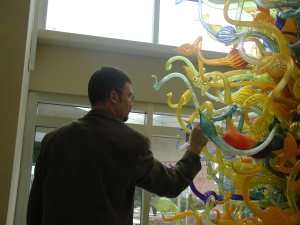
Eight years in Oklahoma City, we decided to move back to Ohio where the end was coming for my career as a registrar, but I did not know it at the time. The Cincinnati Art Museum hired me on as Chief Registrar and I oversaw three fellow registrars that I miss… three good people with much experience. My position, believe it or not, was ‘eliminated’. The reasons I was told I was let go were all bogus and I finally burned my copy of the letter. I believe it was due to financial issues as I was making a seriously big salary for a registrar with full benefits. I think a big contributor however was my link to finding and tracking Mark Landis. A few weeks before I was let go, I was told not to talk about Landis on museum time. So I did not. No phone calls or emails. But you all knew where I was working and if you wanted information on Landis, you called or emailed. I adhered to CAM’s wishes and only talked and worked on Landis at home. I really did not do personal work on Landis at CAM anyway so not sure why they were worried. CAM is in Art and Craft and Cincinnati, OH is pasted all over the big screen. My gain, and a big win for Cincinnati even though the city is not aware of the film hitting the theaters!
After looking for museum work for 14 months, and anything I could find to produce an income, I was hired on by a franchise shipping company. That lasted four months and I knew something was wrong with the company when my direct report had to borrow against life insurance to pay me. So out of work again and back to being a stay at home dad with my six year old angel! But the story goes on to where I am today. I am currently a Fulfillment Associate with Amazon.com. Basically what I have been doing for them in this monster size warehouse, is if you order something online, I go get it to have it shipped to you! It is a whole new world but refreshing and showing me that my career as a registrar can pay off in other fields.
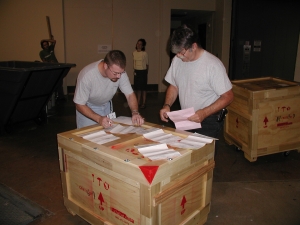
When I left Ohio with my new wife in 1998 I had no clue as to what I would be doing 17 years later. So take my life as a prime example, you will never know what the plan is for your life or career. So be happy where you are today and make each day count as tomorrow brings changes. Sometimes small changes or big, but be prepared. Change is coming. I was scared and worried three years ago when I lost my job which was the first time in my life. But here I am today, a hard working blue collar man with an awesome wife and daughter and I am honored to share how I got here!
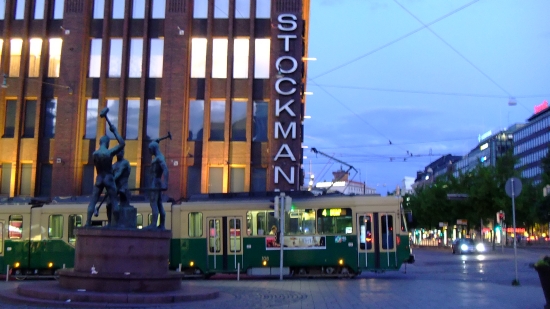
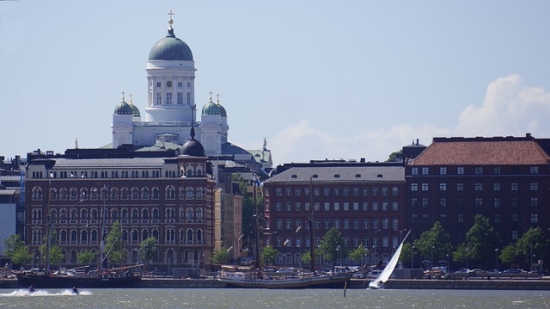
impression from a Helsinki White Night – picture taken around 11 at night!Just arrived home from Helsinki and it will take a few days to review notes, pictures, thoughts… everything. I’m still overwhelmed by the various impressions from the conference, the speeches, the presentations, the high professionality and friendliness of our hosts from the Nordic Registrars Group, the talks with colleagues, the laughter and the fun and especially from the politeliness and discreet warmth of the Helsinki people. But at least I want to make the presentation I did at the end of the conference available to all of our readers. More reports coming up.
The Next Generation: Breaking Barriers with the Project Registrar Trek
Hyvää päivää. Mitä kuuluu?
Mina olen saksalainen.
Unfortunately, these are the only words I can speak in Suomi, one of the languages in this wonderful country that I had the pleasure to be a guest in for the last few days.
Not more than “Hello, how are you, I’m German.” There is a barrier, a language barrier. Today, I’m speaking about breaking down barriers. Language barriers and other barriers.
Maybe as we sit here together we think that language barriers can be overcome by learning another language. This way we are able to communicate and exchange thoughts, for example in English. While it is true that English enables us to hold conferences like this one, we should keep in mind that we all have just crossed a barrier that leaves other colleagues behind. Who attends this conference? Registrars and collection managers who feel able to follow a conference that is held in English. Others who are not so confident about their language skills stayed at home.
The language barrier might be a problem in understanding each other. But on another level we understand each other very well: we share the language of collections people.
If we talk about lending and borrowing, about storage needs and documentation problems we understand each other, no matter what our mother tongue is and which continent we are from. We understand each other so well that it doesn’t come to mind how difficult it is for other people to understand what we do. This is a barrier not only between us and the visitors in our museums; this is even a barrier between other museum professionals and we, the collections people.
There’s a third barrier. A barrier that is so close to us that we need others to let us see it: it’s the barrier of our everyday work experience, the barrier of our own museum’s walls.
Today, I’m going to introduce a project we started a while ago to work towards breaking these barriers. Some of you might know it already: It’s called Registrar Trek: The Next Generation.
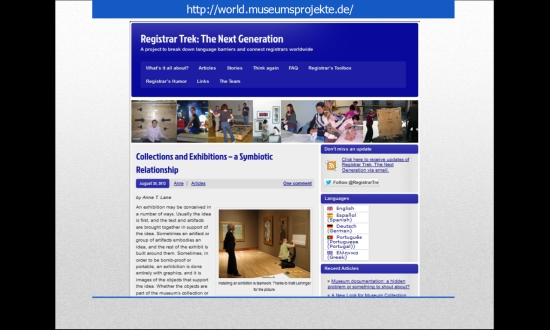
I think there’s no use in clicking through a website and telling you what you see at a conference. That can be better done at home. I think it’s better to tell you something about the general idea of this project, about the spirit of Registrar Trek:
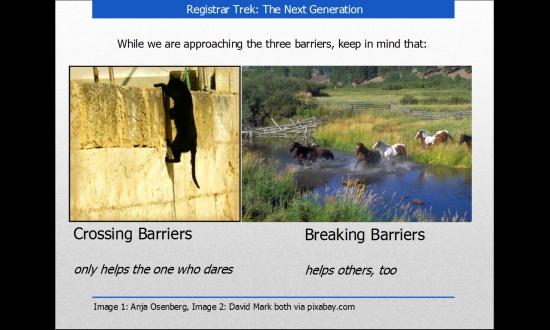
Let us now start to approach the three barriers, starting with the language barrier.
Breaking down the language barrier
The language barrier was the barrier that originally started this project.
We started with three languages: English, Spanish and German. Sure, our translations weren’t always perfect, but it was a start. As soon as we started,
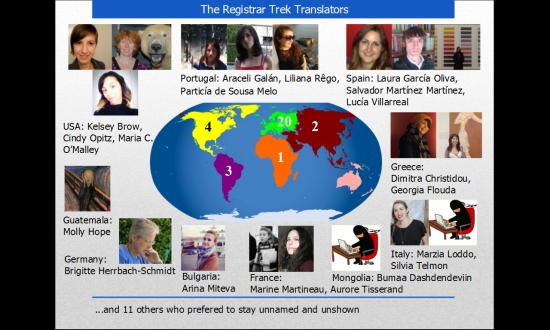
others joined us and right now we have 30 translators from 19 countries providing 16 different languages.
Of course, we don’t have all the posts in all languages right from the start. We are volunteers, mainly working in museums, some studying, some interning, some retired, others job-hunting. So, you can imagine that we are all busy. But because we are many, most of the time we can provide at least 2-3 languages when publishing a new post. Others are added as soon as they arrive.
The good news is that you can’t have too many translators. The more translators we have, the easier it is to balance the workload and the faster we are in adding translations.
So if some of you want to join, I will be glad to say: welcome on board.
Let’s approach the second barrier: The barrier of registrar’s lingo.
Breaking down the barrier of registrar’s lingo: Telling what we really do
We all know what we do every day. When we talk to each other we don’t have to explain many things. We know what a loan contract is and what a disaster plan looks like, we understand categorizing issues, we feel for a colleague that has to upgrade to a new version of a data base, the list goes on and on.
When we talk to “strangers” about our profession we often realize that it’s extremely hard to explain in a few words what the job of a registrar or collections manager consists of.
The question is: why is it that way? We have such a wonderful, thrilling job, why is it so hard to get the message across? So hard, sometimes even our family members have no idea except that we “work at a museum”?
Personally, I think a big part of the challenge is that we try to explain our jobs in an abstract way.
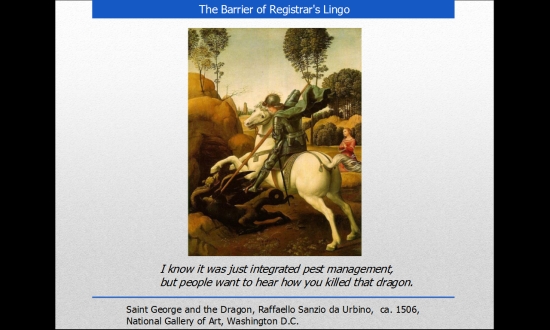
Let me give you an example: I sit together with colleagues at lunch. The educator tells how he guided a difficult class, the press officer tells how she organized a great speaker for the next event and I say that “I did some integrated pest management”.
While I understand what the educator and the press officer did, they don’t understand what I did.
Why didn’t I break this barrier by saying that I had checked and baited mouse traps the whole morning? Well, that’s not exactly slaying dragons, but in the museum perspective, it’s pretty close.
That’s exactly the approach of Registrar Trek to break this barrier: by telling stories.
I know that „storytelling“ has become a buzzword in the museum field, but the truth is: telling stories is a very ancient way of getting messages across in an entertaining way.
A story about what one has to consider when storing earphones or how one built a box for hundreds of buttons gives a better impression of our job to an outsider than collection policies and job descriptions.
A story about how you climbed the roof of your storage area five times to supervise the craftsmen working there will give a better hands-on impression of the job duties than any handbook.
It will help students and young emerging museum professionals decide if collections is really the perfect fit for them or if it might be better to pursue the marketing or education path.
A story about how you found information about an object that proves its significance for the collection and your community will give other museum professionals like educators and press officers food for their own work and an idea why the work you do is important for the museum.
But telling stories can also help us to approach the third barrier: the barrier of your own museum’s walls.
Breaking down the barrier of the own museum’s walls
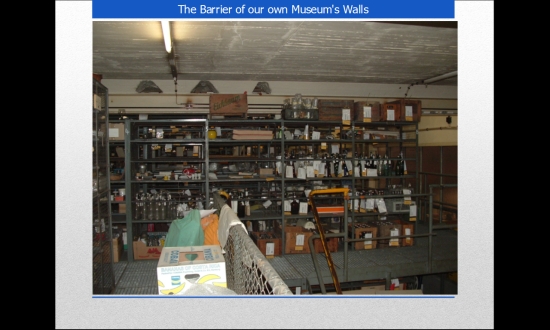
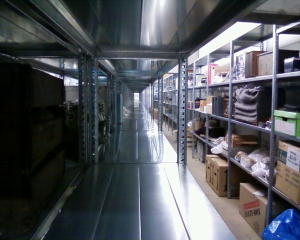
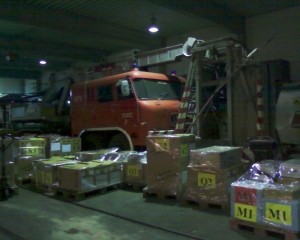
When you work for a specific museum a long time you become blind to its shortcomings and, more often, you don’t see what works well any more. I brought you a picture:
I don’t know how many of you have had this kind of situation. When you are heading for a museum career you absorb everything about best practices, about good storage conditions, about wearing white gloves. Then you take up a job and start with all the enthusiasm of the young, aspiring museum professional. And then, the real museum world hits you.
In short: you have all the knowledge and the guidelines how it should be but literally no one has prepared you for the situation as it will be.
The trouble is that reading guidelines and official publications of museum associations in such a situation isn’t helpful. Instead it’s depressing. But what might be helpful or at least encouraging is to read stories about how someone brought order to such a mess – or how it could be worse. And if you cleaned out this mess it can feel fabulous to write an article for Registrar Trek about it.
I think our author Anne T. Lane said it best when she said:
“Our triumphs are not like other people’s triumphs. Our crises are not like other people’s crises. It’s good to find ourselves part of a community that understands.”
And maybe, when you publish it, you will suddenly get feedback from colleagues from around the world helping you to see your own situation from a different angle.
When you and I look at the picture the immediate thought is: “What a mess! We have to start cleaning and wrapping those objects, someone go, fetch some archival boxes”
But in a small rural museum in Germany, your colleague (who most certainly will also hold the title of director, visitor guide, administration officer, janitor and webmaster) will say: “Oh, lucky you! You have a room for storage, the roof isn’t leaking and it seems all those objects have labels!”
So, the benefit of writing stories and articles for Registrar Trek is not only to help and encourage others, it can also be a chance of reflecting on our own position. And you create a chance for professional discussion.
Best practices are in constant development and improvement and need creative input that comes out of our everyday, hands-on working practice.
Breaking barriers needs many heads and hands
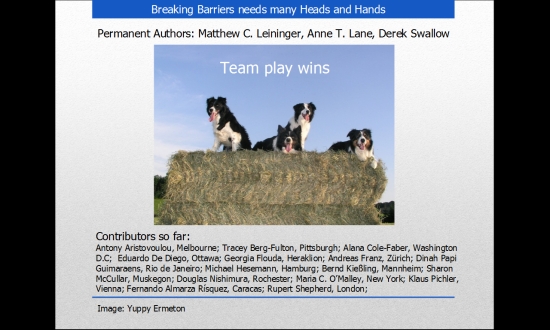
Right from the start Registrar Trek was meant to be a project designed to involve many people from our profession. It was never about one or two people telling their stories and the others just translating and commenting. (Otherwise I would constantly bore you with stories out of collection management in a German Science and Technology Museum).
We wanted to have collection professionals from around the world bringing in their views, their articles, and their stories. For example, Tracey Berg-Fulton who did the wonderful session before this one wrote an article about how she became a registrar, and that’s just one out of many.
We want you to bring in your views, your articles, and your stories.
The core of Registrar Trek is that it is a common project of colleagues. Standing here alone and telling you about Registrar Trek feels somehow wrong. So, to speak for the authors of Registrar Trek I’m very glad to have Derek Swallow here from the Royal British Columbia Museum in Victoria.
Derek Swallow enters the stage and says the following part:
Thank you Angela.
I want to very briefly touch on two points: how you can contribute if you choose and secondly the rewards of being a Registrar Trek author.
Currently we have four main sections in Registrars Trek any of which you can contribute to: the first is Articles which covers broader issues of common interest and a share point for ideas; next is Stories – this section is comprised of real shared events celebrating learning by way of our successes and failures; the third is called the Registrars Tool Box containing practical solutions, and facts to assist with our day-to-day work; and finally Registrar Humour – I find I need a daily dose of humour to keep me sane in this wonderful but stressful job.
Now the rewards of being a Registrar Trek author: personally, it’s about the process of engaging in communication about museum topics with collections specialists from all over the world. For example, in past articles I’ve presented a new approach to conducting collections committee meetings adopted recently at my museum. I’ve also posed the question: how does authenticity relate to collecting in the 21 century museum? I’ve discussed how our roles as registrars are perceived or misperceived by both the general public and other museum employees.
As a result of writing these articles I’ve received important feedback which has helped evolve and clarify my ideas as a professional in this field as well as establish professional connections with colleagues in Europe, North America and Africa.
I want to leave you with one final thought. In this room 34 nations are represented. If even one person from each nation were to join Registrar Trek as a writer or contributor what an amazing network of communication would open up for us all and can you imagine how broad and rich our exchange of ideas would be?
I thank you all.
Thank you so much, Derek.
I believe we’ve said all we wanted to say about our project. Don’t forget we are always glad to publish your stories. Maybe you haven’t killed a dragon. But maybe you found a great new way of reorganizing your storage space. Or to pack an X-Ray-tube. Or you accidentally loaned 200 artifacts and want to tell others how to avoid this.
Keep up the good work, thanks for listening and may the road rise to meet you.
Kiitos paljon, Helsinki!
This post is also available in Italian, translated by Marzia Loddo.
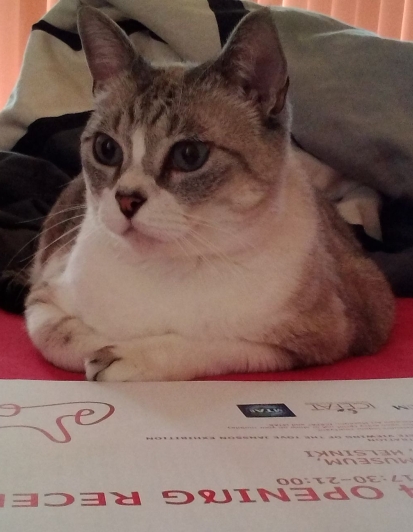
Registrar Cat checks if documents are complete for the trip.Things are busy right now, so you might realize we are not as quick with adding new material the next few weeks. There are various reasons, including that there was a major server issue with deleted webspace that forced me to backup to a previous version (some might have realized we were offline a few days) and that I’m preparing the site to be fully functional in French, too, which means some additional effort. Oh, yeah, and there is my little side job as the collection manager of the TECHNOSEUM, along with garden, man and cats. But especially, I’m busy preparing my presentation and trip to Helsinki.
I’m all excited to speak at the European Registrars Conference about Registrar Trek (see full programme here: http://www.confedent.fi/erc-2014/programme2/) and hope my colleagues will like it. As far as I can see, I’m the only registrar from a Science and Technology Museum attending, so I somehow feel like a representative for an entire museum field and hope I don’t mess this up. I’m looking forward to meet many colleagues there who I only know via email, twitter or linkedin so far and I’m especially glad that Registrar Trek contributors Tracey Berg-Fulton and Derek Swallow will be there.
I guess there will be much to write about when I’m coming back and I hope to inspire some colleagues to contribute their stories and articles with my presentation.
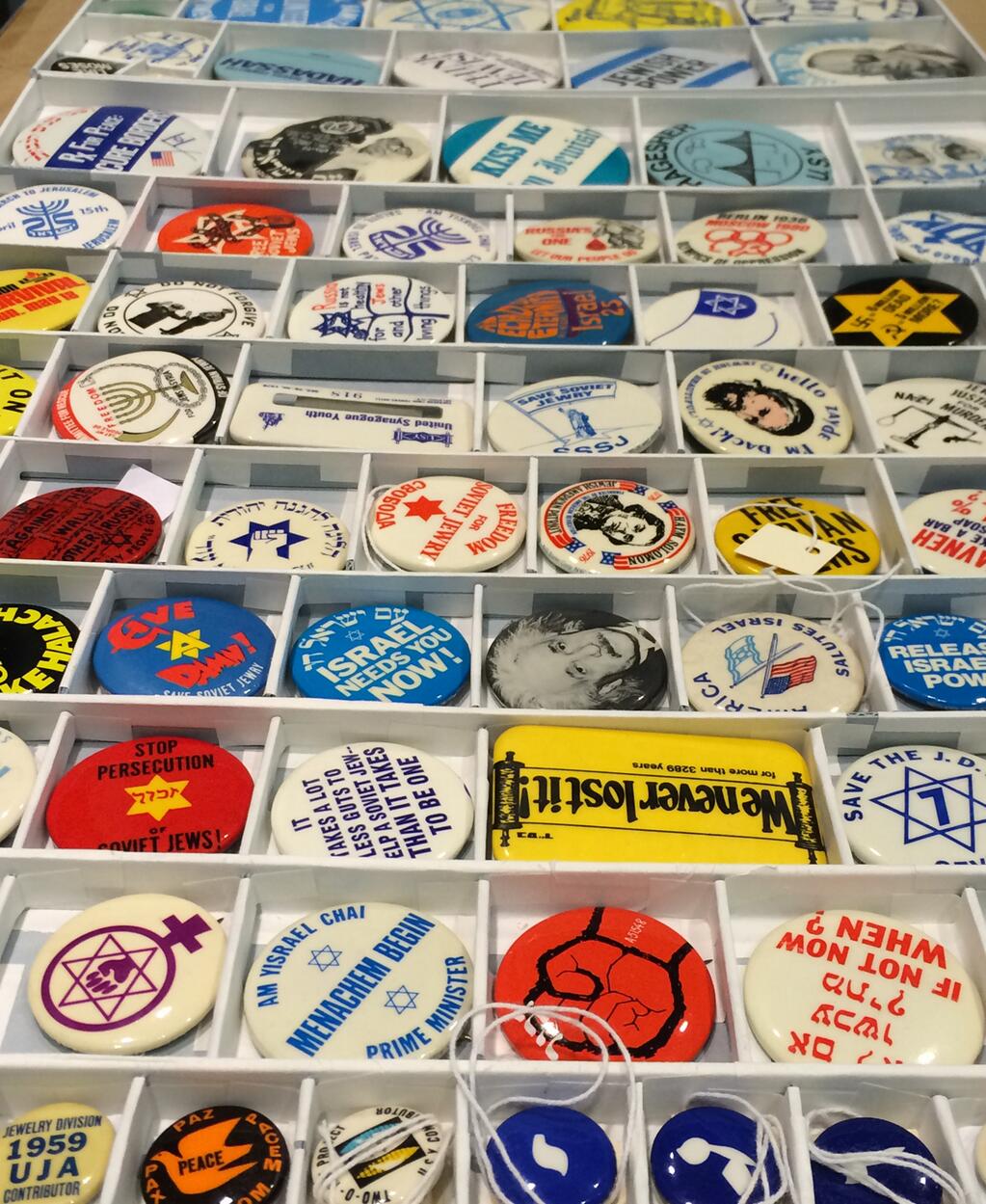
Storing buttons can be tricky. You can’t put them with others into one ziplock bag because they will rub against each other. You can place them each in its own small ziplock bag but then the bags slide in the box and a single button is not easy to retrieve. Recently I stumbled upon a great button storage solution from the Museum of Jewish Heritage in New York:
Button storage at MJH
They published it on the twitter account of their registrars @MJHReg (sure worth a follow, great stuff and pics!) and I contacted them to ask if we were allowed to re-publish it on Registrar Trek. Associate Registrar Jennifer Roberts replied immediately and gave us the permission. She also sent additional pictures…
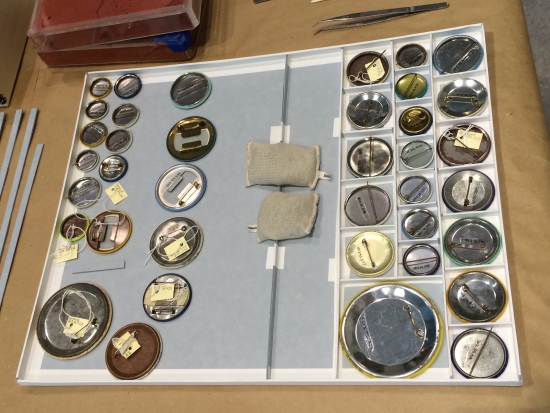
Building the button storage
…and explained how it was made:
“For this particular collection, our Preparator is making custom trays out of blue board and archival paper hinging tape that will stack inside a standard archival box. Making custom trays has allowed us to fit approx. 350 buttons per box while keeping the buttons stable and easily accessible. The buttons are arranged by size to help save space, and we are currently digitizing the collection so we will have reference images to help us locate individual buttons in the future.”
If you were given a choice between donating money for museum conservation, education, or documentation, would you give to documentation?
I was offered this choice by a collecting box at one of the London national museums just before Christmas last year. Or rather, I was given a choice between conservation and education: documentation didn’t feature. This made me think: documentation seldom appears in public discussions of what museums do.
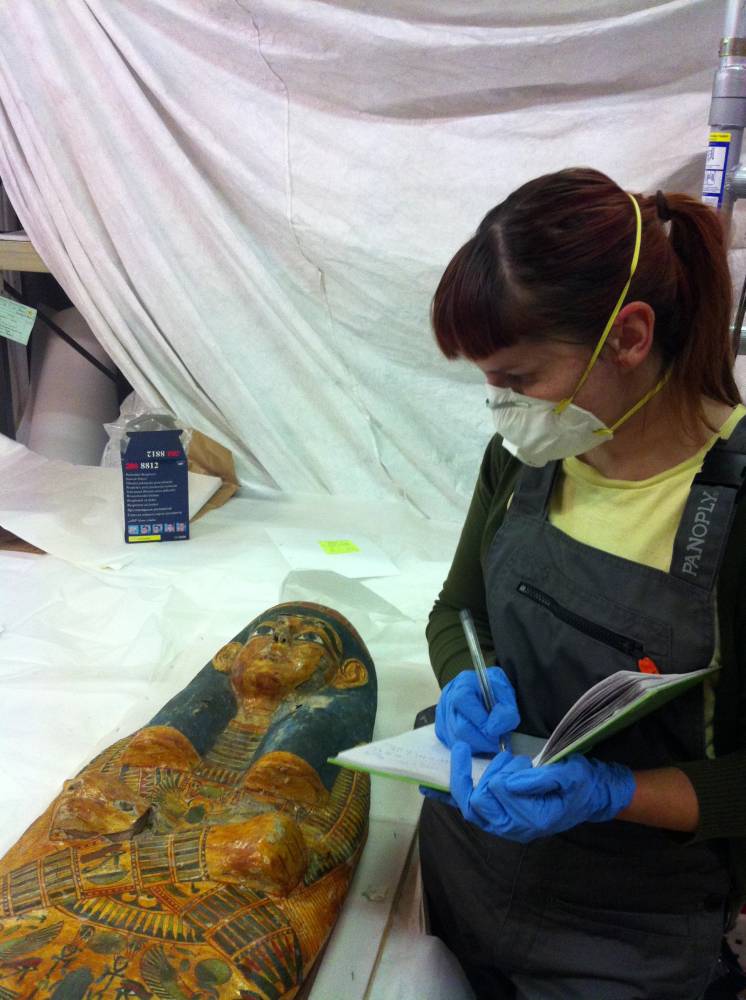
Horniman Museum Collections Assistant Laura Cronin at work reconciling one of the mummies with its paperwork. Photo: Helen Merrett
If you’re reading this blog, then I think you already know what documentation is. For what it’s worth, my definition falls into two parts. Documentation comprises: looking after the information a museum has about its collections; and making sure that the museum is able to account to its public, its funders, and anyone else for its collections and everything that happens to them. And I’m sure you also understand that a museum’s documentation is as central as its objects to everything it does: without documentation, the collections are a meaningless pile of odds and ends. If we don’t know what the objects are and where they come from, we cannot meaningfully display them or help people understand them.
Why, then, does documentation so seldom appear in public? After my encounter with that collecting box, I thought I’d ask my colleagues across the museum community, so I started a discussion on LinkedIn, in Collections Trust’s Collections Management group (you need to have joined the group to read it). The discussion was fascinating, and this blog is really an attempt to pull it together into something more structured and condensed.
Why is documentation important?
In the UK and, I expect, around the world, publicly-funded museums are under great financial pressure: we’re expected to do as much work as we’ve always done – if not more – with less and less money. As a result, we need to look more widely for funding even for our core activities. A few months ago, I was talking about the difficulty in funding day-to-day documentation work with my museum’s director, and she said something which I’ve taken to heart: ‘you need to tell the story’. There’s no point continually saying documentation’s important: we have to say why it’s important.
In an attempt to provide a really inspiring argument for documentation’s significance, I asked people in the LinkedIn group to provide their explanations – ideally, in the 140 characters or fewer needed to create a tweet. (There’ll be more about Twitter later.) There were some great, pithy responses, and a few weeks ago I tweeted one of these a day for a couple of weeks. I’ve Storifyed them here. They pretty much reinforce what I said before: without documentation, we can’t understand or do anything meaningful with our objects, and so we can’t use them to do all those inspiring things we pride ourselves in. And, of course, we need to know where our objects are, be able to prove that we own them, and so on.
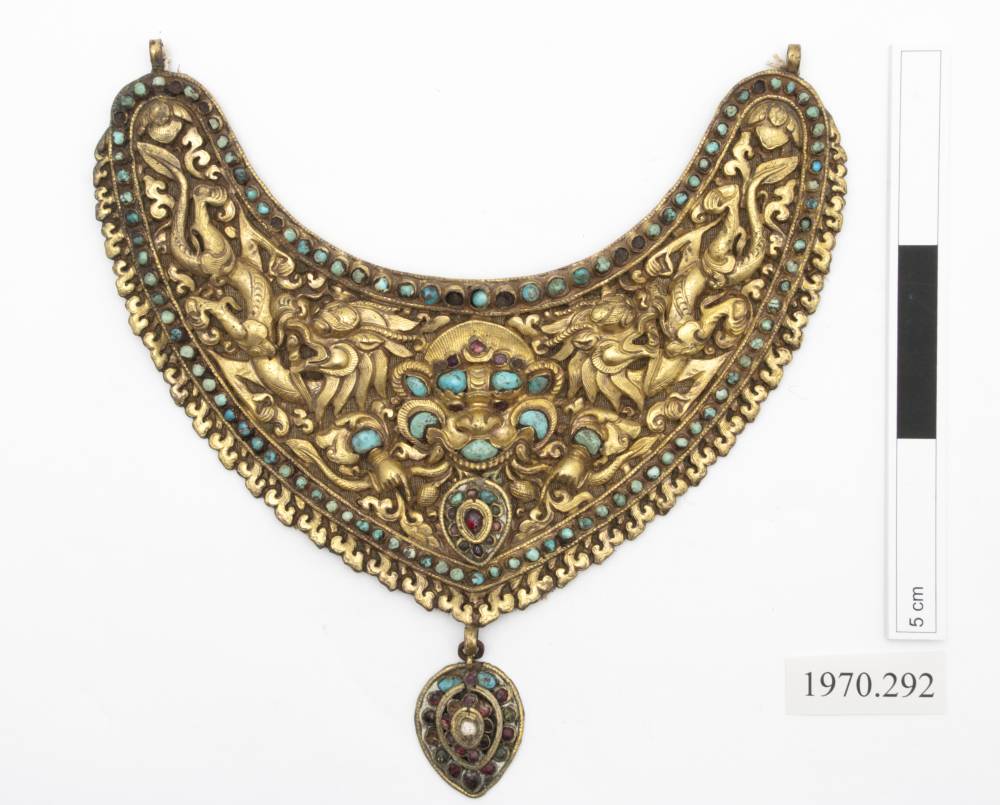
Hidden treasure revealed during the Horniman Museum’s Collections People Stories collection review: a pendant in gold, copper and semi-precious stones from Nepal, 1970.292. Horniman Museum and Gardens
One or two contributors took the wider view: Registrar Trek’s own Angela Kipp said that ‘without documentation, humanity loses its memory’ – and ‘losing your memory means losing yourself’. And perhaps my favourite, for its sheer enthusiasm, came from Barbara Palmer, registrar at the Powerhouse Museum: ‘I uncover hidden treasures and make them accessible. I feel like I have the best job in the world.’
Why isn’t documentation more visible to the public (and why does this matter)?
But is this the right way to proceed? Nick Poole, for one, suggested that we shouldn’t be dividing museums up into separate activities like this: what is important, he said, is the end result. After all, supermarkets focus on the quality of what they sell, not on how it got to their shelves.
But with all respect to Nick, I think this misses the point slightly. In many other fields, the infrastructure is visible: to stay with Nick’s example, supermarkets advertise the freshness of their produce by saying things like ‘from the farm to our shelves in two days’, and we can all see supermarket shelf-stackers and the trucks that carry the produce across the country. In museums, we show off our exhibitions, displays, interpretation, and websites – but visitors can’t see the infrastructure used to create it. When do we ever say ‘this exhibition was brought to you using the quality data in our collections management system’?
And should we be comparing museums to supermarkets anyway? Angela reminded us that museums exist not just to display objects, but also to educate, collect, research, and preserve our objects for future generations and researchers: we all know that not everything we collect ends up going on view to the public straightaway, and much of the research done on the collections does not lead immediately to a new piece of public interpretation. But in the UK, at least, I can’t help feeling that Angela’s is a somewhat unfashionable view: we are constantly being asked to justify what we do in tangible, measurable and visible ways, hence the focus on the public outputs.
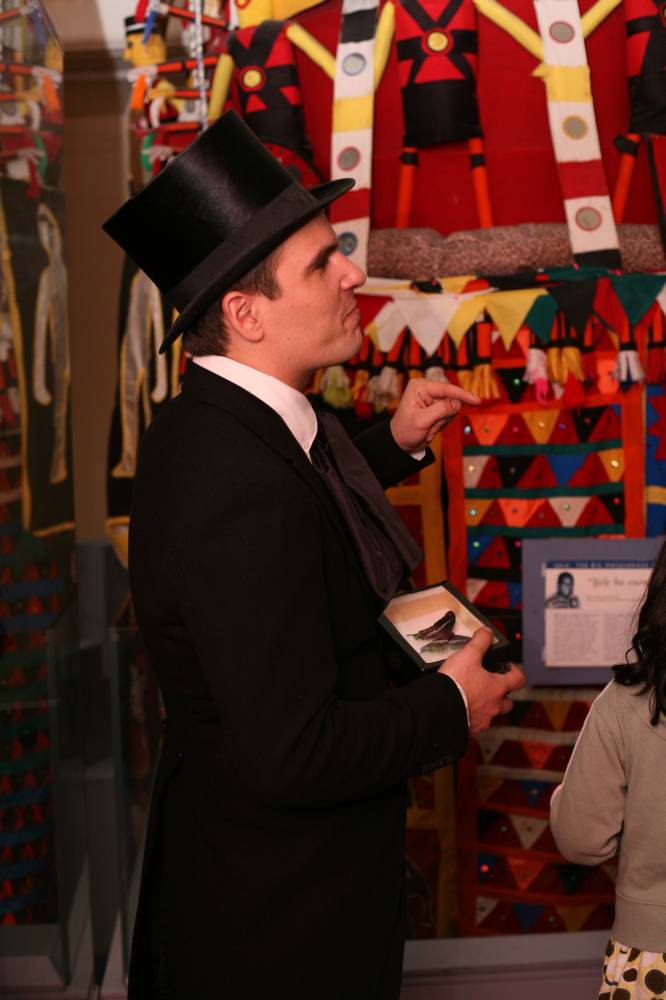
‘Mr Horniman’, holding a specimen of his butterfly, Papilio hornimani, talks about the collections in the Horniman Museum’s African Worlds Gallery. Horniman Museum and Gardens. Photo: Laura Mtungwazi
Other people, such as Michaelle Haughian and Shaun Osborne, suggested that documentation was primarily of interest to other museum people: the public don’t need to see how it works. Michaelle wondered whether ‘the crux of this issue isn’t the way funds are allocated? Do we need to have a second discussion about the bare bones funding models museums are accustomed to? Do we need to talk about why education and programming seem to get more money than collections or registration work?’ This is a point that Angela also made: ‘people decide to fund what they know, see and take part [in] in museums (educational programmes, tours) and not something that is hard for them to imagine, because it needs explanation (conservation, documentation, public relations, administration…).’
I think this is the fundamental problem: if you don’t know something exists, how do you know that it’s important, let alone that you could fund it? And perhaps, as Shaun also suggested, what’s important is not that documentation should be made visible to the public, but that it should be made visible to our senior managers, our trustees, and our funders.
Why is documentation a ‘problem’ (and how did we get to where we are today)?
Nick also suggested that one problem we face when making the argument for documentation is that we tend to see it as a problem: we have a horrible tendency to append the word ‘backlog’ to it. Thinking about my own organisation, the Horniman Museum, we do have backlogs of various kinds, and I would certainly say that they are problems: one reason I’ve been concerned about documentation’s public profile is my wish to clear some of the backlogs which are preventing my museum from working as efficiently as it might. In the current funding climate, we have to work as effectively as possible: poor documentation hinders this; really good documentation enables it.
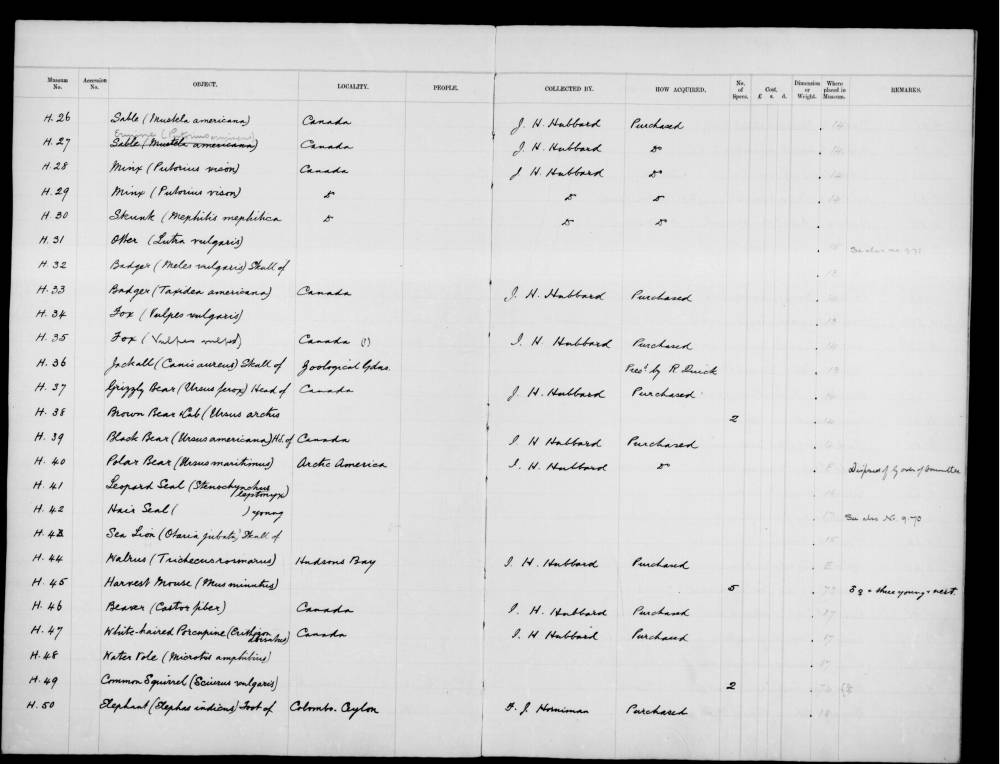
A page from the Horniman Museum’s register of natural history specimens from 1900 to 1934, ARC/HMG/CM/001/008. Horniman Museum and Gardens
Backlogs arise for various reasons. At least in older museums, they exist in part because of the way our current data has been generated: from what I know of my own institution, our records started as register entries, which were expanded into index cards, which were built upon to form catalogue cards, which were imported into an early database, which were in turn imported into MultiMimsy, which were then imported into Mimsy 2000, and then imported into Mimsy XG. (At the Ashmolean, over 200 separate databases were imported into their first museum-wide collections management system, MuseumPlus.)
Every stage represents an opportunity for inaccuracies to creep in (in the manual conversions), and kludges to be made when importing or transferring data (in digital systems) in order to get something up and running in a reasonable time. We always promise ourselves that we will come back to it and tidy it up; and then something else comes up, the opportunity has gone, and we have – a backlog of data tidying.
And this leads to a second reason why backlogs build up: straightforward lack of resources. Museums simply don’t have the people needed to do the work that needs to be done (particularly, that needs to be done now if we’re to create records that we don’t have to keep coming back to). In many organisations, as documentation tasks are increasingly passed to volunteers, placements or interns rather than paid staff in an attempt to get something done, so more of the work needs to be checked and revisited to ensure it’s fit for purpose; and we don’t always have the time to do that as much as we would wish.
Why has this all become so labour-intensive? Graham Oliver, who’s worked as a curator for 35 years, reminded us that documentation used to be part of a curator’s work – but the people contributing to the LinkedIn discussion were called ‘curator, documentation officer, collections information systems manager, content manager, access officer’, and so on. The last two or three decades have indeed seen a huge increase in specialisation in the museum world. When documentation consisted of registering an acquisition, creating index cards for it, pulling one’s research into a history file, and updating a location card when the object moved, it was easier to incorporate it into one’s day-to-day curatorial work.
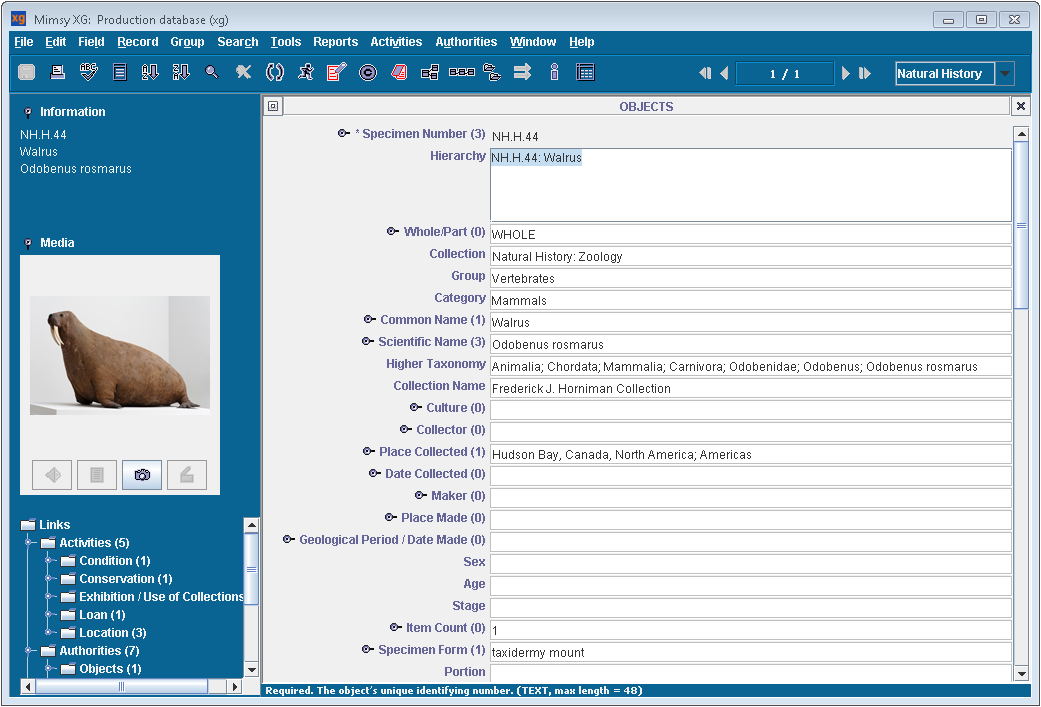
An object record in the Horniman Museum’s Mimsy XG collections management system. Horniman Museum and Gardens
But then computers arrived, and they became the preserve of specialists – understandably, if you look at a system like Mimsy XG, which we use at the Horniman: there are something like 3000 different, discrete units of information in there, and to configure it, maintain it, and keep the data consistent is a specialist job which the vast majority of people who work in museums simply wouldn’t want to do. So documentation jobs were created to manage the information, and to make sure that the procedures drawn up in Spectrum over the last 20-30 years were being implemented and tied into the computerised information: suddenly, there was a new sub-discipline within museums. Many curators took to it; others, alas, didn’t. The same is true of the many other specialists doing the work that used to be done by curators – and there were far fewer curators then, than there are now staff doing all those specialised jobs.
And as documentation has become more and more of a specialism, other museum staff have become less aware of some of the problems which can arise if it’s not done just right. There are a couple of misunderstandings which I think have been particularly pernicious, and have made it much harder for us to argue for resources to address our backlogs.
The first is the database pixie delusion. A senior curator (I’m naming no names, not even institutions, here) once said to me that their ideal collections database would comprise one field, into which they would type what they knew about the object. The database would then organise this information so it could be used effectively. The delusion is the belief that you simply have to put your collection information into a database and everything will be all right. It doesn’t matter that the data is inconsistent, mis-spelt, or incomplete: it’s in a database, so of course it’ll be OK. After all, the database contains little pixies that will get the data tidy (even proof-read it), consistent, linked, and so on. Our colleagues sometimes seem to have had a touching faith in the intelligence of computers, whilst those of us who work with them more frequently know that they are fundamentally dumb, and that if you put rubbish in, you’ll get rubbish out.
Related to this is the Google delusion. We’re now very used to using web search engines to find information. We type something into Google, say, and if we get one useful result in the first page, we reckon it’s worked pretty well. On the other hand, in a well-maintained database, if you run a search, your results will be all the objects that are precisely what you are looking for, and no others.
Again, this reminds me of a conversation I once had with a colleague. We were talking about searching for objects made of copper alloy, and how one would run the search. Ideally, you would enter ‘copper alloy’ in a materials field, and get back all those objects made of copper alloy, and no others. But my colleague was quite happy to run a series of separate searches, for ‘copper alloy’, yes, but also for ‘Cu alloy’, ‘CuA’, ‘bronze’, and so on: in their mind, if they were able to do this and get back most of the relevant objects across all these searches, along with some others which weren’t really relevant, the database was working well. They didn’t seem to realise that this made it much harder to then reuse that information by generating reports or lists of objects which could be used outside the system.
If we return to Google and think of the amount of research and development that has gone into its search algorithms, then we can see that it’s a massively expensive tool for indexing really poorly-structured data, and it does so adequately, at best. It has lowered our expectations of data retrieval in an extremely unhealthy way.
Raising documentation’s public profile
As you can see, I agree with Nick when he says that there’s been a long-standing culture clash between documentalists, who tend to be systems thinkers, and our colleagues who are, as he says, ‘value-driven creative people with a strong set of social values’. This has led to the need to explain the value of documentation in terms of its end users. I’d also agree with Nick that we need to argue for a museum and funding culture that recognises that ‘a building with things in it, but without knowledge or skilled people, is not a museum. And people deserve museums.’
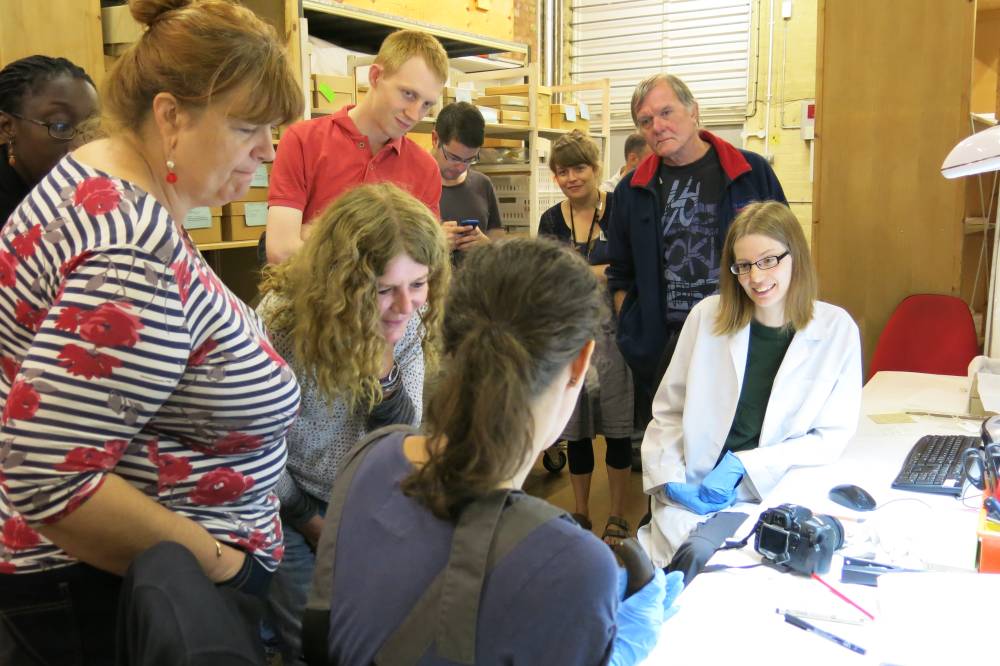
Horniman Museum Collections / Documentation Assistant Clare Plascow (back to camera), and Documentation / Collections Assistant Rachel Jennings, explaining their work on the Collections People Stories review to a ‘behind the scenes’ tour of the Museum’s stores. Photo: Nicola Scott
So we come back to how best to make those arguments. As we’ve seen, our LinkedIn discussion broadly divided into two camps: first, those who feel that it’s not worth raising documentation’s profile to the public, because it’s part of a process that leads to public outputs like displays, exhibitions, engagement or learning events, and those end results are what’s important; and second, those who think that it is worth publicising what we do for its own sake. There was also a group who suggested that documentation should be bundled up as part of general presentations of ‘behind the scenes work’, and this in particular is something that I think we could all try and pursue.
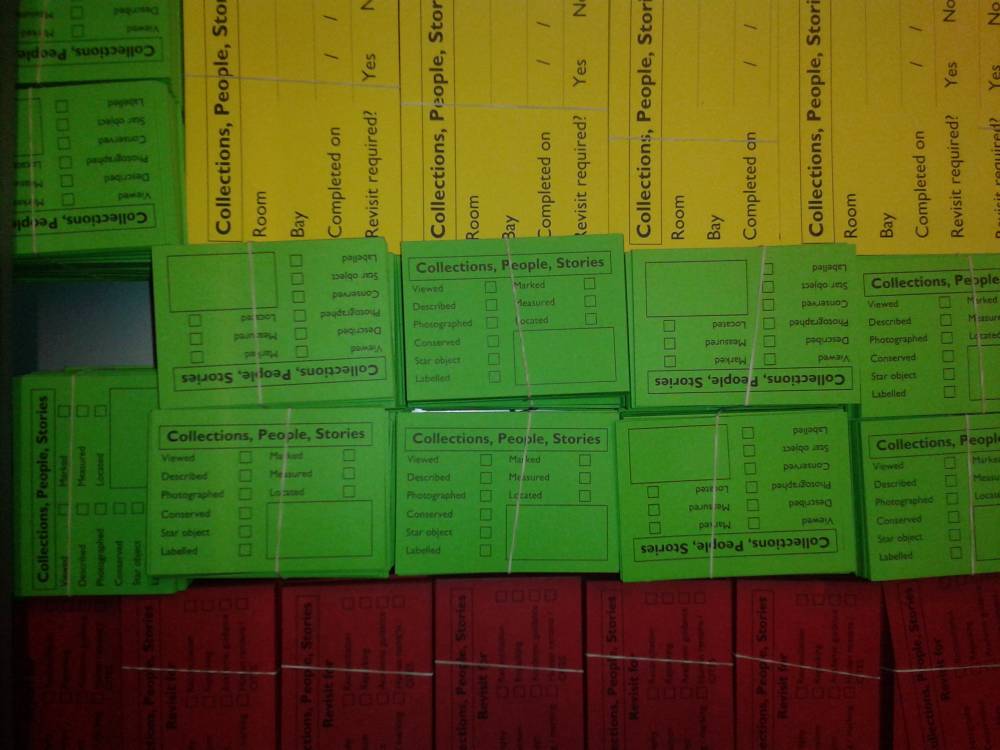
Box and bay labels for the Horniman Museum’s Collections People Stories review awaiting use. Photo: Rupert Shepherd
But generally speaking, I think I’m still part of the second group. Something else that persuaded me to start the discussion was a passing comment when I was in a meeting. One of our conservators said that work had just been finished on an object, and our Digital Media Manager’s immediate response was ‘Great! Can you write me a blog about it? Everyone loves a conservation blog.’ Our conservation department has its own page on our website, linked to ten case studies. Our Documentation (and Collections Management) departments don’t – even though we’ve been making significant contributions to aspects of the museum’s work as diverse as our online collections, our Collections People Storiescollections review, and our famous walrus’s recent trip to the seaside at Margate.
Like that national museum’s collecting box, this showed me that we do publicise our behind the scenes work – but only certain parts of it. And as Angela said, what’s visible is what people think of funding when they reach for their cheque books. Yes, we need to raise documentation’s profile with our managers; but we also need to spread the word more widely, because in the end, it’s not just our managers who provide our funding.
So how can we do this? When I started the discussion on LinkedIn, I also suggested that everyone working in museum documentation who had a Twitter account should tweet what they’ve been doing each day, and – crucially – why it’s important, using the hashtag #MuseumDocumentation. A couple of weeks after we began, Angela Storifyed some of the tweets; and you can also follow them here:
Even if our followers are only our family, friends, or colleagues, it’s a start; but the more momentum we can gather, the more word will spread beyond our immediate circle; and our managers, and perhaps even our funders, will start to understand that documentation really is worth supporting. So I’d like to take this opportunity to thank everyone who’s contributed to the discussion so far, both on LinkedIn and on Twitter: I’ve been hugely impressed by everybody’s enthusiasm for, and dedication to, what we do. I’d also encourage everyone else to have a go at tweeting about #MuseumDocumentation: I’ve found the experience of saying why what I do is important, in a new way every day, quite challenging – and stimulating.
Has it been working? Well, our Digital Media Manager did come through and ask me to write a short blog post about documentation and the hashtag for our website; and I have been interviewed for an article on documentation to go in the Museums Journal, as well as being asked to write a short piece for the Museums & Heritage Magazine. So maybe we’re beginning to raise our profile a bit.
Oh – and when I went back to that London national museum, the collection box no longer offered you a choice ….
About the author: Rupert Shepherd initially trained as an art historian, specialising in the Italian Renaissance, before moving into museum documentation, dabbling in humanities computing and digitisation along the way. He was Manager of Museum Documentation at the Ashmolean Museum for three years, and since 2010 has been Documentation Manager at the Horniman Museum and Gardens in south-east London – but the views he expresses in this post are his own.
Innovation in such areas as exhibition methodology, education programs, revenue generation is expected in the 21st Century museums. This is not always the case for core museum processes. However, necessity can drive such innovation. Many twenty-first century museums face the harsh reality of shrinking budgets. One impact: fewer staff with heavy workloads. To maintain high service standards and internal best practices museum personnel look for ways to work more efficiently. Better time management is one solution. New measures such as pruning the number and length of meetings can conserve this now precious commodity – time. Modifying the delivery and structure of tradition museum business meetings is an area where savings can be found. In early 2013, the Royal BC Museum, where I work, launched a pilot project, aimed simultaneously at carving down our collections committee meeting time and building a more flexible, egalitarian process.
Work load too much? # f 08817 Collection of the Royal BC Museum/BC Archives.
Traditionally, our committee composed of curators, archivists and a conservation representative, guided by a chair person, met monthly for one and a half hours: its mandate to decide which new collections, proposed by discipline curators or archivists, would be accepted into the Royal BC Museum permanent holdings as well as adjudicate recommended collection deaccessions. The agenda, provided electronically to members several days before the meeting allowed time to digest the information about each proposed acquisition including the proponent curator’s acquisition proposal (rationale for acquisition) and the conservation department report. The latter included the general to specific condition of the collection and its components, specifying the time needed to both stabilize and preserve these components over the long term. Armed with this data the members of the collections committee, along with the curator/archivist proponent for each collection, attended the monthly meeting. The proponents “presented” their collections, fielded questions, then the committee would vote. Proposed deaccessions were handled in a similar manner. I suspect this is a familiar format for many of your institutions.Tired of those traditional collections committee meetings? # a 00514 Collection of the Royal BC Museum/BC Archives.The new model at the Royal BC Museum displaced face-to-face meetings with “virtual” consultation and decision making. By “virtual” I mean that all information transfer, and collection discussions, between collection proponents and committee members, is done via electronic means through email. All processing tracking documents, agendas, collections voting lists, and committee decision postings exist as Excel and Word documents and “live” in digital format on a common drive.
Along with the process the committee structure changed. An egalitarian measure was built in: members now included collections managers as well as curators and archivists. The registrar, previously the recording secretary, assumed the role of quasi-chair person responsible for creating and updating the electronic voting agenda, and the capture and dissemination of electronic communication.
In brief, this is how the “virtual” collection committee (CC) works:
Once a collection has a completed acquisition proposal entered into our database by the proponent curator or archivist, conservator and discipline collections manager the registrar posts it to the excel spreadsheet “voting list”, serving as an agenda. The contained fields include the discipline of the collection, registration number (unique number created by our collections management system), the name of the donor or collection, a summary description, the name of the collection proponent, and voting boxes for each committee member. This spreadsheet, posted at the beginning of a month, to a common drive, is accessible to CC members. If a CC member has a question about a given collection this is sent via email to the proponent cc’ing all the other CC members. The response is therefore sent back to the committee as a whole. This replaces in-person discussions regarding the collections. The registrar copies all such questions and answers, as well as general CC member comments, pastes them into a Word document which forms which, along with the voting list/agenda forms part of the permanent record of decision.
Why not use our sophisticated computer tools to do the job better? # na 19565 and # i 24586-1 Collection of the Royal BC Museum/BC Archives.
The voting list/agenda is a “living” document; as collections are readied for review they are added by the registrar for the first three weeks of the month, where after, the agenda is closed and the registrar tallies and posts the results.
Advantages of the new model include the following:
Voting is flexible – can be done when time permits
The process is Greener – no paper is involved
Collection advocate responses to CC member questions can be thought out and clearly presented – rather than being “off the cuff” in a regular meeting. In addition these questions and answers can be saved in whole. I traditional meetings the minutes contain only a synopsis of the discussions. Some subtle and compelled points may accidentally be omitted.
There are no minutes to write up.
Time for travel between offices and the meeting room is saved as well as wasted time waiting for a meeting to start as well as through social engagement during and after the meeting. This easily amounts to an hour savings in itself.
Disadvantages of the new model include the following:
Using only email communication reduces the dialogue related to each acquisition and there can be more communication in less time in a face to face meeting.
Important opportunities to discuss important spin off issues that arise from collections discussion such as policy and procedures are lost.
Some members find the depersonalization of the process discomforting – we need to come together face-to-face as a group.
Since voting is done in a staggered manner there is a possibility a CC member may be influenced by viewing the vote of a respected colleague.
Registrars tracking time is greater.
I am the first to admit, as designer of the system, that the net time savings is relatively nominal. However, a gain of an hour and a half a month is helpful and if others look at internal processes with the same view of saving an hour or so a month soon we have an addition day of time savings. Unfortunately, this doesn’t reduce our workload and give us more free time, it simple means we don’t have to work so onerously hard tackling this workload.
I end with a quote from the famous mid-twentieth century American actor and radio announcer Edgar Bergen: “Hard work never killed anybody, but why take a chance.”
It is common for museums to include in their collections management policies a schedule for the exhibition of light-sensitive objects such as works on paper and textiles. Frequently these policies include recommendations for light levels, and specify the length of time an object can be exhibited before it is returned to storage for a “rest.” The length of the exhibit period and of the rest time are actually purely arbitrary – in reality, all light-sensitive objects have a finite life span. Think of it as each object having a bank account from which you can make withdrawals, but to which you cannot make deposits. Each amount of time on exhibit is a withdrawal. The “rest” period is not a period in which the object recovers from its exhibit time, because – all together now – light damage is cumulative and irreversible. Once the account is gone, it’s gone. You simply have to tell anyone who asks you to shorten the rest time or lengthen the exhibition time that they are really asking you to spend the object’s life faster. Or, to look at it slightly differently, you can display the object frequently now, or you can display it seldom so that your great-great grandchildren might get a chance to see it.
As for how long this lifespan may be, that depends on many factors – your storage environment, the amount of light and other environmental factors in your exhibit space, and the fibers, dyes, inks and what have you that make up the object itself. Along with time spent on exhibit, these factors, both those you control and those you can’t control, will determine how long that bank account will last.
Anne T. Lane
Mountain Heritage Center
Western Carolina University
This post is also available in Italian, translated by Silvia Telmon.
It’s dangerous to be on twitter. Recently, Tanja Praske from KULTUR-MUSEO-TALK threw a blog stick at me. I had to look it up first but now I take it with white gloves and answer her questions:
Who are you? What excites you about your job?
I’m many. No, I’m not schizophrenic, but Registrar Trek is a joint project with four permanent authors, many guest authors and at the moment 36 translators. The range goes from the Canadian collection manager to the Russian marketing expert who lives in Bulgaria to the press officer in Simbabwe. I take the liberty to answer your questions as Angela Kipp, co-founder and administrator of the project.
I’m the collection manager of the TECHNOSEUM in Mannheim/Germany. It might sound trite, but what excites me most about my job is the diversity of tasks. One day you organize the shipping of a huge, fragile machine, the next you wonder how to store 400 little magnetic traffic signs that once belonged to a driving school. Our collection contains about 170,000 artifacts and to safeguard that nothing gets damaged and everything is stored properly, efficient and retrievable is a Sisyphean task, to put it in a positive way: a life’s work.
Registrar Trek is a private project where I act out my passion for writing and new media. As a positive professional side effect it helps socializing with colleagues who work in collections management or related fields around the world.
How long have you been planning for your current exhibition/project? What was the biggest challenge and how did you solve the issue?
Clear a place for household appliances.Oh, that’s not an easy one to answer. We who are working in the museum storage are the logistical backbone for a great deal of activities in a museum, that’s why many tasks and projects run parallel. Recently, we opened the exhibition “The Collection 2: The Electrical Household”. Despite the general opinion this doesn’t mean that the work on the exhibition is done. Now we are clearing the way for the artifacts to come back, which means reorganizing spaces so when we take down the exhibition the artifacts can come to their storage places quick and the whole process runs smoothly. The faster we manage the dismantling of this exhibition, the more buffer time we create for the installation of the next exhibition “Herzblut” (“heart blood”, in Germany a term also used for commitment) about medical history.
Both exhibitions use mainly artifacts from our own collection, this means also that both exhibition teams have/had to work parallel in the storage area. Logically, no object should be confused with another or – worse – disappear. Much more artifacts are sighted than are used in the final exhibition. All database entries must be checked and corrected if necessary, most of the time they also need a picture. Fire engine or hairpin – always keep track of everything.Many objects need to be treated by conservators before they can be photographed which means one more transport. One can roughly imagine how many object moves there are if you know that there are 1750 artifacts exhibited in “Collection 2” and there will be at least 200 artifacts published in the exhibition catalog for “Heart Blood” alone, not to mention the whole exhibition… Needless to say that there is our normal everyday work of acquisitions and loaning to other museums.
The main challenge is to keep track of everything in this gigantic game of Tetris. If work flow and documentation is organized smoothly, a burst pipe on the special exhibition area like we had it this time can be treated relaxed as a minor incident.
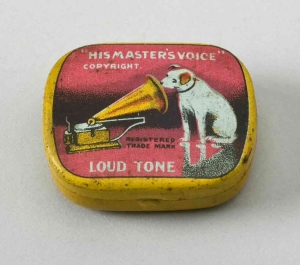
What is the smallest artifact in your collection?
Grammophonnadeldose “His Master’s Voice, 1910-1920, EVZ:2004/0324 TECHNOSEUM, picture Hans BlehIt’s probably a grammophone needle. They are only about one centimeter long and very thin. The respective containers are already so small that I can balance eight of them in the palm of my hand (not that I recommend this from an arthandling point of view!).
Is there an odd story/experience concerning and artifact/exhibition? Tell us about it. It can be an strange object, too.
Oh, there are tons of stories… Talking about “creative packaging”: There was a donation to our museum, the artifact doesn’t matter here. It was in a box and when we opened it, the first thing we saw were trash bags, the ones you get for free in Mannheim to collect plastics for recycling. Anyway, those bags were filled with cut out caps from milk bags. Probably they should form a flexible cushion. The artifact itself was wrapped in a bath mat. The kind that are cut out like an U to put them in front of the toilet. Obviously, this mat was historical too, and hadn’t seen a washing machine before changing its intended use…
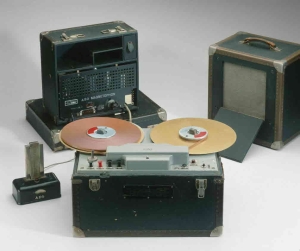
Do you have a favorite artifact? Why? AEG Magnetophon K 2, 1936, EVZ:2002/0057-001 Bild: TECHNOSEUMAsking a grandmother for her favorite grandchild… Maybe the K2 manufactured by AEG, the oldest surviving magnetic tape recorder. Its ancestors K1 were destroyed when an exhibition hall burned down at the international radio show in Berlin 1935. As far as our research goes there is only one copy of the successor K2 left – the one in our collection. While it’s quite natural for a collection of paintings to have unique artifacts it’s something very special for a collection of artifacts that were manufactured in great numbers.
Which artifact was the last one treated by a conservator and why?
Currently there are many artifacts treated for “Heart Blood”. Cleaning measures included we speak about hundreds of artifacts that are treated by our team of conservators. I remember especially the “Blaue Heinrich” (might be known as “Blue Henri” or “Blue Peter” in English speaking countries), a blue bottle used as a spittoon for people suffering tuberculosis. This might sound familiar to all of you who read “The Magic Mountain” by Thomas Mann. For we weren’t sure if there was still infectious material inside it had to be sanitized by a conservator. Guess that’s one of the things you don’t really think about when deciding to study conservation…
What’s the significance of your blog for your museum?
We are not a blog of the TECHNOSEUM, they have their own blog at http://www.technoseum-blog.de (worth a look!), that’s why Registrar Trek has no “official” significance. But of course my work inspired one article or the other, we have some faithful readers among our staff and the international network is helpful in many aspects of everyday work.
Do you have a favorite blogpost? If so, why?
Again asking a grandmother for her favorite grandchild… maybe “The Museum Registrar as Loans…” by Derek Swallow where he names the different professions a registrar has to be while he is involved with a loan – from juggler to legal associate. It’s a great article over all but I especially like the pictures he chose from the archives.
What does culture mean to you?
Culture is very important to me. But I’m not thinking about museums, theaters, opera, the so called “high culture”, in the first place, but culture in a more general meaning of the word, the everyday culture, how we interact as human beings. I find it thrilling to learn about different cultures. You don’t have to go abroad or look at people with migration background. It’s totally sufficient to look at our own surroundings. How much a culture exemplified by television is copied in everyday life. How it influences the language, the clothes, the wishes, for example. I think it’s very rewarding to observe this and to question it. For example many colleagues and friends from North America are surprised when I tell them what we think is “typical American”. The caricature transported by American TV series is not very far from the German as Nazi with leather trousers. To find parallels and differences in other cultures and think about the own culture – or maybe better: cultures – is very exciting.
If you “have an affair” with other cultural venues, what do you do?
I go to other museums and look what I would have done differently. Not fair, but fun. Apart from that I’m so surrounded by culture at my work that I prefer nature in my private life.
You got three wishes, what do you wish for?
1. Health for me and my family, I don’t know how you count, maybe all three are gone now but if not so…
2. Financial security for the rest of my life
3. The third wish I give to anyone desperately needing a wish
Phew, I’ve done it!
Now whom to throw the stick? Most outstanding blogs I can think of already got the #BestBlog Award. But I found one that is definitely worth it: the German/Russian/English Blog “Museum, Politics and Power” http://museumspoliticsandpower.org/ Duck and cover, Katrin, Linda and the others I haven’t known until now, here are your questions:
1. How did you come up with the idea of this blog?
2. How is the collaboration organized despite of the language barriers?
3. What projects are you working on?
4. Which blog entry stirred your emotions?
5. Which blog entry had the most outreach?
6. Which museum blogs do you like especially?
7. Which exhibition you found outstanding recently?
8. Which recent museum trends are interesting?
9. If you could found a museum as team of “Museum, Politics & Power” and you had all the money in the world …what would be the topic?
10. …which three artifacts definitely belong in the exhibition?
11. …where would it be?
And now?
As far as I understood the game:
– Answer the eleven questions. You may bend them to your convenience.
– Put the BestBlog picture in there and link to the blog that awarded you or link to the article of the one who threw the stick.
– Create eleven new questions and ask them ten other bloggers (it can be less than ten).
Would be great to post a comment with the link as soon as you answered my questions.
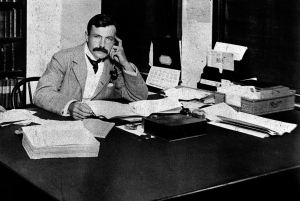
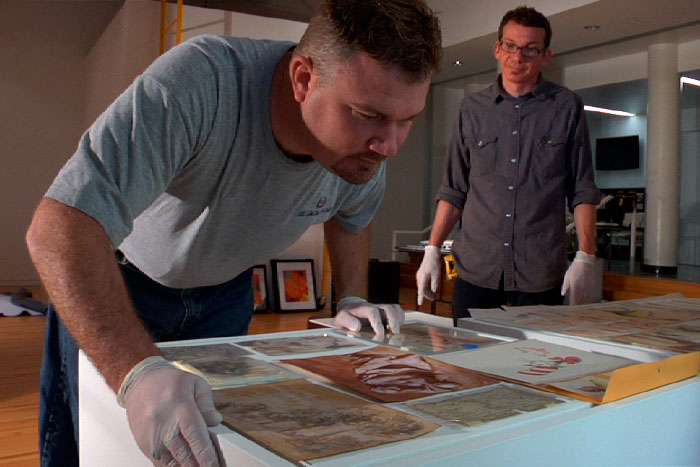
The discerning eye – Matt Leininger uncovering Landis in the new film.Been a while but I have not forgotten you and hope that 2014 has been a blessed year in your work and personal lives, and I mean that with much sincerity! All is quiet on the Landis front but not for long. Next month, the film that has been in production for more than three years comes from Emmy award winning director Jennifer Grausman and Oscar nominated director Sam Cullman, Art and Craft. Art and Craft will makes its world premier at the Tribeca Film Festival in New York City in Chelsea on April 17th. My wife and I will be in NYC for the screening and hopefully I will be able to continue my trek on educating the public not only on Landis but having that discerning eye and taking the time to be diligent in work making sure that no one is duped!
I say this to not only tell you that your position as registrar is important, but it may be one of the best decisions you have made. Why was it I that discovered and uncovered Landis to begin with when there are all of you out there that this task could been placed. I don’t know. What I do know is I did my job, did it well and now have the privilege of keeping my colleagues up to date and stay in communication as I am able with my schedule. I know you are all very busy but check out the links from this recent post and stay healthy, strong, happy and the rest will come in time.
I’m all excited. Last week I got the call that I will do a session at the European Registrar Conference 2014 in Helsinki! See the programme here: http://www.confedent.fi/erc-2014/programme/
The session will be called: The Next Generation: Registrar Blogs and Virtual Networks
I’m happy that Registrar Trek author Derek Swallow will join me and I hope to meet some other Registrar Trekkers and guest authors there.
Well, I won’t tell you what I will say in the presentation. No need to spoil the fun. But I can show you what my session proposal looked like:
A voice for Registrars and Collection Specialists around the world The project „Registrar Trek: The Next Generation“
The focus of this session is to introduce the project „Registrar Trek: The Next Generation“.
For professional exchange and development the registrar or collection manager depends
on colleagues outside her/his own institution, often outside her/his own country. It takes
years to built a personal professional network. Job-starters, multitasking professionals in
small institutions and colleagues in countries where the professions in collection
management are still in the state of development are often left to their own devices. The
major obstacles are language barriers and finding colleagues for thought exchange.
Out of this observation the project Registrar Trek was born. Core of the project are texts
written by collection professionals or people closely related to this field. The spectrum
ranges from serious thoughts on difficult registration issues to lighthearted observations
out of everyday collections work. Starting as a small platform for articles about registration
and collections management in January 2013 in three languages (English, Spanish,
German) it grew to a source of information and exchange with 32 translators from 19
countries providing 16 different languages.
In the outcome, it serves two major purposes: to create a virtual place where collection
specialists from all over the world can feel at home and understood and as an embassy
for collections work in the virtual world. To say it in the words of one of our readers:
„I learn something from each of the articles, even if it’s just that things could be worse.“
See you in Helsinki! Angela
A project to break down language barriers and connect registrars worldwide
 Well Trekkers it is great to write to you once again after seeing the world premier of Art and Craft at the Tribeca Film Festival! The film is great and is going to make history with this whole Landis deal. As I said in the film ‘he messed with the wrong registrar’! Cool thing is gang, Art and Craft will hit the big screen in theaters in the USA late fall, early summer, then the DVD and eventually will be televised. Really neat stuff and I was the registrar to make this all happen.
  Eight years in Oklahoma City, we decided to move back to Ohio where the end was coming for my career as a registrar, but I did not know it at the time. The Cincinnati Art Museum hired me on as Chief Registrar and I oversaw three fellow registrars that I miss… three good people with much experience. My position, believe it or not, was ‘eliminated’. The reasons I was told I was let go were all bogus and I finally burned my copy of the letter. I believe it was due to financial issues as I was making a seriously big salary for a registrar with full benefits. I think a big contributor however was my link to finding and tracking Mark Landis. A few weeks before I was let go, I was told not to talk about Landis on museum time. So I did not. No phone calls or emails. But you all knew where I was working and if you wanted information on Landis, you called or emailed. I adhered to CAM’s wishes and only talked and worked on Landis at home. I really did not do personal work on Landis at CAM anyway so not sure why they were worried. CAM is in Art and Craft and Cincinnati, OH is pasted all over the big screen. My gain, and a big win for Cincinnati even though the city is not aware of the film hitting the theaters!
  When I left Ohio with my new wife in 1998 I had no clue as to what I would be doing 17 years later. So take my life as a prime example, you will never know what the plan is for your life or career. So be happy where you are today and make each day count as tomorrow brings changes. Sometimes small changes or big, but be prepared. Change is coming. I was scared and worried three years ago when I lost my job which was the first time in my life. But here I am today, a hard working blue collar man with an awesome wife and daughter and I am honored to share how I got here!