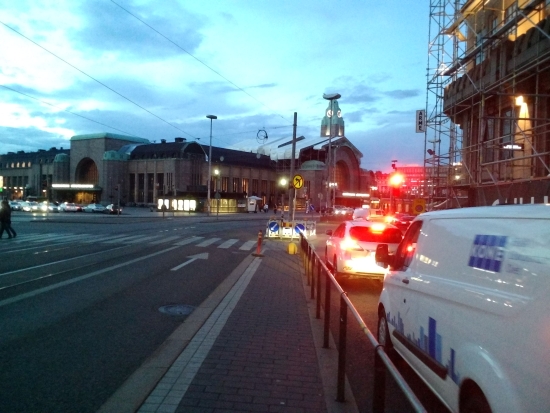
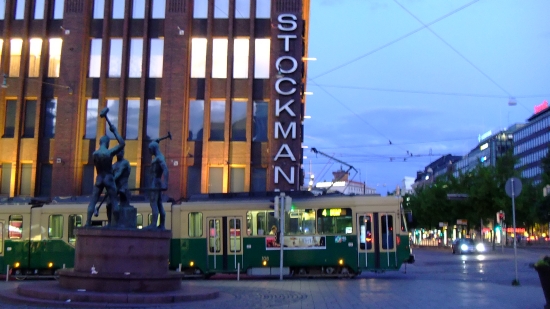
Helsinki white night with the central railway station in the backgroundWhen people ask me how my trip to Helsinki went I start telling them with enthusiasm about the beautiful city, the white nights, the friendly people, the good food, the seagulls,… only to realize then that what they really wanted to know is if there was something useful, innovative, important or in any way interesting at the conference. Okay, sounds legit, after all this wasn’t a holiday trip, although I had lots of fun.
Of course there were lots of interesting things to take away from the sessions. In order to tell it in a way that makes sense to someone who couldn’t attend I started with ordering my thoughts and my notes. The last one was easy, I constantly tweeted from the conference so I only needed to put together a storify to have an easy to access notepad: https://storify.com/RegistrarTrek/erc2014-the-twitter-notepad. I did the work to order the tweets by sessions two times, but unfortunately the program messed it up without me knowing what I’ve done wrong and without the possibility to right the wrong without investing hours. (Note to self: write post about the possibilities and challenges of tweeting from a conference).
Just when I started my report, I realized that the UK Registrars Group had set up a new blog where they posted articles about all the sessions. You can find it here: http://ukregistrarsgroup.blogspot.co.uk/
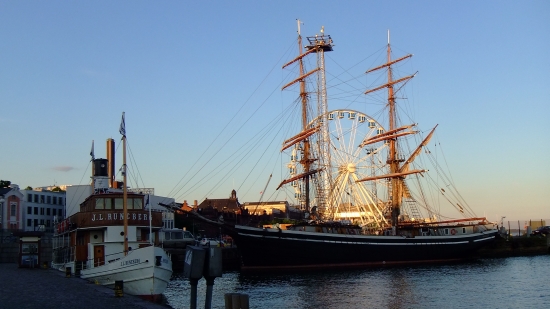
Helsinki HarbourBecause of this I feel somehow relieved from the pressure of reporting in an overarching way and instead can focus on some points in the sessions that seemed especially important to me. I will report in several posts in the order the sessions came up at ERC 2014.
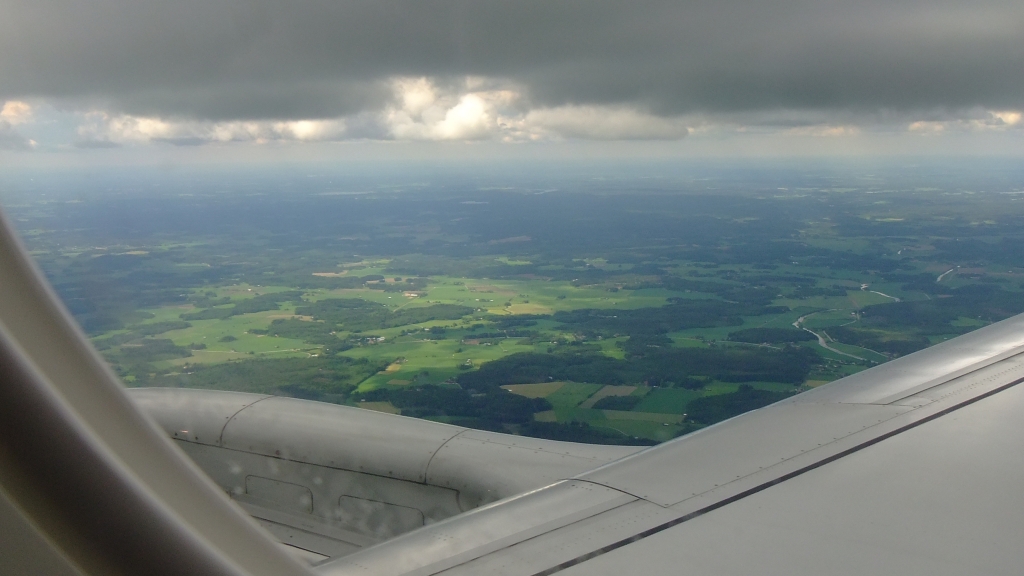
And now, before we dive into the sea of registrar’s techno-babble, please allow me one last picture taken while approaching Helsinki accompanied by the words of the Finnish writer Alexis Kivi, which I unfortunately only found in English:
What is that land of hill and dale
That is so beautiful,
The land aglow with summer days,
Land with the northern lights ablaze,
Whose beauty all the seasons share,
What is that land so fair?
The Finnish Land
This post is also available in French translated by Aurore Tisserand.
impression from a Helsinki White Night – picture taken around 11 at night!Just arrived home from Helsinki and it will take a few days to review notes, pictures, thoughts… everything. I’m still overwhelmed by the various impressions from the conference, the speeches, the presentations, the high professionality and friendliness of our hosts from the Nordic Registrars Group, the talks with colleagues, the laughter and the fun and especially from the politeliness and discreet warmth of the Helsinki people. But at least I want to make the presentation I did at the end of the conference available to all of our readers. More reports coming up.
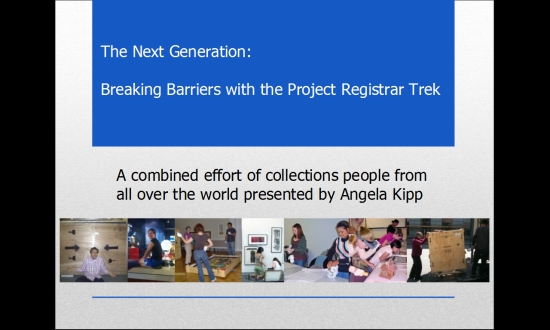
The Next Generation: Breaking Barriers with the Project Registrar Trek
Hyvää päivää. Mitä kuuluu?
Mina olen saksalainen.
Unfortunately, these are the only words I can speak in Suomi, one of the languages in this wonderful country that I had the pleasure to be a guest in for the last few days.
Not more than “Hello, how are you, I’m German.” There is a barrier, a language barrier. Today, I’m speaking about breaking down barriers. Language barriers and other barriers.
Maybe as we sit here together we think that language barriers can be overcome by learning another language. This way we are able to communicate and exchange thoughts, for example in English. While it is true that English enables us to hold conferences like this one, we should keep in mind that we all have just crossed a barrier that leaves other colleagues behind. Who attends this conference? Registrars and collection managers who feel able to follow a conference that is held in English. Others who are not so confident about their language skills stayed at home.
The language barrier might be a problem in understanding each other. But on another level we understand each other very well: we share the language of collections people.
If we talk about lending and borrowing, about storage needs and documentation problems we understand each other, no matter what our mother tongue is and which continent we are from. We understand each other so well that it doesn’t come to mind how difficult it is for other people to understand what we do. This is a barrier not only between us and the visitors in our museums; this is even a barrier between other museum professionals and we, the collections people.
There’s a third barrier. A barrier that is so close to us that we need others to let us see it: it’s the barrier of our everyday work experience, the barrier of our own museum’s walls.
Today, I’m going to introduce a project we started a while ago to work towards breaking these barriers. Some of you might know it already: It’s called Registrar Trek: The Next Generation.
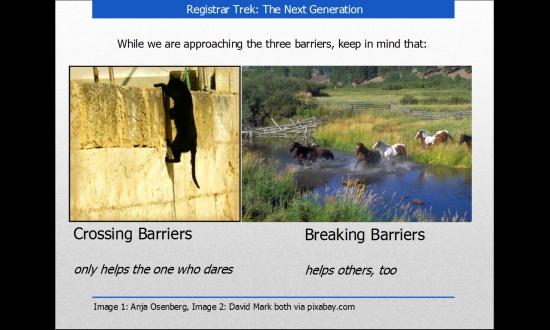
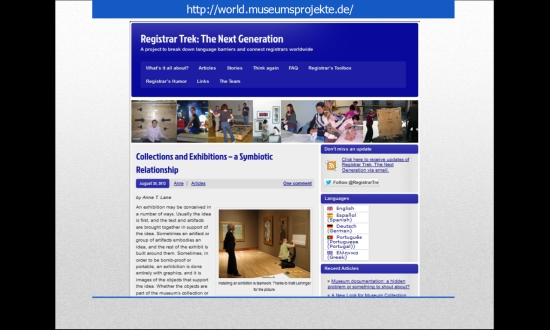
I think there’s no use in clicking through a website and telling you what you see at a conference. That can be better done at home. I think it’s better to tell you something about the general idea of this project, about the spirit of Registrar Trek:
Let us now start to approach the three barriers, starting with the language barrier.
Breaking down the language barrier
The language barrier was the barrier that originally started this project.
We started with three languages: English, Spanish and German. Sure, our translations weren’t always perfect, but it was a start. As soon as we started,
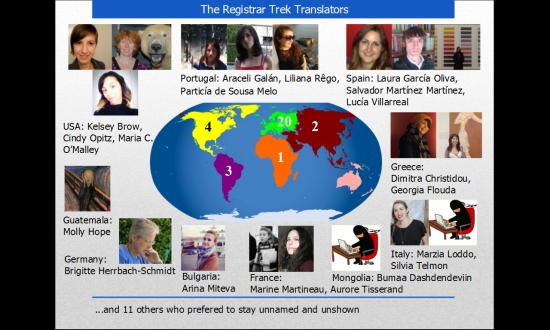
others joined us and right now we have 30 translators from 19 countries providing 16 different languages.
Of course, we don’t have all the posts in all languages right from the start. We are volunteers, mainly working in museums, some studying, some interning, some retired, others job-hunting. So, you can imagine that we are all busy. But because we are many, most of the time we can provide at least 2-3 languages when publishing a new post. Others are added as soon as they arrive.
The good news is that you can’t have too many translators. The more translators we have, the easier it is to balance the workload and the faster we are in adding translations.
So if some of you want to join, I will be glad to say: welcome on board.
Let’s approach the second barrier: The barrier of registrar’s lingo.
Breaking down the barrier of registrar’s lingo: Telling what we really do
We all know what we do every day. When we talk to each other we don’t have to explain many things. We know what a loan contract is and what a disaster plan looks like, we understand categorizing issues, we feel for a colleague that has to upgrade to a new version of a data base, the list goes on and on.
When we talk to “strangers” about our profession we often realize that it’s extremely hard to explain in a few words what the job of a registrar or collections manager consists of.
The question is: why is it that way? We have such a wonderful, thrilling job, why is it so hard to get the message across? So hard, sometimes even our family members have no idea except that we “work at a museum”?
Personally, I think a big part of the challenge is that we try to explain our jobs in an abstract way.
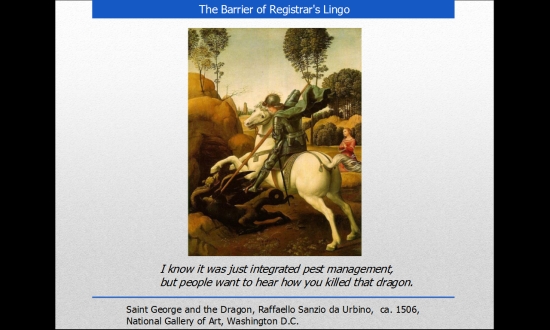
Let me give you an example: I sit together with colleagues at lunch. The educator tells how he guided a difficult class, the press officer tells how she organized a great speaker for the next event and I say that “I did some integrated pest management”.
While I understand what the educator and the press officer did, they don’t understand what I did.
Why didn’t I break this barrier by saying that I had checked and baited mouse traps the whole morning? Well, that’s not exactly slaying dragons, but in the museum perspective, it’s pretty close.
That’s exactly the approach of Registrar Trek to break this barrier: by telling stories.
I know that „storytelling“ has become a buzzword in the museum field, but the truth is: telling stories is a very ancient way of getting messages across in an entertaining way.
A story about what one has to consider when storing earphones or how one built a box for hundreds of buttons gives a better impression of our job to an outsider than collection policies and job descriptions.
A story about how you climbed the roof of your storage area five times to supervise the craftsmen working there will give a better hands-on impression of the job duties than any handbook.
It will help students and young emerging museum professionals decide if collections is really the perfect fit for them or if it might be better to pursue the marketing or education path.
A story about how you found information about an object that proves its significance for the collection and your community will give other museum professionals like educators and press officers food for their own work and an idea why the work you do is important for the museum.
But telling stories can also help us to approach the third barrier: the barrier of your own museum’s walls.
Breaking down the barrier of the own museum’s walls
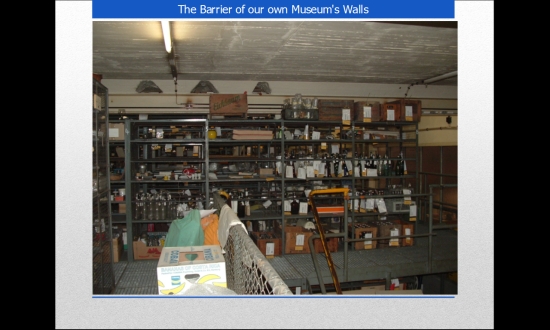
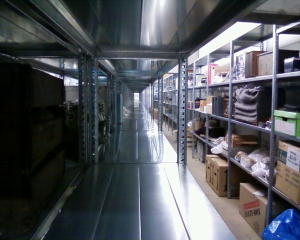
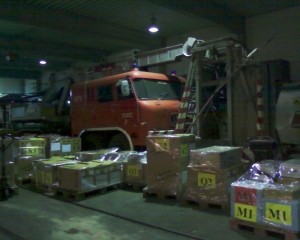
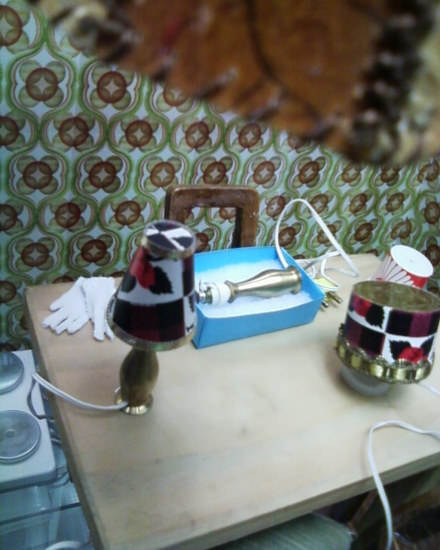
When you work for a specific museum a long time you become blind to its shortcomings and, more often, you don’t see what works well any more. I brought you a picture:
I don’t know how many of you have had this kind of situation. When you are heading for a museum career you absorb everything about best practices, about good storage conditions, about wearing white gloves. Then you take up a job and start with all the enthusiasm of the young, aspiring museum professional. And then, the real museum world hits you.
In short: you have all the knowledge and the guidelines how it should be but literally no one has prepared you for the situation as it will be.
The trouble is that reading guidelines and official publications of museum associations in such a situation isn’t helpful. Instead it’s depressing. But what might be helpful or at least encouraging is to read stories about how someone brought order to such a mess – or how it could be worse. And if you cleaned out this mess it can feel fabulous to write an article for Registrar Trek about it.
I think our author Anne T. Lane said it best when she said:
“Our triumphs are not like other people’s triumphs. Our crises are not like other people’s crises. It’s good to find ourselves part of a community that understands.”
And maybe, when you publish it, you will suddenly get feedback from colleagues from around the world helping you to see your own situation from a different angle.
When you and I look at the picture the immediate thought is: “What a mess! We have to start cleaning and wrapping those objects, someone go, fetch some archival boxes”
But in a small rural museum in Germany, your colleague (who most certainly will also hold the title of director, visitor guide, administration officer, janitor and webmaster) will say: “Oh, lucky you! You have a room for storage, the roof isn’t leaking and it seems all those objects have labels!”
So, the benefit of writing stories and articles for Registrar Trek is not only to help and encourage others, it can also be a chance of reflecting on our own position. And you create a chance for professional discussion.
Best practices are in constant development and improvement and need creative input that comes out of our everyday, hands-on working practice.
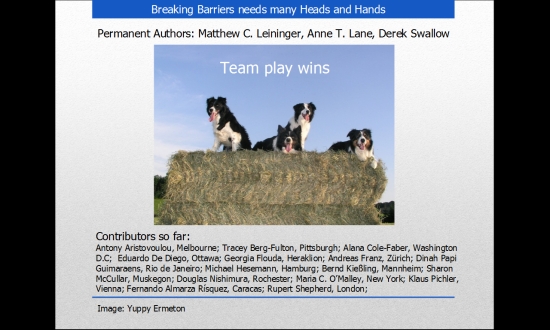
Breaking barriers needs many heads and hands
Right from the start Registrar Trek was meant to be a project designed to involve many people from our profession. It was never about one or two people telling their stories and the others just translating and commenting. (Otherwise I would constantly bore you with stories out of collection management in a German Science and Technology Museum).
We wanted to have collection professionals from around the world bringing in their views, their articles, and their stories. For example, Tracey Berg-Fulton who did the wonderful session before this one wrote an article about how she became a registrar, and that’s just one out of many.
We want you to bring in your views, your articles, and your stories.
The core of Registrar Trek is that it is a common project of colleagues. Standing here alone and telling you about Registrar Trek feels somehow wrong. So, to speak for the authors of Registrar Trek I’m very glad to have Derek Swallow here from the Royal British Columbia Museum in Victoria.
Derek Swallow enters the stage and says the following part:
Thank you Angela.
I want to very briefly touch on two points: how you can contribute if you choose and secondly the rewards of being a Registrar Trek author.
Currently we have four main sections in Registrars Trek any of which you can contribute to: the first is Articles which covers broader issues of common interest and a share point for ideas; next is Stories – this section is comprised of real shared events celebrating learning by way of our successes and failures; the third is called the Registrars Tool Box containing practical solutions, and facts to assist with our day-to-day work; and finally Registrar Humour – I find I need a daily dose of humour to keep me sane in this wonderful but stressful job.
Now the rewards of being a Registrar Trek author: personally, it’s about the process of engaging in communication about museum topics with collections specialists from all over the world. For example, in past articles I’ve presented a new approach to conducting collections committee meetings adopted recently at my museum. I’ve also posed the question: how does authenticity relate to collecting in the 21 century museum? I’ve discussed how our roles as registrars are perceived or misperceived by both the general public and other museum employees.
As a result of writing these articles I’ve received important feedback which has helped evolve and clarify my ideas as a professional in this field as well as establish professional connections with colleagues in Europe, North America and Africa.
I want to leave you with one final thought. In this room 34 nations are represented. If even one person from each nation were to join Registrar Trek as a writer or contributor what an amazing network of communication would open up for us all and can you imagine how broad and rich our exchange of ideas would be?
I thank you all.
Thank you so much, Derek.
I believe we’ve said all we wanted to say about our project. Don’t forget we are always glad to publish your stories. Maybe you haven’t killed a dragon. But maybe you found a great new way of reorganizing your storage space. Or to pack an X-Ray-tube. Or you accidentally loaned 200 artifacts and want to tell others how to avoid this.
Keep up the good work, thanks for listening and may the road rise to meet you.
Kiitos paljon, Helsinki!
This post is also available in Italian, translated by Marzia Loddo.
If you were given a choice between donating money for museum conservation, education, or documentation, would you give to documentation?
I was offered this choice by a collecting box at one of the London national museums just before Christmas last year. Or rather, I was given a choice between conservation and education: documentation didn’t feature. This made me think: documentation seldom appears in public discussions of what museums do.
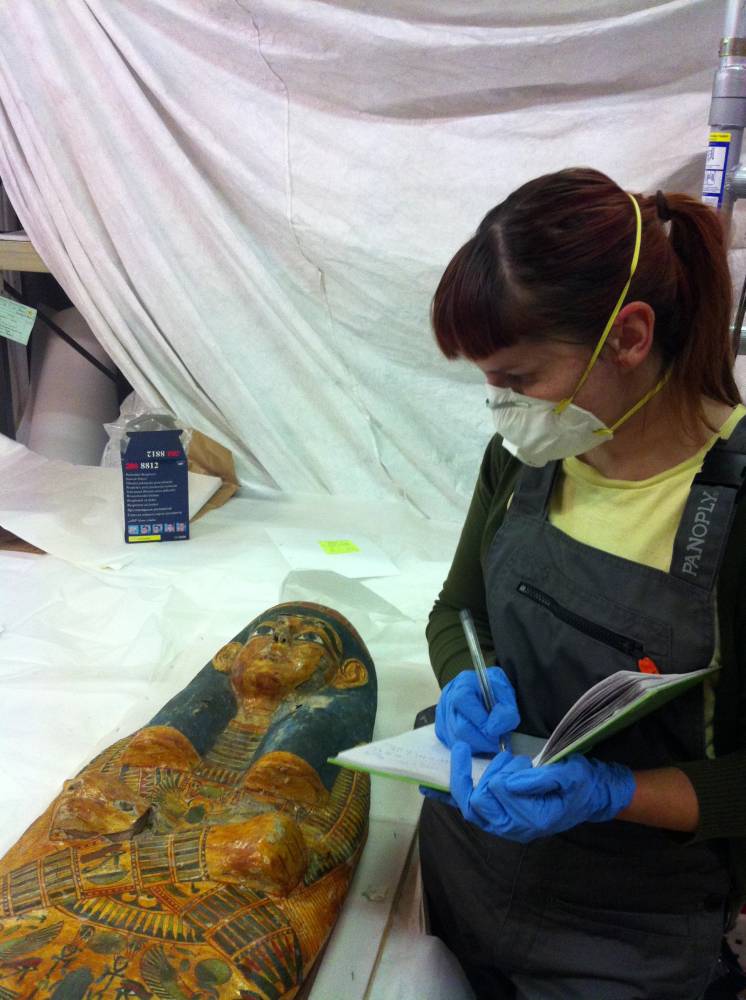
Horniman Museum Collections Assistant Laura Cronin at work reconciling one of the mummies with its paperwork. Photo: Helen Merrett
If you’re reading this blog, then I think you already know what documentation is. For what it’s worth, my definition falls into two parts. Documentation comprises: looking after the information a museum has about its collections; and making sure that the museum is able to account to its public, its funders, and anyone else for its collections and everything that happens to them. And I’m sure you also understand that a museum’s documentation is as central as its objects to everything it does: without documentation, the collections are a meaningless pile of odds and ends. If we don’t know what the objects are and where they come from, we cannot meaningfully display them or help people understand them.
Why, then, does documentation so seldom appear in public? After my encounter with that collecting box, I thought I’d ask my colleagues across the museum community, so I started a discussion on LinkedIn, in Collections Trust’s Collections Management group (you need to have joined the group to read it). The discussion was fascinating, and this blog is really an attempt to pull it together into something more structured and condensed.
Why is documentation important?
In the UK and, I expect, around the world, publicly-funded museums are under great financial pressure: we’re expected to do as much work as we’ve always done – if not more – with less and less money. As a result, we need to look more widely for funding even for our core activities. A few months ago, I was talking about the difficulty in funding day-to-day documentation work with my museum’s director, and she said something which I’ve taken to heart: ‘you need to tell the story’. There’s no point continually saying documentation’s important: we have to say why it’s important.
In an attempt to provide a really inspiring argument for documentation’s significance, I asked people in the LinkedIn group to provide their explanations – ideally, in the 140 characters or fewer needed to create a tweet. (There’ll be more about Twitter later.) There were some great, pithy responses, and a few weeks ago I tweeted one of these a day for a couple of weeks. I’ve Storifyed them here. They pretty much reinforce what I said before: without documentation, we can’t understand or do anything meaningful with our objects, and so we can’t use them to do all those inspiring things we pride ourselves in. And, of course, we need to know where our objects are, be able to prove that we own them, and so on.
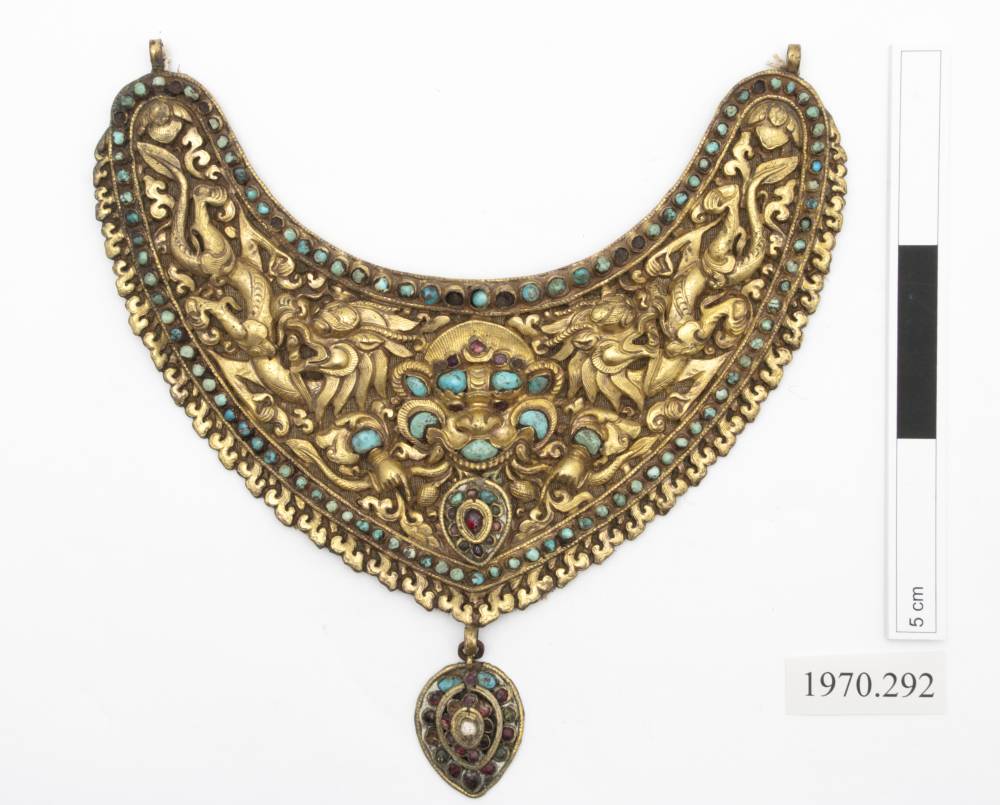
Hidden treasure revealed during the Horniman Museum’s Collections People Stories collection review: a pendant in gold, copper and semi-precious stones from Nepal, 1970.292. Horniman Museum and Gardens
One or two contributors took the wider view: Registrar Trek’s own Angela Kipp said that ‘without documentation, humanity loses its memory’ – and ‘losing your memory means losing yourself’. And perhaps my favourite, for its sheer enthusiasm, came from Barbara Palmer, registrar at the Powerhouse Museum: ‘I uncover hidden treasures and make them accessible. I feel like I have the best job in the world.’
Why isn’t documentation more visible to the public (and why does this matter)?
But is this the right way to proceed? Nick Poole, for one, suggested that we shouldn’t be dividing museums up into separate activities like this: what is important, he said, is the end result. After all, supermarkets focus on the quality of what they sell, not on how it got to their shelves.
But with all respect to Nick, I think this misses the point slightly. In many other fields, the infrastructure is visible: to stay with Nick’s example, supermarkets advertise the freshness of their produce by saying things like ‘from the farm to our shelves in two days’, and we can all see supermarket shelf-stackers and the trucks that carry the produce across the country. In museums, we show off our exhibitions, displays, interpretation, and websites – but visitors can’t see the infrastructure used to create it. When do we ever say ‘this exhibition was brought to you using the quality data in our collections management system’?
And should we be comparing museums to supermarkets anyway? Angela reminded us that museums exist not just to display objects, but also to educate, collect, research, and preserve our objects for future generations and researchers: we all know that not everything we collect ends up going on view to the public straightaway, and much of the research done on the collections does not lead immediately to a new piece of public interpretation. But in the UK, at least, I can’t help feeling that Angela’s is a somewhat unfashionable view: we are constantly being asked to justify what we do in tangible, measurable and visible ways, hence the focus on the public outputs.
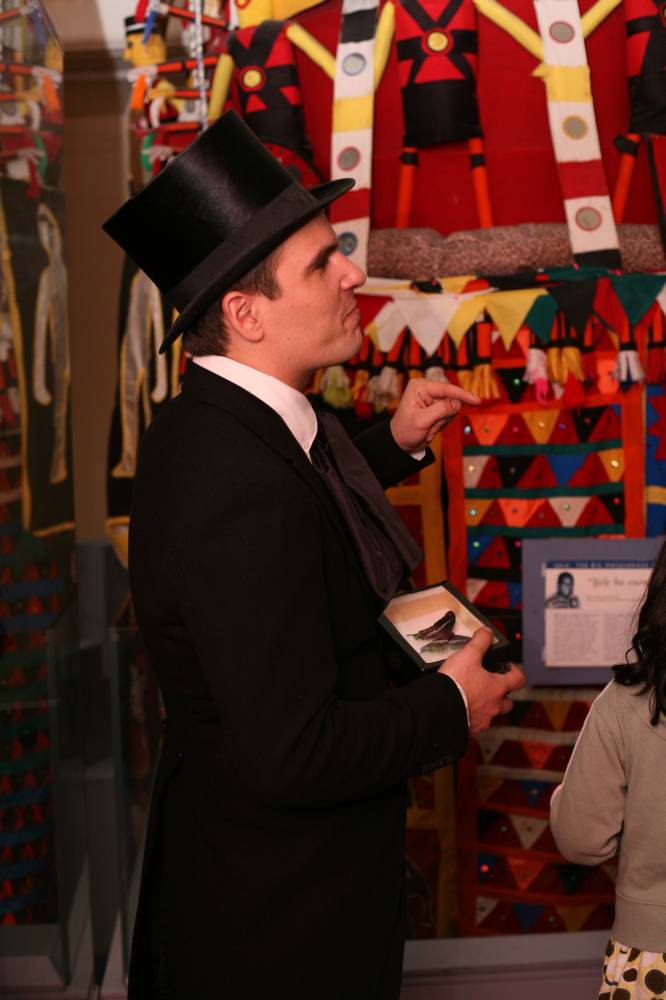
‘Mr Horniman’, holding a specimen of his butterfly, Papilio hornimani, talks about the collections in the Horniman Museum’s African Worlds Gallery. Horniman Museum and Gardens. Photo: Laura Mtungwazi
Other people, such as Michaelle Haughian and Shaun Osborne, suggested that documentation was primarily of interest to other museum people: the public don’t need to see how it works. Michaelle wondered whether ‘the crux of this issue isn’t the way funds are allocated? Do we need to have a second discussion about the bare bones funding models museums are accustomed to? Do we need to talk about why education and programming seem to get more money than collections or registration work?’ This is a point that Angela also made: ‘people decide to fund what they know, see and take part [in] in museums (educational programmes, tours) and not something that is hard for them to imagine, because it needs explanation (conservation, documentation, public relations, administration…).’
I think this is the fundamental problem: if you don’t know something exists, how do you know that it’s important, let alone that you could fund it? And perhaps, as Shaun also suggested, what’s important is not that documentation should be made visible to the public, but that it should be made visible to our senior managers, our trustees, and our funders.
Why is documentation a ‘problem’ (and how did we get to where we are today)?
Nick also suggested that one problem we face when making the argument for documentation is that we tend to see it as a problem: we have a horrible tendency to append the word ‘backlog’ to it. Thinking about my own organisation, the Horniman Museum, we do have backlogs of various kinds, and I would certainly say that they are problems: one reason I’ve been concerned about documentation’s public profile is my wish to clear some of the backlogs which are preventing my museum from working as efficiently as it might. In the current funding climate, we have to work as effectively as possible: poor documentation hinders this; really good documentation enables it.
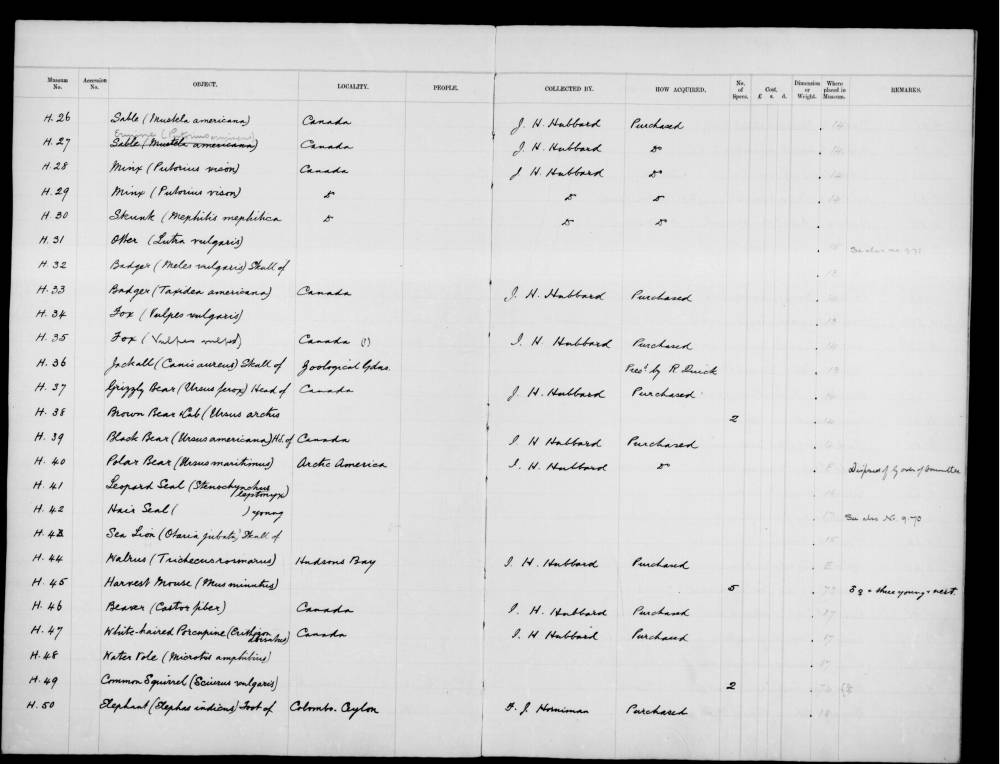
A page from the Horniman Museum’s register of natural history specimens from 1900 to 1934, ARC/HMG/CM/001/008. Horniman Museum and Gardens
Backlogs arise for various reasons. At least in older museums, they exist in part because of the way our current data has been generated: from what I know of my own institution, our records started as register entries, which were expanded into index cards, which were built upon to form catalogue cards, which were imported into an early database, which were in turn imported into MultiMimsy, which were then imported into Mimsy 2000, and then imported into Mimsy XG. (At the Ashmolean, over 200 separate databases were imported into their first museum-wide collections management system, MuseumPlus.)
Every stage represents an opportunity for inaccuracies to creep in (in the manual conversions), and kludges to be made when importing or transferring data (in digital systems) in order to get something up and running in a reasonable time. We always promise ourselves that we will come back to it and tidy it up; and then something else comes up, the opportunity has gone, and we have – a backlog of data tidying.
And this leads to a second reason why backlogs build up: straightforward lack of resources. Museums simply don’t have the people needed to do the work that needs to be done (particularly, that needs to be done now if we’re to create records that we don’t have to keep coming back to). In many organisations, as documentation tasks are increasingly passed to volunteers, placements or interns rather than paid staff in an attempt to get something done, so more of the work needs to be checked and revisited to ensure it’s fit for purpose; and we don’t always have the time to do that as much as we would wish.
Why has this all become so labour-intensive? Graham Oliver, who’s worked as a curator for 35 years, reminded us that documentation used to be part of a curator’s work – but the people contributing to the LinkedIn discussion were called ‘curator, documentation officer, collections information systems manager, content manager, access officer’, and so on. The last two or three decades have indeed seen a huge increase in specialisation in the museum world. When documentation consisted of registering an acquisition, creating index cards for it, pulling one’s research into a history file, and updating a location card when the object moved, it was easier to incorporate it into one’s day-to-day curatorial work.
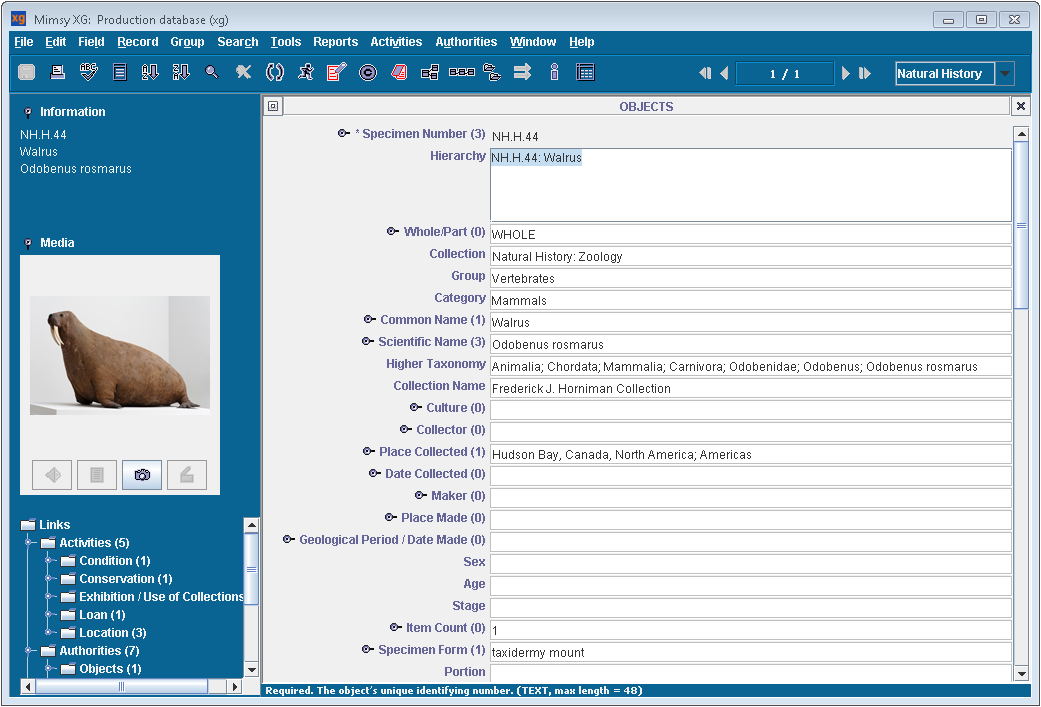
An object record in the Horniman Museum’s Mimsy XG collections management system. Horniman Museum and Gardens
But then computers arrived, and they became the preserve of specialists – understandably, if you look at a system like Mimsy XG, which we use at the Horniman: there are something like 3000 different, discrete units of information in there, and to configure it, maintain it, and keep the data consistent is a specialist job which the vast majority of people who work in museums simply wouldn’t want to do. So documentation jobs were created to manage the information, and to make sure that the procedures drawn up in Spectrum over the last 20-30 years were being implemented and tied into the computerised information: suddenly, there was a new sub-discipline within museums. Many curators took to it; others, alas, didn’t. The same is true of the many other specialists doing the work that used to be done by curators – and there were far fewer curators then, than there are now staff doing all those specialised jobs.
And as documentation has become more and more of a specialism, other museum staff have become less aware of some of the problems which can arise if it’s not done just right. There are a couple of misunderstandings which I think have been particularly pernicious, and have made it much harder for us to argue for resources to address our backlogs.
The first is the database pixie delusion. A senior curator (I’m naming no names, not even institutions, here) once said to me that their ideal collections database would comprise one field, into which they would type what they knew about the object. The database would then organise this information so it could be used effectively. The delusion is the belief that you simply have to put your collection information into a database and everything will be all right. It doesn’t matter that the data is inconsistent, mis-spelt, or incomplete: it’s in a database, so of course it’ll be OK. After all, the database contains little pixies that will get the data tidy (even proof-read it), consistent, linked, and so on. Our colleagues sometimes seem to have had a touching faith in the intelligence of computers, whilst those of us who work with them more frequently know that they are fundamentally dumb, and that if you put rubbish in, you’ll get rubbish out.
Related to this is the Google delusion. We’re now very used to using web search engines to find information. We type something into Google, say, and if we get one useful result in the first page, we reckon it’s worked pretty well. On the other hand, in a well-maintained database, if you run a search, your results will be all the objects that are precisely what you are looking for, and no others.
Again, this reminds me of a conversation I once had with a colleague. We were talking about searching for objects made of copper alloy, and how one would run the search. Ideally, you would enter ‘copper alloy’ in a materials field, and get back all those objects made of copper alloy, and no others. But my colleague was quite happy to run a series of separate searches, for ‘copper alloy’, yes, but also for ‘Cu alloy’, ‘CuA’, ‘bronze’, and so on: in their mind, if they were able to do this and get back most of the relevant objects across all these searches, along with some others which weren’t really relevant, the database was working well. They didn’t seem to realise that this made it much harder to then reuse that information by generating reports or lists of objects which could be used outside the system.
If we return to Google and think of the amount of research and development that has gone into its search algorithms, then we can see that it’s a massively expensive tool for indexing really poorly-structured data, and it does so adequately, at best. It has lowered our expectations of data retrieval in an extremely unhealthy way.
Raising documentation’s public profile
As you can see, I agree with Nick when he says that there’s been a long-standing culture clash between documentalists, who tend to be systems thinkers, and our colleagues who are, as he says, ‘value-driven creative people with a strong set of social values’. This has led to the need to explain the value of documentation in terms of its end users. I’d also agree with Nick that we need to argue for a museum and funding culture that recognises that ‘a building with things in it, but without knowledge or skilled people, is not a museum. And people deserve museums.’
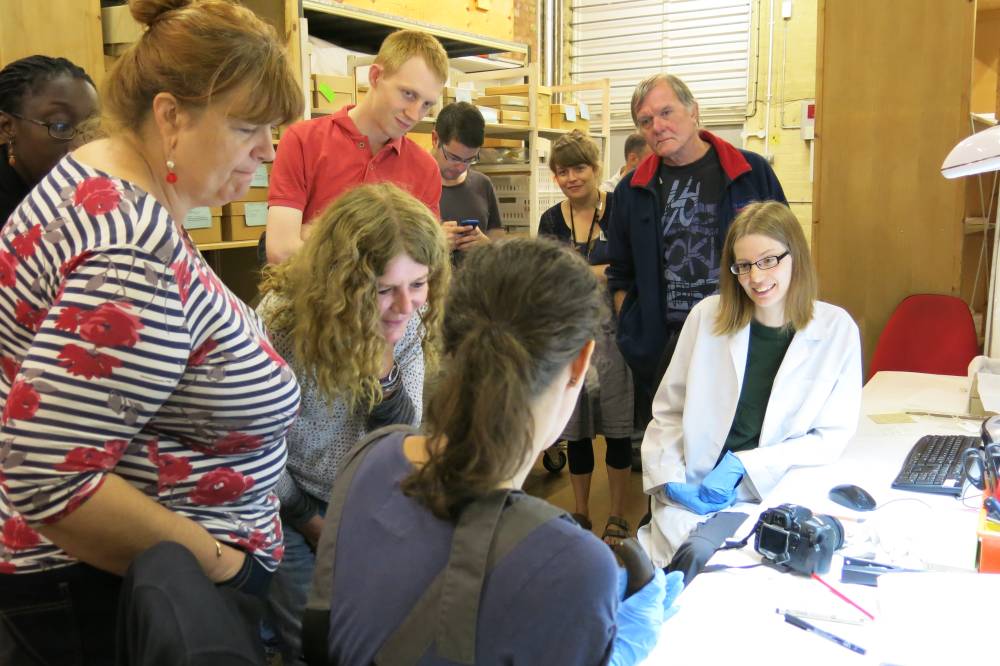
Horniman Museum Collections / Documentation Assistant Clare Plascow (back to camera), and Documentation / Collections Assistant Rachel Jennings, explaining their work on the Collections People Stories review to a ‘behind the scenes’ tour of the Museum’s stores. Photo: Nicola Scott
So we come back to how best to make those arguments. As we’ve seen, our LinkedIn discussion broadly divided into two camps: first, those who feel that it’s not worth raising documentation’s profile to the public, because it’s part of a process that leads to public outputs like displays, exhibitions, engagement or learning events, and those end results are what’s important; and second, those who think that it is worth publicising what we do for its own sake. There was also a group who suggested that documentation should be bundled up as part of general presentations of ‘behind the scenes work’, and this in particular is something that I think we could all try and pursue.
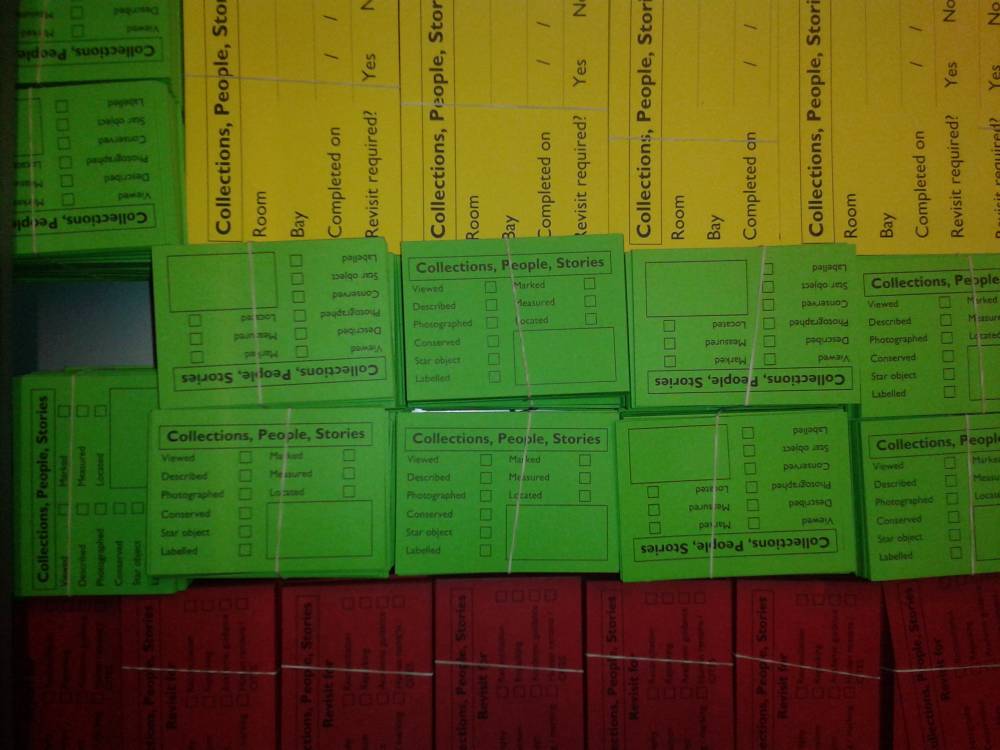
Box and bay labels for the Horniman Museum’s Collections People Stories review awaiting use. Photo: Rupert Shepherd
But generally speaking, I think I’m still part of the second group. Something else that persuaded me to start the discussion was a passing comment when I was in a meeting. One of our conservators said that work had just been finished on an object, and our Digital Media Manager’s immediate response was ‘Great! Can you write me a blog about it? Everyone loves a conservation blog.’ Our conservation department has its own page on our website, linked to ten case studies. Our Documentation (and Collections Management) departments don’t – even though we’ve been making significant contributions to aspects of the museum’s work as diverse as our online collections, our Collections People Storiescollections review, and our famous walrus’s recent trip to the seaside at Margate.
Like that national museum’s collecting box, this showed me that we do publicise our behind the scenes work – but only certain parts of it. And as Angela said, what’s visible is what people think of funding when they reach for their cheque books. Yes, we need to raise documentation’s profile with our managers; but we also need to spread the word more widely, because in the end, it’s not just our managers who provide our funding.
So how can we do this? When I started the discussion on LinkedIn, I also suggested that everyone working in museum documentation who had a Twitter account should tweet what they’ve been doing each day, and – crucially – why it’s important, using the hashtag #MuseumDocumentation. A couple of weeks after we began, Angela Storifyed some of the tweets; and you can also follow them here:
Even if our followers are only our family, friends, or colleagues, it’s a start; but the more momentum we can gather, the more word will spread beyond our immediate circle; and our managers, and perhaps even our funders, will start to understand that documentation really is worth supporting. So I’d like to take this opportunity to thank everyone who’s contributed to the discussion so far, both on LinkedIn and on Twitter: I’ve been hugely impressed by everybody’s enthusiasm for, and dedication to, what we do. I’d also encourage everyone else to have a go at tweeting about #MuseumDocumentation: I’ve found the experience of saying why what I do is important, in a new way every day, quite challenging – and stimulating.
Has it been working? Well, our Digital Media Manager did come through and ask me to write a short blog post about documentation and the hashtag for our website; and I have been interviewed for an article on documentation to go in the Museums Journal, as well as being asked to write a short piece for the Museums & Heritage Magazine. So maybe we’re beginning to raise our profile a bit.
Oh – and when I went back to that London national museum, the collection box no longer offered you a choice ….
About the author: Rupert Shepherd initially trained as an art historian, specialising in the Italian Renaissance, before moving into museum documentation, dabbling in humanities computing and digitisation along the way. He was Manager of Museum Documentation at the Ashmolean Museum for three years, and since 2010 has been Documentation Manager at the Horniman Museum and Gardens in south-east London – but the views he expresses in this post are his own.
Innovation in such areas as exhibition methodology, education programs, revenue generation is expected in the 21st Century museums. This is not always the case for core museum processes. However, necessity can drive such innovation. Many twenty-first century museums face the harsh reality of shrinking budgets. One impact: fewer staff with heavy workloads. To maintain high service standards and internal best practices museum personnel look for ways to work more efficiently. Better time management is one solution. New measures such as pruning the number and length of meetings can conserve this now precious commodity – time. Modifying the delivery and structure of tradition museum business meetings is an area where savings can be found. In early 2013, the Royal BC Museum, where I work, launched a pilot project, aimed simultaneously at carving down our collections committee meeting time and building a more flexible, egalitarian process.
Work load too much? # f 08817 Collection of the Royal BC Museum/BC Archives.
Traditionally, our committee composed of curators, archivists and a conservation representative, guided by a chair person, met monthly for one and a half hours: its mandate to decide which new collections, proposed by discipline curators or archivists, would be accepted into the Royal BC Museum permanent holdings as well as adjudicate recommended collection deaccessions. The agenda, provided electronically to members several days before the meeting allowed time to digest the information about each proposed acquisition including the proponent curator’s acquisition proposal (rationale for acquisition) and the conservation department report. The latter included the general to specific condition of the collection and its components, specifying the time needed to both stabilize and preserve these components over the long term. Armed with this data the members of the collections committee, along with the curator/archivist proponent for each collection, attended the monthly meeting. The proponents “presented” their collections, fielded questions, then the committee would vote. Proposed deaccessions were handled in a similar manner. I suspect this is a familiar format for many of your institutions.Tired of those traditional collections committee meetings? # a 00514 Collection of the Royal BC Museum/BC Archives.The new model at the Royal BC Museum displaced face-to-face meetings with “virtual” consultation and decision making. By “virtual” I mean that all information transfer, and collection discussions, between collection proponents and committee members, is done via electronic means through email. All processing tracking documents, agendas, collections voting lists, and committee decision postings exist as Excel and Word documents and “live” in digital format on a common drive.
Along with the process the committee structure changed. An egalitarian measure was built in: members now included collections managers as well as curators and archivists. The registrar, previously the recording secretary, assumed the role of quasi-chair person responsible for creating and updating the electronic voting agenda, and the capture and dissemination of electronic communication.
In brief, this is how the “virtual” collection committee (CC) works:
Once a collection has a completed acquisition proposal entered into our database by the proponent curator or archivist, conservator and discipline collections manager the registrar posts it to the excel spreadsheet “voting list”, serving as an agenda. The contained fields include the discipline of the collection, registration number (unique number created by our collections management system), the name of the donor or collection, a summary description, the name of the collection proponent, and voting boxes for each committee member. This spreadsheet, posted at the beginning of a month, to a common drive, is accessible to CC members. If a CC member has a question about a given collection this is sent via email to the proponent cc’ing all the other CC members. The response is therefore sent back to the committee as a whole. This replaces in-person discussions regarding the collections. The registrar copies all such questions and answers, as well as general CC member comments, pastes them into a Word document which forms which, along with the voting list/agenda forms part of the permanent record of decision.
Why not use our sophisticated computer tools to do the job better? # na 19565 and # i 24586-1 Collection of the Royal BC Museum/BC Archives.
The voting list/agenda is a “living” document; as collections are readied for review they are added by the registrar for the first three weeks of the month, where after, the agenda is closed and the registrar tallies and posts the results.
Advantages of the new model include the following:
Voting is flexible – can be done when time permits
The process is Greener – no paper is involved
Collection advocate responses to CC member questions can be thought out and clearly presented – rather than being “off the cuff” in a regular meeting. In addition these questions and answers can be saved in whole. I traditional meetings the minutes contain only a synopsis of the discussions. Some subtle and compelled points may accidentally be omitted.
There are no minutes to write up.
Time for travel between offices and the meeting room is saved as well as wasted time waiting for a meeting to start as well as through social engagement during and after the meeting. This easily amounts to an hour savings in itself.
Disadvantages of the new model include the following:
Using only email communication reduces the dialogue related to each acquisition and there can be more communication in less time in a face to face meeting.
Important opportunities to discuss important spin off issues that arise from collections discussion such as policy and procedures are lost.
Some members find the depersonalization of the process discomforting – we need to come together face-to-face as a group.
Since voting is done in a staggered manner there is a possibility a CC member may be influenced by viewing the vote of a respected colleague.
Registrars tracking time is greater.
I am the first to admit, as designer of the system, that the net time savings is relatively nominal. However, a gain of an hour and a half a month is helpful and if others look at internal processes with the same view of saving an hour or so a month soon we have an addition day of time savings. Unfortunately, this doesn’t reduce our workload and give us more free time, it simple means we don’t have to work so onerously hard tackling this workload.
I end with a quote from the famous mid-twentieth century American actor and radio announcer Edgar Bergen: “Hard work never killed anybody, but why take a chance.”
It’s dangerous to be on twitter. Recently, Tanja Praske from KULTUR-MUSEO-TALK threw a blog stick at me. I had to look it up first but now I take it with white gloves and answer her questions:
Who are you? What excites you about your job?
I’m many. No, I’m not schizophrenic, but Registrar Trek is a joint project with four permanent authors, many guest authors and at the moment 36 translators. The range goes from the Canadian collection manager to the Russian marketing expert who lives in Bulgaria to the press officer in Simbabwe. I take the liberty to answer your questions as Angela Kipp, co-founder and administrator of the project.
I’m the collection manager of the TECHNOSEUM in Mannheim/Germany. It might sound trite, but what excites me most about my job is the diversity of tasks. One day you organize the shipping of a huge, fragile machine, the next you wonder how to store 400 little magnetic traffic signs that once belonged to a driving school. Our collection contains about 170,000 artifacts and to safeguard that nothing gets damaged and everything is stored properly, efficient and retrievable is a Sisyphean task, to put it in a positive way: a life’s work.
Registrar Trek is a private project where I act out my passion for writing and new media. As a positive professional side effect it helps socializing with colleagues who work in collections management or related fields around the world.
How long have you been planning for your current exhibition/project? What was the biggest challenge and how did you solve the issue?
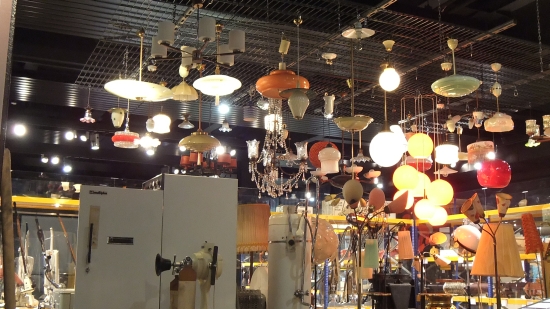
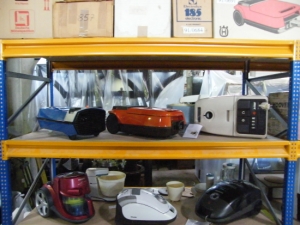
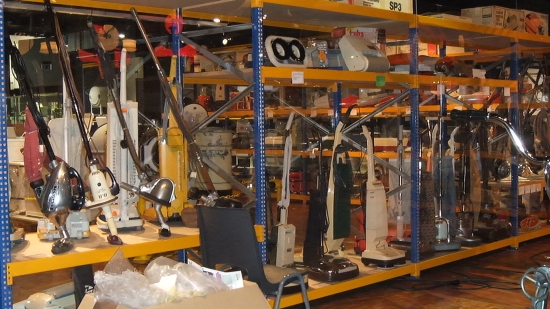
Clear a place for household appliances.Oh, that’s not an easy one to answer. We who are working in the museum storage are the logistical backbone for a great deal of activities in a museum, that’s why many tasks and projects run parallel. Recently, we opened the exhibition “The Collection 2: The Electrical Household”. Despite the general opinion this doesn’t mean that the work on the exhibition is done. Now we are clearing the way for the artifacts to come back, which means reorganizing spaces so when we take down the exhibition the artifacts can come to their storage places quick and the whole process runs smoothly. The faster we manage the dismantling of this exhibition, the more buffer time we create for the installation of the next exhibition “Herzblut” (“heart blood”, in Germany a term also used for commitment) about medical history.
Both exhibitions use mainly artifacts from our own collection, this means also that both exhibition teams have/had to work parallel in the storage area. Logically, no object should be confused with another or – worse – disappear. Much more artifacts are sighted than are used in the final exhibition. All database entries must be checked and corrected if necessary, most of the time they also need a picture. Fire engine or hairpin – always keep track of everything.Many objects need to be treated by conservators before they can be photographed which means one more transport. One can roughly imagine how many object moves there are if you know that there are 1750 artifacts exhibited in “Collection 2” and there will be at least 200 artifacts published in the exhibition catalog for “Heart Blood” alone, not to mention the whole exhibition… Needless to say that there is our normal everyday work of acquisitions and loaning to other museums.
The main challenge is to keep track of everything in this gigantic game of Tetris. If work flow and documentation is organized smoothly, a burst pipe on the special exhibition area like we had it this time can be treated relaxed as a minor incident.
What is the smallest artifact in your collection?
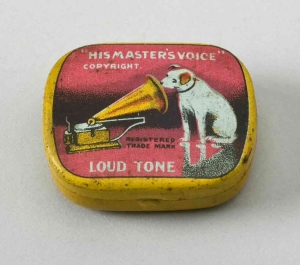
Grammophonnadeldose “His Master’s Voice, 1910-1920, EVZ:2004/0324 TECHNOSEUM, picture Hans BlehIt’s probably a grammophone needle. They are only about one centimeter long and very thin. The respective containers are already so small that I can balance eight of them in the palm of my hand (not that I recommend this from an arthandling point of view!).
Is there an odd story/experience concerning and artifact/exhibition? Tell us about it. It can be an strange object, too.
Oh, there are tons of stories… Talking about “creative packaging”: There was a donation to our museum, the artifact doesn’t matter here. It was in a box and when we opened it, the first thing we saw were trash bags, the ones you get for free in Mannheim to collect plastics for recycling. Anyway, those bags were filled with cut out caps from milk bags. Probably they should form a flexible cushion. The artifact itself was wrapped in a bath mat. The kind that are cut out like an U to put them in front of the toilet. Obviously, this mat was historical too, and hadn’t seen a washing machine before changing its intended use…
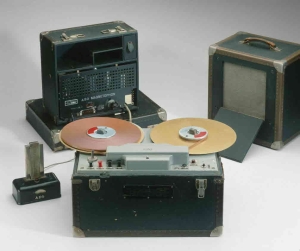
Do you have a favorite artifact? Why? AEG Magnetophon K 2, 1936, EVZ:2002/0057-001 Bild: TECHNOSEUMAsking a grandmother for her favorite grandchild… Maybe the K2 manufactured by AEG, the oldest surviving magnetic tape recorder. Its ancestors K1 were destroyed when an exhibition hall burned down at the international radio show in Berlin 1935. As far as our research goes there is only one copy of the successor K2 left – the one in our collection. While it’s quite natural for a collection of paintings to have unique artifacts it’s something very special for a collection of artifacts that were manufactured in great numbers.
Which artifact was the last one treated by a conservator and why?
Currently there are many artifacts treated for “Heart Blood”. Cleaning measures included we speak about hundreds of artifacts that are treated by our team of conservators. I remember especially the “Blaue Heinrich” (might be known as “Blue Henri” or “Blue Peter” in English speaking countries), a blue bottle used as a spittoon for people suffering tuberculosis. This might sound familiar to all of you who read “The Magic Mountain” by Thomas Mann. For we weren’t sure if there was still infectious material inside it had to be sanitized by a conservator. Guess that’s one of the things you don’t really think about when deciding to study conservation…
What’s the significance of your blog for your museum?
We are not a blog of the TECHNOSEUM, they have their own blog at http://www.technoseum-blog.de (worth a look!), that’s why Registrar Trek has no “official” significance. But of course my work inspired one article or the other, we have some faithful readers among our staff and the international network is helpful in many aspects of everyday work.
Do you have a favorite blogpost? If so, why?
Again asking a grandmother for her favorite grandchild… maybe “The Museum Registrar as Loans…” by Derek Swallow where he names the different professions a registrar has to be while he is involved with a loan – from juggler to legal associate. It’s a great article over all but I especially like the pictures he chose from the archives.
What does culture mean to you?
Culture is very important to me. But I’m not thinking about museums, theaters, opera, the so called “high culture”, in the first place, but culture in a more general meaning of the word, the everyday culture, how we interact as human beings. I find it thrilling to learn about different cultures. You don’t have to go abroad or look at people with migration background. It’s totally sufficient to look at our own surroundings. How much a culture exemplified by television is copied in everyday life. How it influences the language, the clothes, the wishes, for example. I think it’s very rewarding to observe this and to question it. For example many colleagues and friends from North America are surprised when I tell them what we think is “typical American”. The caricature transported by American TV series is not very far from the German as Nazi with leather trousers. To find parallels and differences in other cultures and think about the own culture – or maybe better: cultures – is very exciting.
If you “have an affair” with other cultural venues, what do you do?
I go to other museums and look what I would have done differently. Not fair, but fun. Apart from that I’m so surrounded by culture at my work that I prefer nature in my private life.
You got three wishes, what do you wish for?
1. Health for me and my family, I don’t know how you count, maybe all three are gone now but if not so…
2. Financial security for the rest of my life
3. The third wish I give to anyone desperately needing a wish
Phew, I’ve done it!
Now whom to throw the stick? Most outstanding blogs I can think of already got the #BestBlog Award. But I found one that is definitely worth it: the German/Russian/English Blog “Museum, Politics and Power” http://museumspoliticsandpower.org/ Duck and cover, Katrin, Linda and the others I haven’t known until now, here are your questions:
1. How did you come up with the idea of this blog?
2. How is the collaboration organized despite of the language barriers?
3. What projects are you working on?
4. Which blog entry stirred your emotions?
5. Which blog entry had the most outreach?
6. Which museum blogs do you like especially?
7. Which exhibition you found outstanding recently?
8. Which recent museum trends are interesting?
9. If you could found a museum as team of “Museum, Politics & Power” and you had all the money in the world …what would be the topic?
10. …which three artifacts definitely belong in the exhibition?
11. …where would it be?
And now?
As far as I understood the game:
– Answer the eleven questions. You may bend them to your convenience.
– Put the BestBlog picture in there and link to the blog that awarded you or link to the article of the one who threw the stick.
– Create eleven new questions and ask them ten other bloggers (it can be less than ten).
Would be great to post a comment with the link as soon as you answered my questions.
Have you ever wondered what it would be like to do the same exhibition again? Do the opportunities for avoiding mistakes make it different or better? Well, that’s kind of the situation we ran into recently.
How it all began
Installation of the exhibit “The Collection: 1001 Artifacts to Listen To and Look At” TECHNOSEUM, picture Klaus Luginsland
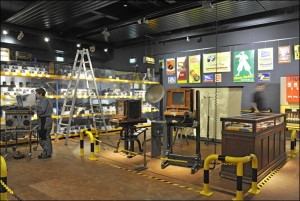
In 2010 the museum building needed to take clearing-up measures that ate up much of the budget. But, of course, our visitors still wanted to see something. No money, no staff, no time – was there a solution? Yes, there was. We still had our own collections! Minimum transportation costs, no courier fees, no insurance problems. If we used only storage racks as showcases and archival materials for presentation we didn’t need much exhibition design and could re-use the materials afterwards. The more we thought about it, the more we fell for the idea. As an extra, we could check a large amount of our collection, correct data base entries, maybe retrieve some of the “location unknown“ artifacts and resolve some “found in collections.” To make a long story short, in 2011 we opened “Die Sammlung: 1001 Objekt zum Hören und Sehen“ (The Collection: 1001 Artifacts to Listen To and Look At), a presentation of our collections of radios, TV sets, record players, film projectors, cameras, tape recorders, video recorders… Our visitors loved it!
So, as you can imagine, when it became clear we would repeat the exhibition using our collection of household appliances, we were all excited. And while team spirit during the preparation of the first collection’s exhibition was like manning an expedition ship and sailing into the Great Unknown, this time it was like a soccer match against our former selves: we wanted to make it bigger, better and more colorful than the first time.
Bigger, better and more colorful: The Collection 2. Picture: Bernd Kießling
Spirit of improvement: Right or left – my position
We knew what worked well last time and so we had a map to follow. But instead of following it slavishly in the spirit of “we always did it that way,“ we followed it in the spirit of improvement.
Working on the testing rack in the storage area: 2 teams worked on different sides.
For example, the first time we had tested all layouts of the artifacts on the shelves beforehand. We had a rack similar to those in the exhibition set up in the storage area, so we could arrange the artifacts until they looked best. Investing in the time to do this during preparation reduces stress during the final installation process. In addition, it’s not important who does the final installation. The positions on the racks are clear, so anybody with experience in artifact handling can do it without taking time thinking about the perfect layout.
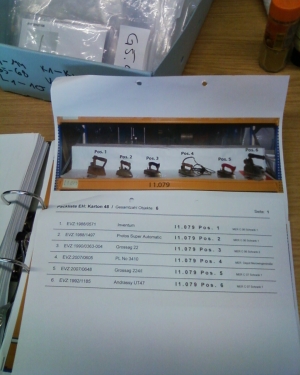
After the artifacts were arranged we gave them position numbers on the shelf. The first time we went with directions, so our packing lists looked like this:
Inventory number, object name, rack number, shelf number, left
While this had worked pretty well, we made some observations:
Positioning with terms like left and right might seem clear on paper, but if you have team members who sometimes confuse left and right (like myself), mistakes in positioning are likely to happen.
Left, middle and right work well if you only have three radios on the shelf. You can work with more artifacts by inventing terms like “outer left“ and “middle left.” This sounds charming, but impractical.
So we switched to using position numbers from 1 on up, numbering from left to right. Now our packing lists looked like this:
For the same reason we decided to take an additional step in preparation. The first time we had noted the positions on the shelf only in our data base. This time we took a picture of every shelf layout and wrote the position numbers on it. We attached the picture to every packing list. Now, whoever was positioning the artifacts during installation could use the picture as a reference.
This was only one example of the many things we improved during preparation.
A second loop of improvement
We all worked in “improvement mode“ during preparation and continued that way during installation. We ran into several things we could do better next time.
For example, after we attached the exhibit labels, we took down the inventory cards and collected them. The first time we had collected them all in a box and sorted them by inventory number so that they could be found pretty quickly once one had the inventory number.
Suddenly our student assistant said, “Wait a minute, wouldn’t it be better to collect and store them by rack and shelf number?“
The “Pakenis Maneuver”
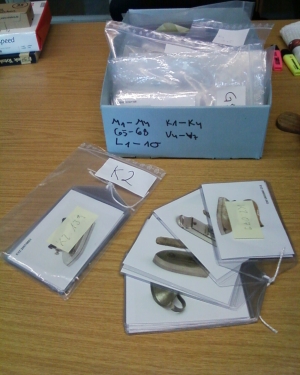
We briefly discussed the idea, approved it, and in his honor named it “The Pakenis Maneuver.” From this moment on we collected the inventory cards in zip-lock bags, one for each shelf, with the rack number and shelf number written on them. When we take down the exhibition everybody can grab the bags of the rack she or he has to pack up and is equipped with the appropriate inventory cards.
Another example is the layout pictures. I described how we prepared them and it sounded pretty good to you, didn’t it? Yep, thought so. We were pretty proud of the idea. However, during preparation we realized that it was a good idea, but not the best.
We had a picture attached to every packing list, which wasn’t necessary. Most of the time we simply took the picture from the first box, put it on the shelf and used this picture as a reference. So, in the future we can skip the effort of printing out the picture and attaching it to the packing list. We will print all the pictures immediately before preparation and place them on the corresponding shelves. This will save some paper and ink, too.
Having the position numbers written on the pictures was of help but you had to skip between the picture and the packing list, because you had the inventory number on the artifact and the packing list, but not on the picture. This also led to confusion with similar-looking artifacts on the same shelf. Next time we will also write the inventory numbers on the picture.
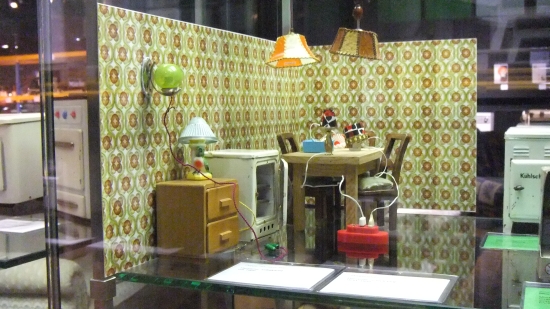
Looking at a puppet kitchen…
The art of making mistakes
One thing we realized during preparation and installation was that we ran into mistakes we had already made the first time. Not wanting to admit mistakes is human. Making the same mistake twice is dumb. The main mistake we made last time was not making notes of what didn’t work. So we only improved the things we remembered, while we were forced to repeat the mistakes we forgot.
Being in “improvement mode“ we decided to do it better this time. Every time we realized something that could have been improved upon, someone said, “Stop. Make a note!“ And we did. It didn’t matter if we were standing on ladders, cleaning acrylic glass or attaching labels; someone always took a quick note of what we had realized.
Shortly after the exhibit opening we sat down, collected all our notes and discussed other things we remembered. We will collect them all in one paper, including the things that worked well and that we will definitely do again. This might serve as a reference for upcoming collections exhibitions and even if many of our suggestions are very specific, some might be helpful for other projects, too.
…just a moment, is this a registrar’s kitchen?
Our Score
On February 19 we opened “The Collection 2: The Electrical Household.”
Installation of the exhibition “The Collection 2: The Electrical Household” Picture: Bernd Kießling
I said we were like a soccer team playing against our former selves. So, what was the score?
We showed more artifacts than the first time (1750 against 1639, but the first figure included about 300 archival items, while this exhibition was composed almost entirely of artifacts).
We had a closer collaboration with our marketing department, resulting in more blog entries, a Christmas tree decorated with household appliances and a Tweetup (#Sammlung2).
We looked into a greater number of artifact groups and therefore were able to set more data base entries straight.
Both times, we were done with the basic installation a few days before opening, allowing us to improve some more things immediately.
Let’s see if we can improve on the number of visitors to the first exhibition, which was 14,400 higher than expected.
But there’s no reason to stop here. When it comes to doing things better, there is no finish line. Next time our rallying cry will be again:
Working with databases is one of the core responsibilities of a registrar. Often enough, one becomes upset with insufficiencies of the used system. You can imagine my excitement when I learned about the project of Michael Hesemann. He took the effort to develop a web database for his own field of interest, the foraminifera. Voluntarily, only out of enthusiasm for his field and collection. It provides quick access to all relevant information for scientists and collectors around the world. Now, even well-known institutions like the Smithonian and the Geological Survey Austria provide information about their collections of forams there. Read more about the development of this project.
Cheers!
Angela
written by Michael Hesemann, Foraminifera.eu Project, Hamburg
Project Development
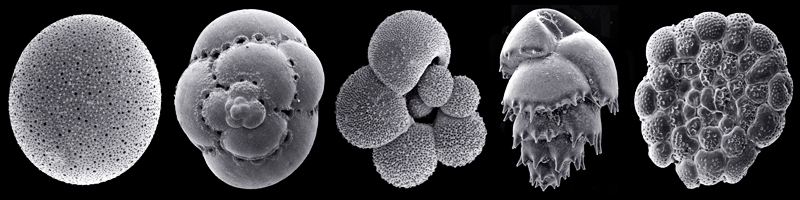
In December 2007, I became interested in Foraminifera (aka forams)—not widely known single-cell organisms that have been building delicate internal shells for 540 million years. I was surprised to learn that up to 1/3 of the composition of the cliffs of Dover, Egyptian pyramids, and other examples of stone can be forams. Perhaps just as surprising is the fact that all living forams make up 1% of the earth’s biomass and are therefore more substantial than all mammals.
This is likely the first time you’re hearing about this, which suggests that basic information does not come to light without detailed study, review of the literature, and intense research. Fortunately, I met two foram enthusiasts in Hamburg, who, like Ernst Häkel was back in 1900, had long been interested in the beauty of forams and their rich variety of forms. We decided to photograph our collections and post them on the internet at www.foraminifera.eu.
Getting our images online, arduously taken through a microscope, went really well at first. But within a few weeks, Fabrizio contacted us, an Italian scientist offering to contribute 100 SEM (scanning electron microscope) images. Suddenly there were 250 images, which meant we had to sort them somehow and make them easily accessible. We realized we would need to develop a concept that could also accommodate 2500 images.
Or Own Database Concept Was Inevitable!
The concept of databases used by large museums, scientific institutions, and online databases like EOL or WoRMS turned out to be uni-dimensionally tailored to taxonomy and numbering. Don’t foraminifera have more information to offer? And what did we want from the collection as users? Considerable inconsistencies among datasets, a lack of illustrations, and clumsy interfaces seemed less than satisfactory.
Our Multidimensional Database Concept with Consistent Categories
Our philosophy is that a collection should make its objects easily accessible to everyone, from the absolute layman to the most highly specialized scientist. Every kind of object—in our case, foram shells—carries with it a variety of information. In a database, we’re limited to categories of information that apply to nearly any other object or can be researched with a reasonable amount of effort. For analysis, a high level of data consistency is essential.
With forams, consistent categories are taxonomy, morphology, locality, era (geologic), reference citations, dataset relevance, and collector information. Whether the habitat (ecological niche) can be consistently provided is debatable.
User-oriented Access
The user should be able to easily and reliably retrieve all available information by means of an easy-to-use interface. This necessitates the following:
Each object must be represented by realistic illustrations (drawings, photos, 3D objects), and each of the defined fields must be populated (metadata)
The interface must allow the user to conduct searches in every field
The user must receive a list of search results that includes thumbnail images and essential information from which the user can drill down to more detailed information, including references
Technical and Financial Resources
Because this is not a commercial project, there are no financial resources. Contributions result from enthusiasm for the topic. All contributors cover the cost of their own contributions. All contributors are individually named and receive their own websites and the opportunity for evaluation of their contributions.
Regarding technical issues, only the most simple programs and systems are used: Excel, PHP, SQL, HTML, and a grassroots website hosted by a mass-provider.
A comprehensive collection of literature on forams, journal subscriptions, and good contacts with relevant scientists is available. Collection of sediments and forams are conducted, and detailed how-to’s and tools on processing samples are also available. No-cost access to a scanning electron microscope (SEM) is also available.
Milestones
Not necessarily planned this way, but looking back, this is how it happened:
2008
Development and promotion of the website; receipt of samples from amateur fossil collectors
2009
Further temporal and geographic coverage through 1200 images; creation of a support community of amateurs and junior scientists
2010
Introduction of the project to 400 scientists at the FORAMS2010 conference in Bonn; support from scientists; aid offered to amateurs and young scientists, particularly those in less-developed countries
2011
Expansion of database criteria to 20; conversion from pure HTML to PHP-SQL; support from senior scientists secured; presentations at international conferences; expansion to 4000 images
2012
Top ranking by Google (SEO; expansion of database criteria to 30; networking; receipt of image rights from publishers and institutions; expansion to 5500 images
2013
Permission to use c. 30,000 foram images (including those of numerous type specimens) from the Smithsonian Institute, the Austrian Federal Geological Agency, and the Brzybowski Foundation; permission from senior scientists to use their life’s works; expansion of the image database to 7700 images; cultivation of the support community; collaboration with WoRMS
2014
Project presentation at the FORAMS2014 conference in Chile; continued collaboration with WoRMS; image rights secured for remaining images; expansion of database to 10,000 images; cultivation of the support community
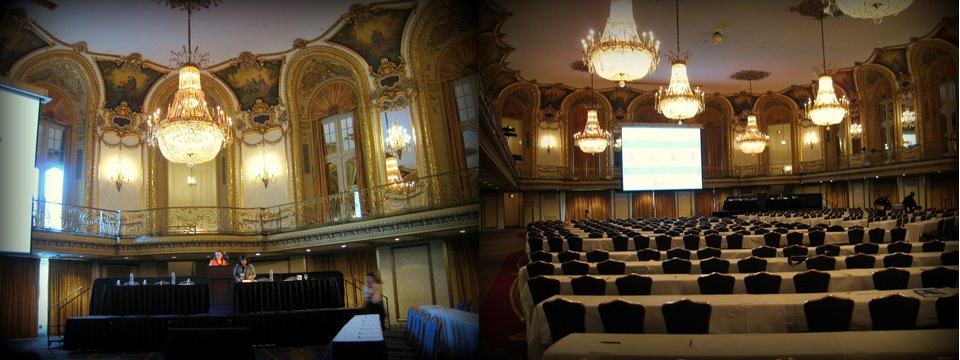
Cascading crystal chandeliers, softly illuminating Beaux Arts wall murals with gilded foliated reliefs, border the massive ballroom: a breathtaking setting that one participant described as “the Versailles” of Chicago. This expansive, opulent hall in the historic Chicago Hilton Hotel, once hosting glamorous balls and formal receptions, now served as our conference room: a somewhat humbling setting, in contrast to the small, utilitarian offices in our home museums. It seemed an incongruous choice of venue at first. With reflection the sense of the location gelled in my mind.
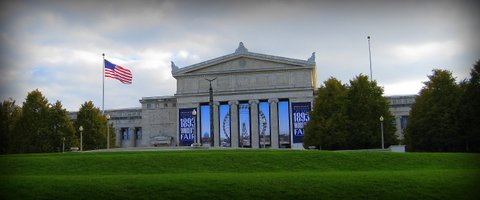
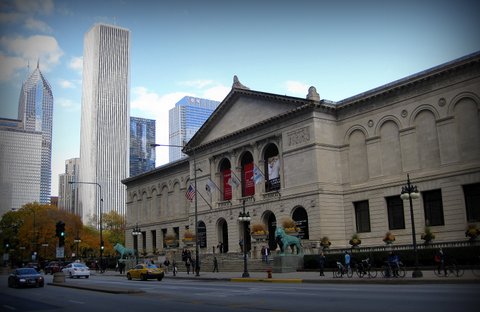
Grand Ballroom in the Chicago Hilton – Conference roomThe spacious room and dynamic decor metaphorically represented the energy, optimism, and breadth of the newly created ARCS organization and the glittering wealth of knowledge held by the 530 attendees from 28 countries. Selecting Chicago as host city was also ideal: a cultural center home to innovative world class public art and esteemed institutions such as the Art Institute of Chicago and the Field Museum, to name but two.
The Field Museum, ChicagoArt Institute of Chicago
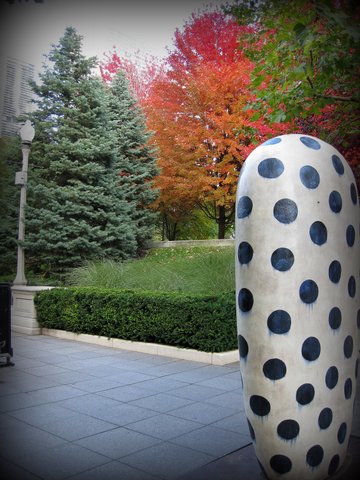
The three day conference offered 24 sessions with 60 presenters. The diverse topics appropriately reflected the broad scope of interests held by such a large and eclectic group of participants.I felt fortunate to participate in this important inaugural event and would like to personally thank all the organizers, presenters and particularly the founding benefactors whose generous support made it all possible. To enhance our comfort the sponsors provided participants with a cornucopia of delicious, waist-expanding food that sustained us through the information packing sessions. Public art sculpture near the Art Institute of ChicagoFor those unfamiliar with ARCS, the acronym stands for the Association of Registrars and Collections Specialists. Its mandate and mission: “…to represent and promote Registrars and Collections Specialists, nationally and internationally, to educate them in the professional best practices of registration and collections care, and to facilitate communication and networking.” http://www.arcsinfo.org/home
For the benefit of Reg Trek readers, in follow-up articles, I will synthesize the information from those sessions that I believe inform about topics of global interest to registrars, collections managers and other museum professionals. The first of these will explore the session entitled: Deaccessioning: Is there One Right Way? moderated by Devon Pyle-Vowles ARCS Board Member and Conference Chair with presentation by Dawn Roberts, Collections Manager at the Chicago Academy of Sciences, Peggy Notebaert Nature Museum; Elizabeth Varner, Executive Director of the National Art Museum of Sport; and Linda Wilhelm, Associate Registrar, Collections, The Museum of Fine Arts, Houston.
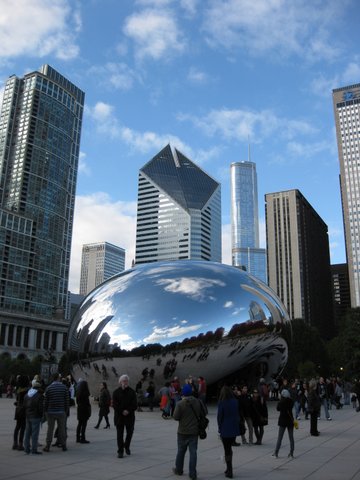
“Cloud Gate” affectionately known as “The Bean” in Millennium ParkTo end I’d like to return to the beginning: the formative era leading to the conception of ARCS. The roots for this organization run deep, starting with the appointment, in 1880, of the first US registrar tasked to manage the collections of the National Museum, Smithsonian Institution. Nearly 100 years lapsed before the next major step occurred. In 1977 the US registrars formed the Registrars Committee of the American Association of Museums (RC-AAM) followed two years later by the UK Registrars Group. Subsequent years saw registrar groups surfacing around the globe. “Best practices” and dialogue enhancement now tethered widely separated colleagues. The early 21st century witnessed an upsurge of international loans and the attendant need to develop global standards for transport, documentation, etc. To cultivate such standards an appropriate forum was required. The RC-AAM fabricated one by sponsoring four international registrar’s symposia, the first in New Orleans in 2004. At the last, in Houston in 2011, the renowned US registrar Jean Gilmore proposed the creation of a new organization to meet 21st century needs. After many months of intensive work the Association of Registrars and Collections Specialists materialized: an inclusive, yet highly focused group targeting the challenges of our profession in the new millennium.
“For the first time, registrars and collections specialists have stepped forward as a unified, independent, international group to provide programs and services directed especially to the collections worker.”
(History – Association of Registrars and Collections Specialists – Association of Registrars and Collections Specialists. http://www.arcsinfo.org/about/history).
”So what do you do for a living?” I’m asked. “I work as a museum collections registrar.” I reply, gazing on the now blank look of the asker. I continue, briefly describing my job duties: registering potential acquisitions, tracking the process through to the collections committee and ultimate accessioning. This usually draws the ego crippling words: “That sounds interesting” said in that particular pitch that translates to “what a deadly boring job.” The Beautiful:Buprestis aurulenta – The Golden Buprestid. (Interesting fact – the larvae feed on the wood of recently dead or dying trees and may take more than 60 years to mature if the wood is very dry. (From the Entomology Collection – Royal BC Museum)Barely controlling my irritation I refrain from spitting out the words: “I love my job. It’s really interesting. You really know nothing about it. So what the heck do you do that’s so wonderful – are you an astronaut or something?” Instead I take a deep breath, smile amiably and prepare for my crushing blow.
Bizarre: Goose-neck Barnacle (Pollicipenes polymerus) Stalked barnacles that grow in clusters or colonies along exposed shores of the BC Coast) (From the Invertebrate Collection – Royal BC Museum)Turning slightly away, to show mild indifference, I softly roll out these charged words: “And I manage multi-million dollar loans, sending our priceless museum artefacts to exhibits around the globe.” A brief silence follows, the listener’s head turns, the facial expression transformed to one of amazement, then the response: “What a fascinating and important job you have!” The words “Got ya” drift through my mind. Then, I’m peppered with questions about these awe-inspiring loans. Fair enough, loans do have a certain cache. However, in reality they provoke a huge amount of very unromantic work, often have nearly unattainable time lines and can drive a teetotaler to the nearest pub.
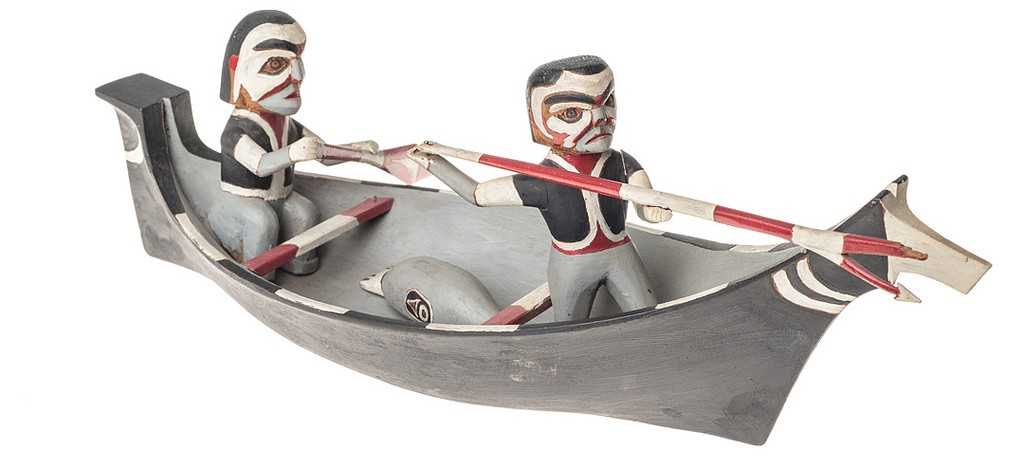
Ethnologically enlightening: Kwakwaka’wakw model sealing canoe (early 20th century) (From the Ethnology Collection – Royal BC Museum #14097 a, b)I’m not saying I don’t enjoy loans work – I really do. But our acquisition work is underrated as an interesting component of our job. Without doubt, the process has mechanical aspects but few jobs in a museum open access to information spanning the entire spectrum of the collections. I’m privileged to know exactly what enters these collections, on a monthly basis, whether it augments our archival, modern history, ethnological or natural history holdings and how these records, objects, or specimens demonstrate relevance to the human and natural history of our province: intellectual candy for a life-long learner like myself. It’s a pleasure to play my small role in the acquisition of some notable objects – from the historically stellar, to ethnologically enlightening, to the bizarre and the beautiful.
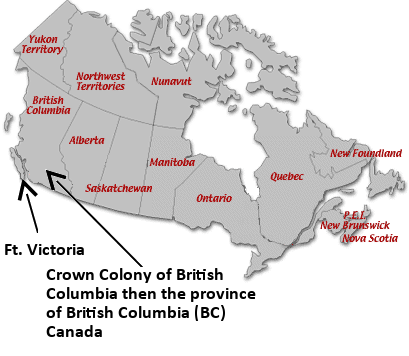
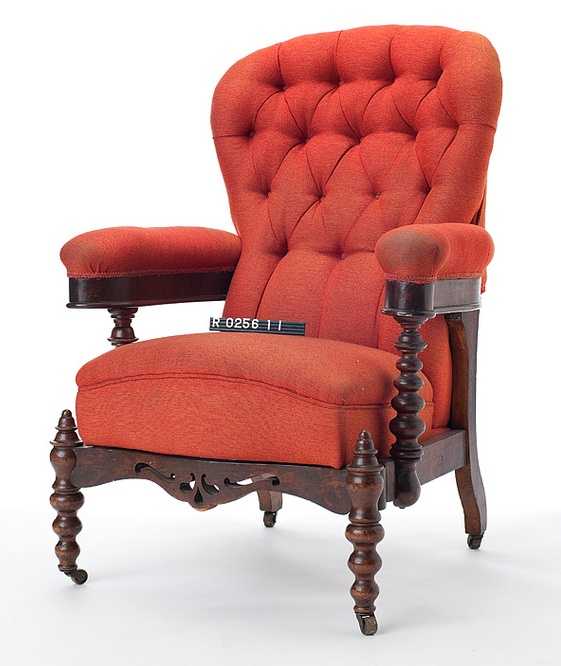
Sir James Douglas – A-01229 (from the BC Archives Collection – Royal BC MuseumMost often a registrar’s participation begins after a collection enters the door of the museum. A few years ago I had the good fortunate to assist one of our history curators retrieve the Douglas chair (see image) and other components of the Douglas collection; the curator needed an extra pair of hands considering the size of some of the objects. The donor was a relative of Sir James Douglas, a renowned historical political figure in British Columbia. Douglas founded the fur trade post Fort Victoria In the mid-19th century then later led the small population of European settlers when this west coast region attained British colonial status. During Douglas’ retirement, in 1871, the colony joined Canada as the 6th province: British Columbia. Not long after the union he suffered a heart attack. In 1877, Douglas died in his residence while seated at his chair.The chair remained a utilitarian object in the family. With original fabric worn out, the chair was reupholstered in the 1960/70s using a popular colour fabric and colour from that period – Danish Modern orange. Sir James Douglas, despite his auspicious career and elevated rank, was a practical man. I’m sure he would have approved of extending the service of the chair to over 140 years through such refurbishment.
Historically Stellar – Douglas Chair – C1870 – Victorian Parlour Chair – History Collection – Royal BC MuseumFor curators, collections managers and registrars the restored chair provokes an interesting question. Is it still authentic? To be authentic and worthy of museum collection must an object retain its original appearance or does it suffice that it need only retain its original function and association? In this case, it is still a chair, the very chair where James Douglas died whether it has original upholstery or not. Reviewing our museum’s collection policy, which guides what we do and do not collect, the Douglas chair fits into our collecting parameters: it has historical significance to the province of British Columbia, clear provenance, and meshes with our requirement for its “condition or completeness” The policy states: “Objects included in the collections of the RBCM [Royal BC Museum] will be complete, sound, and/or in original condition, where possible.” The phrase “where possible” permits us to collect objects of enormous historical significance, such as the Douglas chair, despite modifications made over time.
I stumbled upon this interesting link which I’d like to share with you. The author muses on the term “authenticity” within the heritage/museums context. She has some very interesting points. http://ejarchaeology.wordpress.com/2013/03/29/my-bike-the-authentic-object-with-its-own-biography/. I look forward to your comments on this subject. I would also be interesting to learn your museum’s particular guidelines regarding “authenticity”.
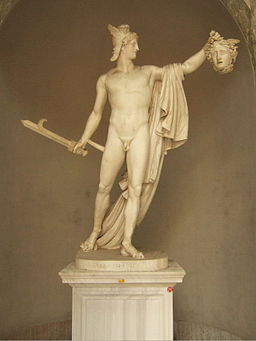
Perseus by Antonio Canova, picture by Hans WeingartzA few weeks ago, I took my four-year-old twins to the Metropolitan Museum of Art in New York to see the museum’s beautiful Neapolitan crèche. Of course, once we arrived we were easily distracted by mummies and temples and sculpture and barely made time for the crèche itself. While strolling through one of the European sculpture halls, my children became enthralled by Antonio Canova’s Perseus with the Head of Medusa. We had read the story of Perseus several times in the past, and this depiction of the hero was immediately recognizable to them. My daughter was pleased to see that Perseus was wearing a helmet, but my son was rather upset that he seemed to have forgotten a crucial gift from Athena: a reflective shield. While the twins were debating the accuracy of the sculpture, two men walked by. One said to the other, “Oh, hey, it’s a sculpture of that guy from that myth.” My daughter overheard and softly replied, “Perseus,” but the men did not hear her. The second man said, “Yeah, it’s that guy who killed Medusa. What was his name?” The men stood silently scratching their heads for a few moments. “Perseus,” my daughter said a little louder, but again she was ignored. “Perseus!” exclaimed the first man after a long pause, at which point my daughter turned to me and said, “I told him it was Perseus, but he didn’t listen to me.”
“He didn’t listen to me.” I could hear my daughter’s words in my head as I read the recent article about children in museums by Tiffany Jenkins entitled, “Children Should Be Seen and Not Heard.” The author asserts that museums have become too child-friendly in recent years and claims this is essentially a waste of funds, since she believes children are incapable of truly benefitting from the collections that museums offer. The article so severely critiques the inclusion of children in museums that it almost reads as satire. Almost.
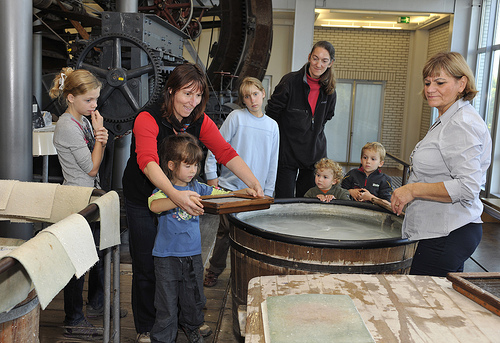
Children discovering the secret of calculating machines in the TECHNOSEUM in Mannheim/Germany. TECHNOSEUM, picture Klaus LuginslandYes, children are often noisy in museums. Yes, sometimes they run when they should walk. Yes, sometimes they touch when they should not. However, children are brought to museums for their education, and this education includes more than simply who made what and when. Bringing children to museums teaches them that these institutions have value, that what is inside them has value, and that the people who work there have value. With the help of a committed docent, the children might even learn how to behave themselves in the galleries, but even if they do not, the seeds are nonetheless planted for future growth. Studies made by the National Endowment for the Arts indicate there are numerous benefits to involving children in the arts and that those benefits are especially significant for children from low-income families.
Ms. Jenkins’s assertion that museums have become too child-friendly is impossible to support. I have worked with and visited many museums in many different countries over the years. Not once have I ever believed that any museum was too child-centered. I recently visited the Smithsonian’s Air and Space Museum, which in the United States is a sort of museum mecca for little ones. Airplanes and rocket ships hang from the ceiling, and there are interactives and videos throughout the galleries. There are children everywhere, and plenty of things for them to touch and climb upon. If any museum might be accused of being overly geared towards children, this one might be it. Yet I noticed at each interactive, there were at least as many adults participating as children. Grandfathers pointed out famous aircraft to their small companions, and children asked repeatedly of their parents, “What does this say? What is that?” It was loud, sure, but there was learning taking place in every nook and cranny of those galleries by visitors of all ages. I have no doubt at least some of those children will be returning as adults, sharing their experience with their own children and grandchildren.
Hand papermaking at the TECHNOSEUM in Mannheim/Germany. TECHNOSEUM, picture Hans BlehIf our museums are not for children, then whom are they for? Are we not in this business to preserve art, culture, and history for future generations? For those of us who work behind-the-scenes with collections, it is easy to think of the work of enticing our youngest citizens into museums as something apart from us. At some point in our careers, most of us have said, “Oh, I’m not really a curator and/or educator.” But we who preserve the stuff are part of that educational mission, and it is in our best interest that it succeed. If we are not teaching our youngsters that what we do matters, that all of this old stuff we care for has value, then we are surely all out of a job when the next generation comes of age, and Ms. Jenkins will be without her “palace of knowledge” altogether. Next time we hear a noisy bunch of school children wandering through a museum gallery, perhaps we should be thankful someone cares enough to bring them. And then we can make sure they don’t touch anything they are not supposed to.
If you were waiting for the outcome of the Registrar’s Trilemma, wait one more week, we will reveal it on January 17.
A project to break down language barriers and connect registrars worldwide