Category Archives: Articles

Failures in Figures – A Series with Real-World Examples and Real Data

Nowadays everybody seems to be obsessed with numbers. Big Data, KPIs, ROI, people like to count and somehow they believe that only if they have counted enough numbers they can make sense of what’s going on. Recently someone asked how many artifacts are needed to justify a curator’s position. People ask ”How many artifacts does your collection hold?” as if this information says anything about how significant or valuable the collection is or how good it is cared for. Data base entries done to achieve unrealistic “objects per day/month/year” goals instead of focusing on the quality of the entries let me bang my head against the wall pretty often.

I could argue for hours about what is wrong with those approaches but I guess you, our readers, could do it just as well. Instead, I tried to look at it from a different angle: We, the collections people, deal a lot with data every day. One could say that data is nearly our native tongue. But so far we let other people, less fluent in this language, dictate which figures are important and what they tell us. So today, I start a series based on common collection issues that I can make visible using real data. I will present the figures and then analyze what they tell us.

Part 1: How bad is being a little sloppy with location tracking, really?

Recently we were improving the storage situation for some of our tin plate and enamel signs. This is just one of these situations where you stumble upon a set of very different common storage mistakes: confused numbers, wrong data base entries, missing locations… In fact, those relocation projects, following a stringent procedure of taking everything out and checking it against its data base entry are sometimes the only occasions where you have a real chance to discover objects that were marked “missing”.
total_mistakes
Those are also projects where you sometimes encounter “time saving” ideas like “but they are all in the data base, can’t we just take them to their new location and change the location entry in the data base without cross-checking?” It’s sometimes not easy to argue against such ideas – until you have figures that tell you why it isn’t exactly a good idea. So, let’s take a look at the figures:

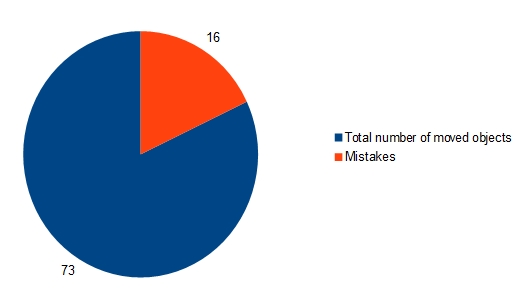
We moved 73 signs in one day. During the check we encountered the following issues:
9 signs had a wrong location in the data base. Sometimes it was an “old” location, where the sign had been before, because someone had forgotten to mark the location change in the data base or because he or she confused the accession number and made the location change for a totally different object. Sometimes the location was plain wrong because someone choose the wrong entry from the location thesaurus or, again, confused the accession number with another object.
2 signs where marked “missing” in the data base, which means that somebody already tried to find them. They were discovered when unwrapping a sign and discovering that there was a second sign packed within. One of the two had no accession number attached but could be identified later.
4 signs had a wrong accession number attached, although most of our object labels (and, in fact, all 4 labels in question here) bear pictures.
1 data base entry showed the wrong picture.

This translates into an error rate of 21,91 % which means that there was something wrong with every 5th data base entry.
Wrong location entries top the pile with 12%, followed by confused accession numbers with 5,48%, “missing” objects with 2,74% and wrong picture with 1,37%.

mistakes

In the next parts of this series we will take a look at what led to these errors, how they could have been avoided and how this translates into invested working time.
Part 2: The damage done by sloppy location tracking

Where’d It Go?

TECHNOSEUM utilizes barcodes to track collections

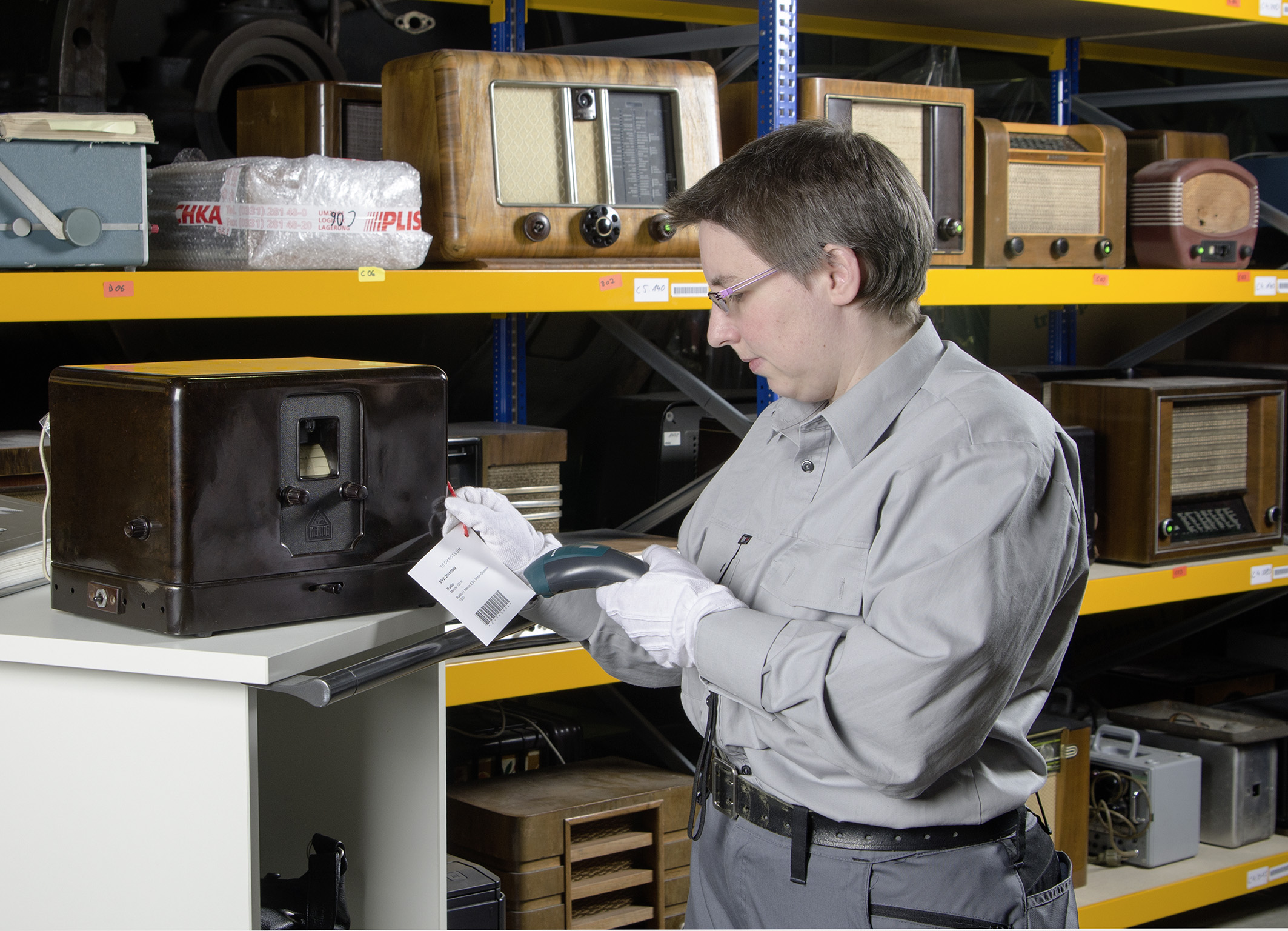
Simple and effective inventory control: Most of the radio collection has already been barcoded. TECHNOSEUM, photo Hans Bleh
Simple and effective inventory control: Most of the radio collection has already been barcoded. TECHNOSEUM, photo: Hans Bleh
When things disappear in museums, everyone’s first thought is of break-ins or theft. Museum objects do disappear on a daily basis, but the reason they do is usually more mundane: the object was removed for exhibition, loan, or conservation. Changes in location are usually tracked in a database, but the system has one weakness: a human being enters the object number into the database and notes its new location. One transposed numeral and suddenly it’s the coffeepot instead of the typewriter that’s gone to the conservation lab, though the pot never really left its location in storage. The mistake usually goes unnoticed until an object is urgently needed but can’t be found where the database says it should be. When thousands of objects are moved each year, as they are at the TECHNOSEUM, errors in location management are a serious problem. The obvious solution is to make the object numbers and locations machine-readable, eliminating the potential for input errors.

Barcode or RFID?

As with every practical issue, there is an abundance of technical know-how on the one hand, versus concrete local limitations on the other. Something that makes sense in one museum might not in another. At the TECHNOSEUM, we first considered several possibilities in an open and unbiased manner, starting with barcodes. Most of us know these as the striped codes on packaging in stores, or as blotchy squares of code in ads or magazines commonly known as QR codes. Next we considered RFID chips, which are usually associated with anti-theft devices or animal tracking. We also got in touch with colleagues around the world, who are already using these systems in their museums and were able to give us a great deal of insight into their problems and potential. We weighed this information against our own local conditions and decided to go with the striped barcode.

By the People, For the People

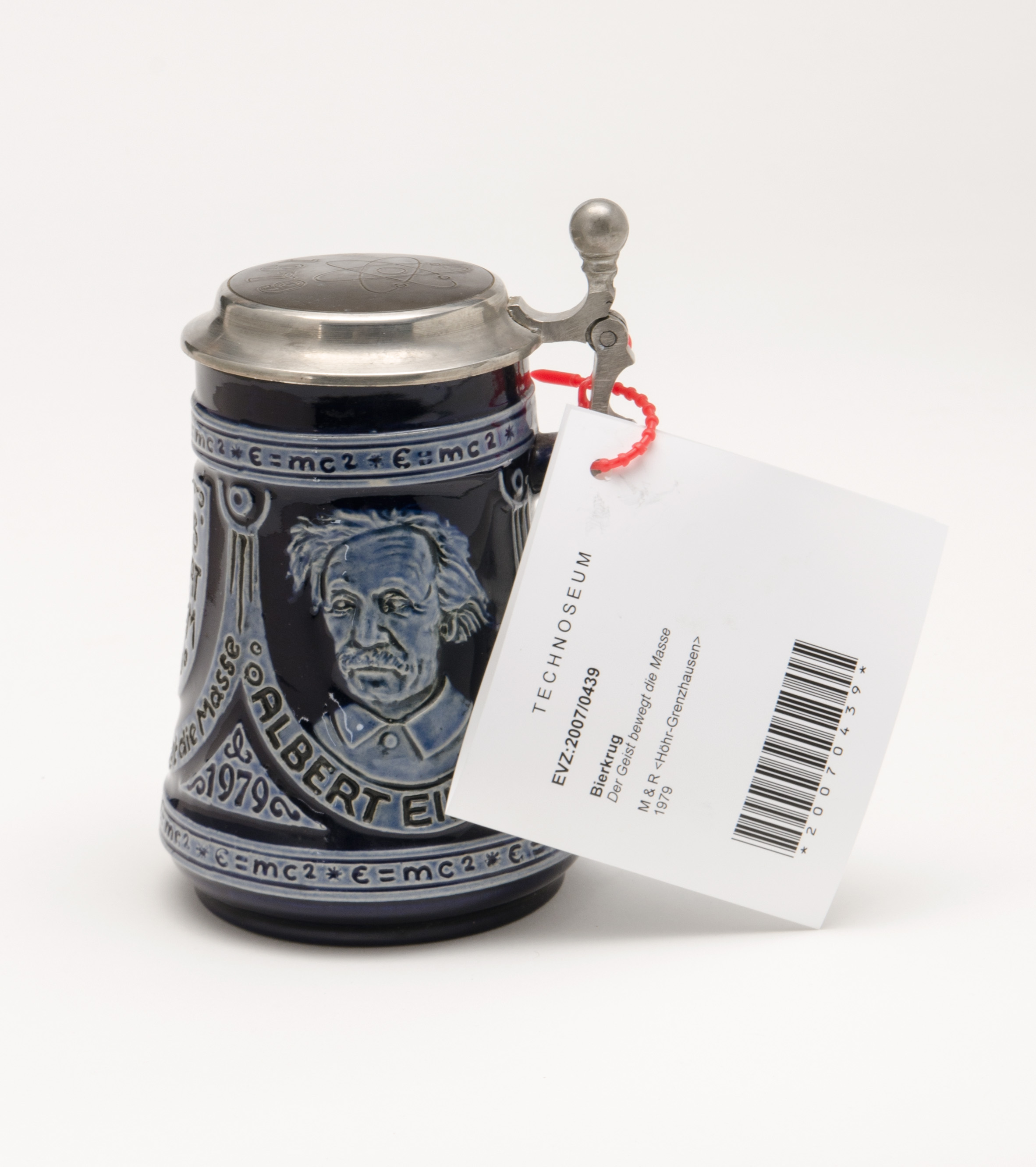
Inventory card on a “Einstein Beer Tankard,” one of about 100 examples in the collections. A special exhibit on the topic “Beer” will appear at the TECHNOSEUM in 2016. TECHNOSEUM; photo Hans Bleh
Inventory card on a “Einstein Beer Tankard,” one of about 100 examples in the collections. A special exhibit on the topic “Beer” will appear at the TECHNOSEUM in 2016. TECHNOSEUM, photo Hans Bleh
We knew from the start that we would not be affixing the barcodes directly on the objects. Only the object number goes directly on an object. The barcode is part of the a laser-printed polyethylene film inventory card associated with each object at the TECHNOSEUM. The barcode on each card is merely a conversion of the object number into a machine-readable form. The same is true of the barcodes that designate storage locations: they are not arbitrary numbers, but rather a simplified version of our alphanumeric location designations.

This kind of conversion has many advantages:
• Collections staff can continue working even when the scanner system is not working. People can still read all numbers and find the locations.
• Barcodes can be implemented gradually, parallel to older inventory methods, with no workflow delays when objects or locations have not been barcoded yet.
• With the low number of characters, the capacity of the classic barcode is sufficient and cheaper readers can be used.
Work on Site and in the Database
The barcode scanner works just like a keypad or mouse. When a barcode is scanned, our database (Faust 7) displays the associated record, which can then be edited. If the object’s location is to change, we scan the location barcode directly from the storage unit itself or from a list at the workstation. The barcode readers we use at the TECHNOSEUM work over a wireless network. They also have a memory function, so barcodes outside the range of the receiver can be scanned and then uploaded back at our work stations.

Implementation: From Zero to 170,000?

At first, implementing a system like this might seem like a mammoth undertaking. After all, eventually all of the TECHNOSEUM’s approximately 170,000 objects are to sport “their” barcodes. The simple directive “Everything you touch gets a barcode” makes the reality of implementing the system much less daunting. Since February 2015, every new acquisition has received its barcode as soon as it enters the collection. And every object loaned, photographed, audited, or restored gets a barcoded tag—that’s between 4,000 and 6,000 objects annually. Every object in the database already has a barcode, which automatically appears on every newly printed inventory card, packing list, and box label. Any hours our part-time student assistants have to spare are spent providing entire storage units with new inventory cards. The barcodes have withstood their first baptism by fire: the deinstallation of the “Herzblut” (Lifeblood) exhibition. About 600 of the 700 objects on display came from our own collections and were packed up and sent back to storage in June. For the first time ever, thanks to the barcodes, there were no “blind spots” in the logistics chain: every object could be found at any point in time, whether in the exhibit vitrine, the numbered packing case, or back in storage. And another first: Never in the museum’s 25-year history had an exhibition been deinstalled without a single transposed numeral—until now!

Angela Kipp

This article was originally published in KulturBetrieb, (Cultural Enterprise) a magazine for innovative and economic solutions in museums, libraries, and archives; issue 3 (August 2015). www.kulturbetrieb-magazin.de

Abbreviations and technical terms employed:

RFID (English abbreviation for “radio-frequency identification): identification using radio waves.

Translated from German into English by Cindy Opitz

New Digital Publication Now Available!
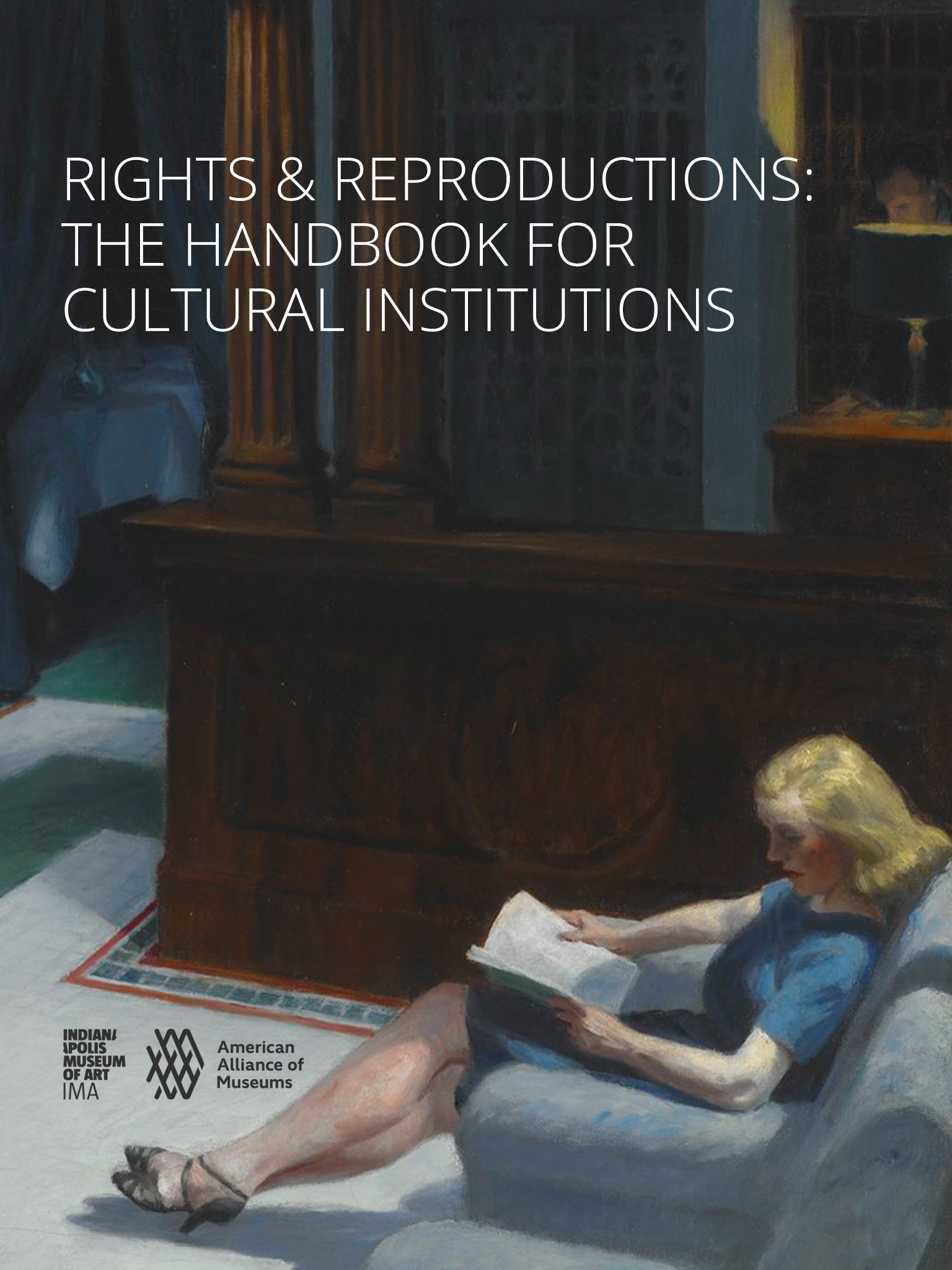
Rights & Reproductions: The Handbook for Cultural Institutions

by Anne M. Young
Manager of Rights and Reproductions
Indianapolis Museum of Art

Last week Rights & Reproductions: The Handbook for Cultural Institutions was published by the Indianapolis Museum of Art and American Alliance of Museums. Read the official press release here: http://www.imamuseum.org/sites/default/files/attachments/RR%20Handbook%20PR%20FINAL.pdf. After two years of in-depth work on the Handbook, it is my great pleasure to see the efforts of so many people come to fruition and be released to the public. As I have taken to calling the Handbook, my third “child” has now been born—a bouncing baby ePub.

Cover design for the publication. Artwork depicted: Edward Hopper (American, 1882–1967), Hotel Lobby (detail), 1943, oil on canvas, 32-1/4 x 40-3/4 in. Indianapolis Museum of Art, William Ray Adams Memorial Collection, 47.4 © Edward Hopper.

The Handbook is the first publication available to rights and reproductions specialists that focuses solely on the guidelines, established standards and emerging best practices in this field. As defined in the Handbook, a rights and reproductions specialist refers to anyone working at a cultural institution who handles this type of work, including but not limited to registrars, rights and reproductions managers, archivists, librarians and lawyers.

Writing, editing and designing Rights & Reproductions: The Handbook for Cultural Institutions has been, relatively speaking, the easy part. The true “work” has been the coordination of all the moving parts associated with its production. Getting the IMA and AAM in line as the publishers, bringing together over 20 contributing authors and legal review panelists, the IMA’s receipt of the National Leadership Grant from the U.S. Institute of Museum and Library Services (IMLS), and the Getty Foundation’s support of its production as a digital publication utilizing the Online Scholarly Catalogue Initiative (OSCI) Toolkit are the only reasons it is now available for purchase. As one of the contributing authors recently quipped, “Anne, you are now awarded the title ‘Champion Cat Herder,’” which I humbly accept.

Highlights or stats, if you will, of the Handbook include, but are not limited to, the following:

  • Over 400 “pages” of text and almost 800 footnotes (just four shy, which is simply annoying).
  • An overview of Intellectual Property (IP) law, ethics and risk (in the United States) and other personal, moral, and third party rights compared with the broad differences found in international IP rights.
  • Discussion of the importance of maintaining an IP policy, considering open access policies and conducting regular IP audits.
  • 50 references each to Creative Commons and open access and over 170 references to fair use and/or fair dealing.
  • Rights issues in permanent collections: determining the rights status of collection objects, identifying rights holders and preparing non-exclusive licenses.
  • Use of materials with IP considerations, including, but not limited to, publications and exhibitions, educational materials, websites and social media, marketing and promotion, and retail and commercial products.
  • Varying processes employed for clearing permissions and sourcing materials, as well as when a utilization of fair use is appropriate and the types of attribution required.
  • Over 20 case studies that outline real-world examples from the contributing authors’ experiences and practices at their respective institutions.
  • The process of expanding audiences and potential revenue generation by leveraging collection content with external distribution partners.
  • Analysis of communicating IP to the public, including licensing materials to external users and the evolution of photography policies.
  • Direct hyperlinks to external sources and related articles within the footnotes, appendices and bibliography as well as embedded video files.
  • Four appendices: international treaties, federal legal materials and court decisions; document and contract templates (over 100 pages!); terms and definitions; and references and resources.

If you haven’t already, I encourage you to skip the morning stop at the coffee shop and purchase your copy of Rights & Reproductions: The Handbook for Cultural Institutions. Available now for purchase through AAM’s website at https://aam-us.org/ProductCatalog/Product?ID=5186 for $4.99 USD (non-members and Tier 1 members) and $1.99 USD (Tier 2 and 3 members).

r&r-logos5

Rights & Reproductions: The Handbook for Cultural Institutions is made possible by a grant from the U.S. Institute of Museum and Library Services. The project utilizes the OSCI Toolkit, which is supported by the Getty Foundation as a part of its Online Scholarly Catalogue Initiative.

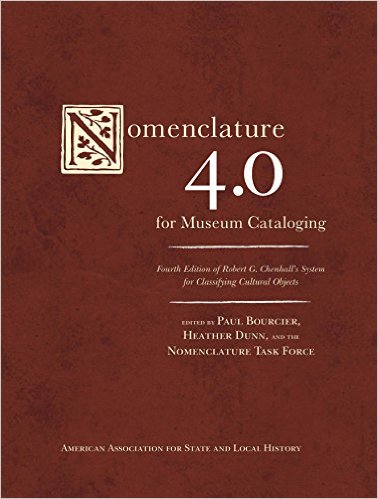
But what is it called? Nomenclature 4.0 is here to help you!

Using the right terms is crucial for good museum documentation, the foundation for professional museum work. We have discussed this a couple of times in the past. Now I’m really happy that Nomenclature, the standard work for naming objects correctly in historical museums in the U.S. sees its fourth edition. Those of you who ever had to discuss with colleagues if it’s an adjustable spanner or a monkey wrench (which gets even worse in German where the same tool is called “Englishman” or “Frenchman” depending on the region in addition to about four “normal” terms) will know why having a controlled vocabulary is a blessing. I asked Jennifer Toelle to tell us a little more about the new edition:

nimnclatureNomenclature 4.0 is the most up-to-date print edition of one of North America’s most popular controlled vocabularies for classifying and naming objects in historical museums. Building on professional standards and a hierarchical structure introduced in the last edition, Nomenclature 4.0 features expanded coverage and revision by reflecting new research and contributions by museum professionals throughout the United States and Canada.

For over 35 years, Nomenclature has offered a practical, flexible framework to ensure museum documentation, retrieval and data sharing is more consistent. This system remains a standard cataloging tool for thousands of museums and historical organizations. Nomenclature serves museums by providing a system designed to consistently name objects and facilitate sharing information with staff and researchers, other institutions, and the public.

Nomenclature allows catalogers to assign names to the artifacts / objects within their collection consistently and accurately. Much like plants are grouped and categorized by family, genus and species, Nomenclature groups items in hierarchical levels based on object function. Thus, objects originally created to be used as toys or to carry on the activities of games, sports, gambling, or public entertainment are grouped in one category (Category 9: Recreational Objects) while those items originally created as expressions of human thought (for example, art, documents, religious objects,) are grouped in Category 8: Communication Objects.

The lexicon has ten categories covering all aspects of human-made objects ranging from Built Environment Objects, Furnishings, Personal Objects, Tools and Equipment for Materials, Tools and Equipment for Science and Technology, Tools and Equipment for Communication, Distribution and Transportation Objects, Communication Objects, Recreational Objects and Unclassifiable Objects. Each category is then divided into classifications and sub-classifications with Primary, Secondary and Tertiary object terms available to choose.

Catalogers in other countries beyond North America’s borders may find Nomenclature 4.0’s object terms useful in daily cataloging operations. It may be a useful reference tool supplementing already existing object terminology that may be incorporated into routine museum documentation practices.
Nomenclature 4.0 For Museum Cataloging includes:

  • An introductory essay featuring a Nomenclature users’ guide and a discussion of best cataloging practices
  • A list of more than 14,600 preferred object terms, organized according to a six-level classification hierarchy first introduced in Nomenclature 3.0
  • An alphabetical index of more than 16,900 preferred and non-preferred terms
  • A revised and updated users’ guide with new tips and advice
  • An expanded controlled vocabulary featuring nearly 950 new preferred terms
  • 475 more non-preferred terms in the index
  • An expanded and reorganized section on water transportation
  • Expanded coverage of exchange media, digital collections, electronic devices, archaeological and ethnographic objects, and more!
  • The content has been updated to accommodate cultural changes and evolving collections, making it easier to describe contemporary material culture as well as more traditional items.
  • Access to this up-to-date terminology ensures consistency of catalogued records and vastly improves the facilitation of sharing and retrieval of data.
  • This edition incorporates many new terms in direct response to recommendations made and needs expressed by colleagues “in the trenches” of collections and collection records management.

Connect with the Nomenclature Online Community!

Ordering Nomenclature 4.0

To order Nomenclature 4.0 For Museum Cataloging: https://rowman.com/ISBN/9781442250987

Jennifer Toelle works as the Registrar at the Smoky Hill Museum in Salina, Kansas, United States. Jennifer is a member of the American Association for State and Local History’s Nomenclature Task Force. For questions, please contact Jennifer at jennifer.toelle@salina.org

What are those objects and where do they come from?

Making The Collection of the Anna Maria Island Historical Society (AMIHS) accessible

By Ashley Burke

Throughout the country, there are local communities concerned with preserving their historic heritage. As a result, small historical societies and museums are created to help preserve this history. Many of these organizations are volunteer run and often they do not have proper museum training, especially in regards to the management of museum collections. These museums often hold collections with minimal information and as a consequence can create difficulties in future research and development.

Saving the Heritage of Anna Maria Island

AMIHS on eHiveThe AMIHS was one of those museums. It was created in 1992 by community members concerned with their changing community. Many of the long time residents were moving away or passing on and rapid redevelopment of the island had begun to take place. AMIHS set out to capture this history before it disappeared and in 1997 also started collecting historical artifacts to help tell these stories. Over the next 18 years they amassed over 1300 objects, a historic 1920s cottage and many more archives and scrapbooks still being processed.

Many years later in 2014 on one hot Florida summer day, an unknown museum person visited the collection and commented to the volunteer on duty that the museum was not being a good steward to their collections. From this moment, the museum began thinking about its collections differently and initiated a relationship with a local museum consultant (this author). The consultant was initially brought in to perform a site evaluation to outline the preservation concerns and recommendations for implementation. One of the major recommendations was to complete a full inventory and cataloging of the collections. Based on the recommendations and the evaluation, the museum chose to move forward with the cataloging project.

Cataloging – Assembly Line Style

The museum decided to close for a month and a half (during the slowest part of the year for tourism) to allow the consultant full access to the museum unheeded by volunteers and patrons. The consultant set up an assembly line type process and went room by room numbering, photographing and taking notes in a spreadsheet, as well as adding buffers and other preservation tools to better protect the objects on display. Over time, the process became streamlined and focused on the photography. A large set of objects would be laid out, then all of them numbered followed by photography and then put back on display. During the photography, the consultant would first photograph the number of the object and then photograph the object. Once the images were uploaded to the computer, the images were all renumbered to reflect the object number. This method allowed the consultant to do most of the cataloging work off site. Armed with high-resolution images of the collection, the consultant could easily add nomenclature 3.0 vocabularies and perform some web-based research.

After the collection was fully numbered and cataloged (in the end, estimated time per object came to 7 minutes), the archives and local newspaper records were consulted for any possible donor information. Since the consultant knew the collection very well at the end of the cataloging, it was easier to match up donor information to objects.

Making The Collection Accessible Online

At the end of the cataloging project, the museum was fully cataloged, numbered, and photographed, but now what should be done with all the information? A hard copy was provided to the museum for easy access, but the museum needed a computer solution that was more than just an excel spreadsheet. The museum, however, had a number of hurdles, the main one was that there was only one computer on site and it spent most of its life in the closet. There was no server and no real tech support available. The museum needed an inexpensive, cloud, web-based solution. With this information, the consultant set about researching all the available open-source and web-based collections management software solutions.

Attached is the initial report on the various systems that were analyzed (includes the cost, and a list of pros and cons). With this report and lengthy conversations with the museum, the choice was narrowed down to two choices—eHive and OMEKA. Collections items were added to both solutions and then showcased to the board of the museum. Armed with all the information, the museum choose eHive.

Once the collections management software was chosen, the museum and the consultant worked with the database company to map the data into the collections database. The AMIHS now has a useable, searchable museum collections database—one they can easily point researchers to, as well as to actively add new accessions, and add the archival data into the database.

Ashley Burke is the collections manager at the Leepa-Rattner Museum of Art in Tarpon Springs, Florida and a museum consultant for Burke Museum Services. She has over a decade of experience in museums with a variety of types of collections from fine arts to decorative arts to natural history to archeology to medical collections (including wet tissue). She has a passion for all things museum related, Florida history and is a part-time metalsmith. She makes museum inspired jewelry in her free time.

Rembrandt on the Forklift

Originally published on March 25, 2015, in German on the TECHNOblog of the TECHNOSEUM

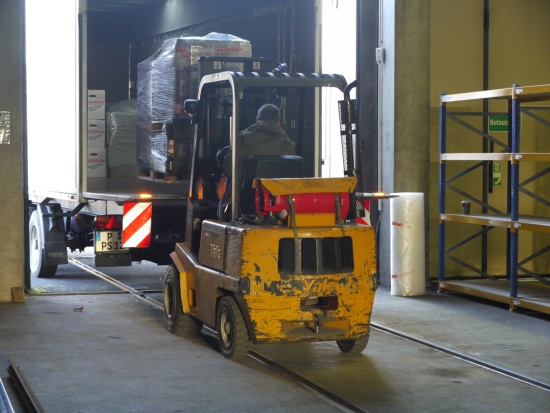
The forklift is indispensible in our storage facility. TECHNOSEUM, picture Bernd Kießling
Admittedly, when colleagues from art museums take in collections, you could go green with envy. Rembrandt, Goya, Cranach… While our AEG K2 Magnetophon is rarer than a Blue Mauritius, there aren’t many people who get really excited about it. And whether the Mona Lisa or our “Eschenau” steam locomotive brings a gleam to more children’s eyes is debatable. Technology fans must confess, though, that the names of technical devices are often short on glamour.

From Berlin to Mannheim

The delivery of the objects from the Deutsche Rundfunk (German Broadcasting) archives has made up for some of that. In recent weeks, we unloaded about 1,500 devices from the former German Broadcasting Museum from various trucks and moved them to our collections storage facility. Of course we had to confirm that everything that came from Berlin had safely made it to Mannheim. During the verification process, we suddenly felt a little like our colleagues at the art museums—or maybe more like tour operators and recording officials.

A Rembrandt of Our Own

Our colleagues in the storage facility know exactly where each television is located. TECHNOSEUM, picture Bernd Kießling
Our colleagues in the storage facility know exactly where each television is located 1 TECHNOSEUM, picture Bernd Kießling.
Sachsenwerk and Rafena in Radeberg gave their television sets artistic names such as Rembrandt, Dürer, and Cranach. Philips, on the other hand, stuck with cryptic designations like “23TD321A,” but their nicknames read like a “Who’s Who?” of art history: Raffael, Leonardo, Michelangelo, Tizian, Bellini, Goya, and another Rembrandt, though this one from 1962. Blaupunkt imagined itself in southern vacation paradises, with names like “Toskana” (Tuscany) and “Sevilla” (Seville). Graetz went all noble with “Landgraf” (Landgrave) and “Markgraf” (Margrave). Nordmende sent a “Diplomat” into the field, Philips a “Mediator,” and the marketing team at Loewe even decided on an “Optimat.” VEB Fernsehgerätewerke Staßfurt (Stassfurt Television Works) struck out on a different path, where Ines, Marion, and Sibylle provide good sound and picture quality. And if they don’t, who could seriously hold it against an appliance with such a pretty name?

Those of us in the Collections Department cannot allow ourselves to be taken in by the fancy names, however. In the upcoming months, our task will be to examine, sort, and register the collection. Then we’ll have to pack the objects in such a way manner that they come to no harm for the next few decades yet are still available at any time: the “Zauberspiegel” (Magic Mirror) as well as the “Bildmeister” (Image Master), “Lady,” and her “Kornett” (Cornet)—and a “Rembrandt” or two, of course.

Angela Kipp

Translated from German into English by Cindy Opitz.

  1. Disclaimer: Neither I nor the other colleagues are responsible for the stacking of up to three TV sets, the paletts arrived that way. We put it in order immediately.

Managing Previously Unmanaged Collections –
Will you join me in this journey?

Dear Readers of this Registrar Trek Blog,

For the last three years we’ve seen a growing number of faithful readers who not only read, but also contribute by sharing the articles, writing comments and sparking conversation with their peers. Some even wrote stories and articles for this blog. That’s great!

Today, I want to share with you a new project I’m working on and I ask you to join.

In my working life I’ve stumbled upon one conundrum of our profession time and again: there are really great books and online resources about best practice in collections management – the wonderful 5th Edition of Museum Registration Methods readily comes to mind, but of course there are much more. You read what is best for the artifacts, how to treat them, document them, store them… These books are written from the perspective of ”best practices“ and as we all strive to reach the best for our collections, that’s a good thing. Only that the starting position is often all but ”best practice“. Take Antony Aristovoulou ‘s story ”Match-ball for the Registrar“ as a prime example: being contracted for relocating and registering a collection of tennis artifacts and discover that all is stored in one giant shipping container and you have to start from scratch, including sourcing locations and material.

hhAll too often, especially for small and middle sized museums with historical, agricultural and/or science and technology collections there is a gap between what is written in books and the real world. Reading about best practices is great and necessary, but standing in an old shed with a leaking roof and heaps of rusty things that were euphemistically called an agricultural collection in your contract you are miles away from taking your acid-free cardboard and start building a custom box for a single artifact.

To make a long story short: I’m about to write a practical guide to manage previously unmanaged collections. This book will be written with the worst case scenario in mind, starting with nothing than a collection in peril and working step-by-step towards improving the situation 1. It will be written for the practitioner in the field who has to deal with all possible and impossible circumstances while trying to get her/his collection managed. Especially it will be written for people who are thrown into this situation without having it done before – may it be job starters or colleagues who have only worked in larger and/or well organized institutions so far.

DSCF0373This is where you, the readers, come in. This book will be much better and encouraging with real world examples. Sure, everyone loves to be the best practice example but what I’ll need here are examples of how difficulties were tackled and how issues were resolved. How collections that were in peril were brought to a better stage. Maybe still far away from being ”best practice“ but still much better than before. I’m collecting all kinds of worst case examples, brought in from veteran museum professionals young and old who have encountered unbelievable situations in collections management (I’ve seen a main sewage pipe right above the shelves of an archive, so, the possibilities are endless…).

Every now and then I will present you some aspects I’m writing about here on this blog and will ask for your experiences and thoughts. It would be great if you would be willing to share them. I promise that I won’t abuse your willingness to share and will always check if the way I want to use some of those examples in the book is acceptable for the original author and her/his institution.

Thanks for reading and best wishes

Angela

This post is also available in Russian translated by Helena Tomashevskaya.

  1. Janice Klein and I have written a short article about ”Tackling Uncatalogued Collections“ in the March/April 2015 edition of the ”museum“ magazine of the American Alliance of Museums (p. 59-63), here you will find some additional ideas and the general direction of this project, although being uncatalogued is just one of the issues of an unmanaged collection.

The Journey to the Fourth Edition of Basic Condition Reporting

by Deborah Rose Van Horn

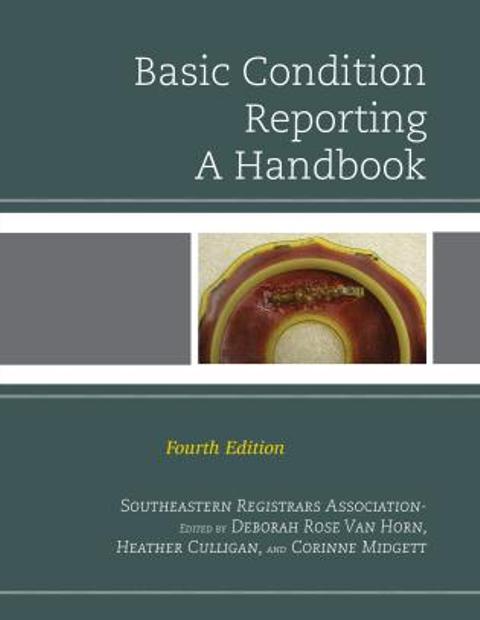
BCROver 3 years ago, the Southeastern Registrars Association (SERA), decided to update their book, Basic Condition Reporting: A Handbook. The third edition had been published in 1998 and had not been updated since. The goal of the book has always been to create a common framework for professionals when conducting condition reports. It is intended to be a reference tool for experienced collections professionals and a training tool for those new to the field.

Over time, the popularity of the book had grown. SERA started getting an increasing number of orders both within the country and overseas. This meant that the SERA Treasurer had to carry a bunch of books to the post office on a weekly or bi-weekly basis. This made the treasurer’s position one that volunteers often wanted to avoid.

When we began looking at the fourth edition of Basic Condition Reporting the board started looking at the book from a new perspective. Could we get a publishing partner? How much work would that be? Would we lose money? We decided to find out but first we needed a book.

Our first step was to contact all of the authors from the previous edition and see if they wanted to update their chapters. Less than half wanted to take on the project so the search for new authors began. This was easy at first, but as we got closer to contacting publishers we had a number of authors or editors drop out of the project. That meant that we were back to square one and we had to recruit more authors. At times it felt like herding cats!

We gave the authors the choice of either completely re-writing the chapter or updating the existing chapter and giving the previous author credit as a co-author. We also asked the authors to update the chapters by adding photographs and giving the book a whole new look. After two and a half years, we finally had something to take to publishers to see if we could find a publishing partner.

No, we didn’t have every chapter in hand but we felt that we soon would. We approached Rowman & Littlefield, the company that owns Alta Mira Press, to see if they would be interested. Within two days we had a publishing partner.

That was when we had to get serious about getting the remaining chapters turned in for editing. The process of emailing and calling people began and then disaster struck! One of our authors disappeared! We couldn’t reach them by phone or email and we had to have a chapter. We reached out once again to the previous authors and asked if we could reprint the chapter. We were saved! They agreed and the project could move forward.

After three years of managing this project, I am happy to announce that Basic Condition Reporting: A Handbook, Fourth Edition will be available on February 27, 2015. The new edition has over 70 new illustrations depicting different types of damage and sample condition report forms for many different material types. It also features updated and expanded chapters on a variety of material types including: archaeological artifacts, basketry, ceramics, glass, ethnographic artifacts, furniture, metals, natural history specimens, paintings, paper, photographs, sculpture, skins and leather, and textiles. The book also features a new chapter on condition reporting for loans. We hope you will find the book as useful as we do!

The books are available on the Rowman & Littlefield website or through Amazon.com.

BCR flier with special discout

Deborah Rose Van Horn is the registrar at the Kentucky Historical Society and together with Heather Culligan and Corinne Midgett editor of the fourth edition of “Basic Condition Reporting: A Handbook”.

Post-its never die; they just fade away

A fascinating experiment on light damage

by Judith Haemmerle, Executive Director
Digital Game Museum, Santa Clara, California

In our startup video game museum, everything is done by volunteers on a ridiculously limited budget. So it’s always a balance between collections care and – well, everything else. My biggest anxiety last year was light damage.

We removed half the fluorescent bulbs in the collections area and covered the remaining ones with UV shields; not too expensive, and it was work that was easy to get done. But the big expanse of glass in the room where we install our exhibits remained unprotected. No one was willing to tackle the exacting job of applying UV film, and having it done was far too costly, especially in a facility we were renting short term. We put in a display of items of interest but easily replaceable, and I worried about light. Then one day, our past stepped in to help.

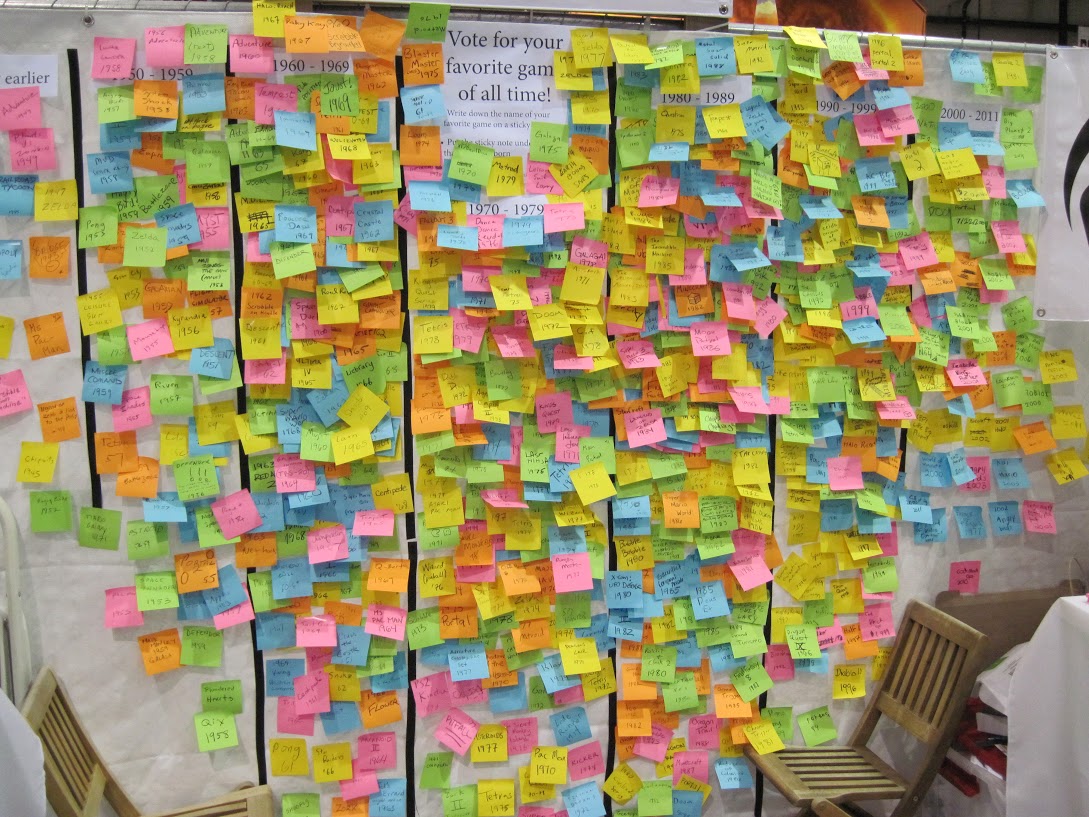
The first public event we did involved a 10’x10′ space that would be difficult to tempt visitors into, so we stopped every passerby we could and had them write the name of their favorite video game on a colored Post-it note, plus the year they were born in. This was, of course, completely for fun and not real research, but there were some interesting things we found nonetheless. 1 We put the notes on the back wall grouped by decade, and it proved to be eye catching display. And we added hundreds of people to our new mailing list, so it was a very effective strategy.

The Post-it wall, photo by Brian Quan

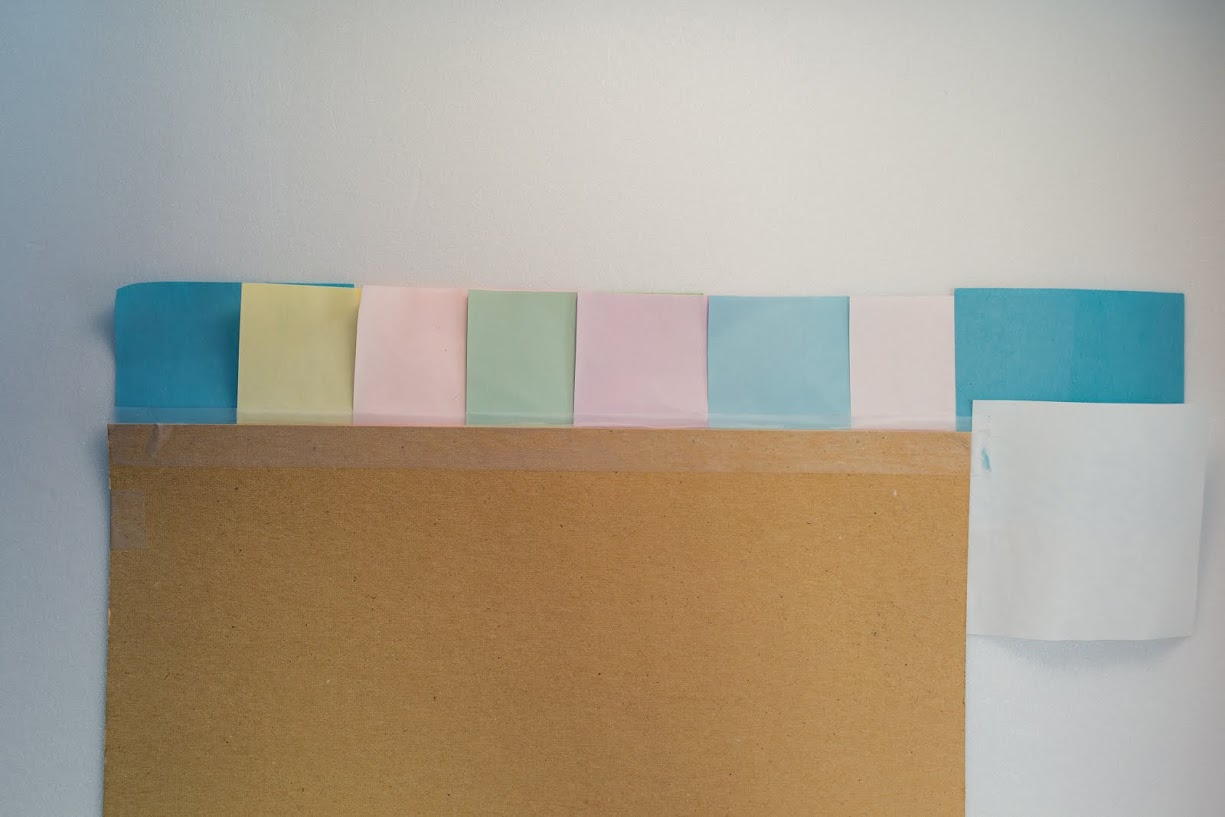
There were piles of leftover Post-it notes; we bought a lot of them to get a good selection of colors. And one day, while worrying about light, I took a sheet of cardboard from the back of a pad of notebook paper and lined up the different colored Post-its so that they would be half behind the cardboard and half exposed. I also overlapped them for no particular reason. And then I hung it in the window.

Months went by. I don’t know how many, because I forgot to date it. I’d guess six or eight. We finally bought shielding, even though no one wanted to install it, and I took down the Post-it note color fade tester and asked our photographer to take some pictures of it. The photos that follow show the before and afters.

Post-its from the outside, photo by Brian Quan

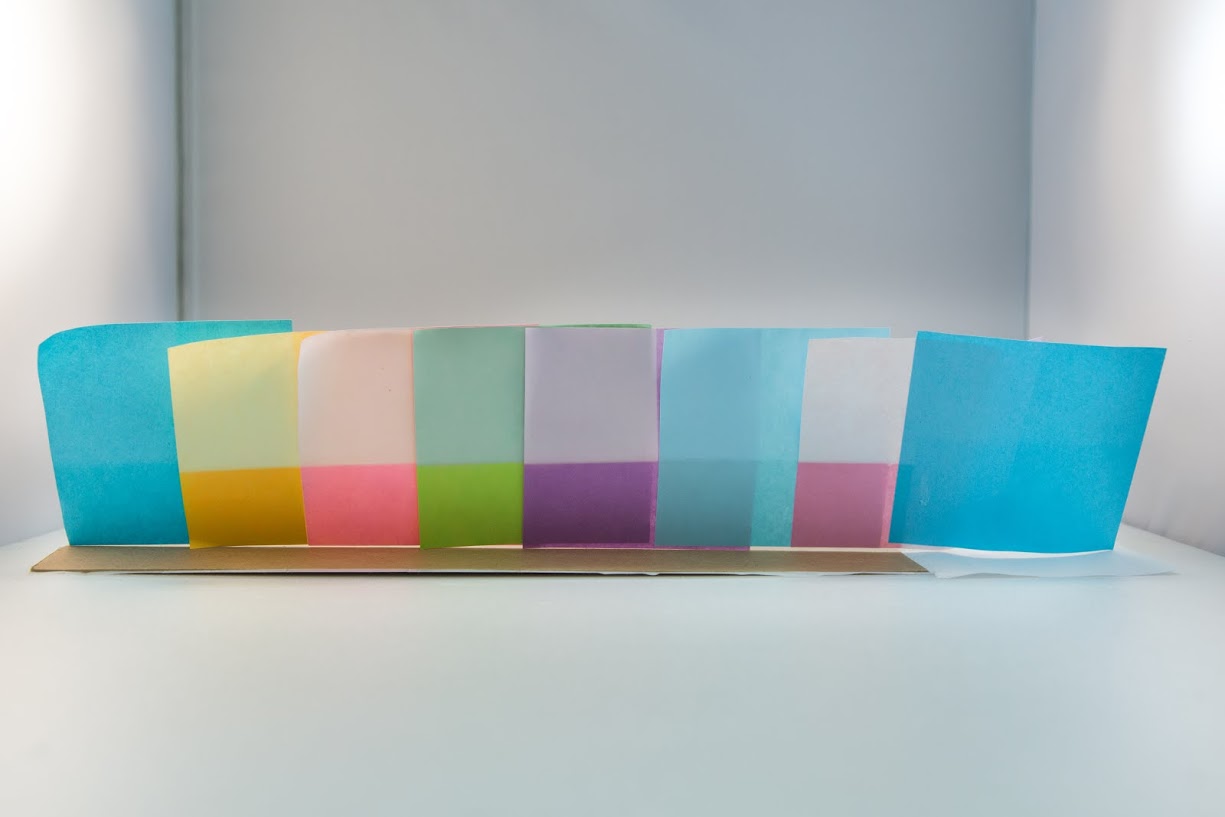
The photo above is what it looked like from the outside of the window when I took it down. The photo below is what it looked like when we flipped back the notes to compare the part protected by the cardboard with the part in the sun.

Faded post-its, photo by Brian Quan
Faded Post-its, photo by Brian Quan

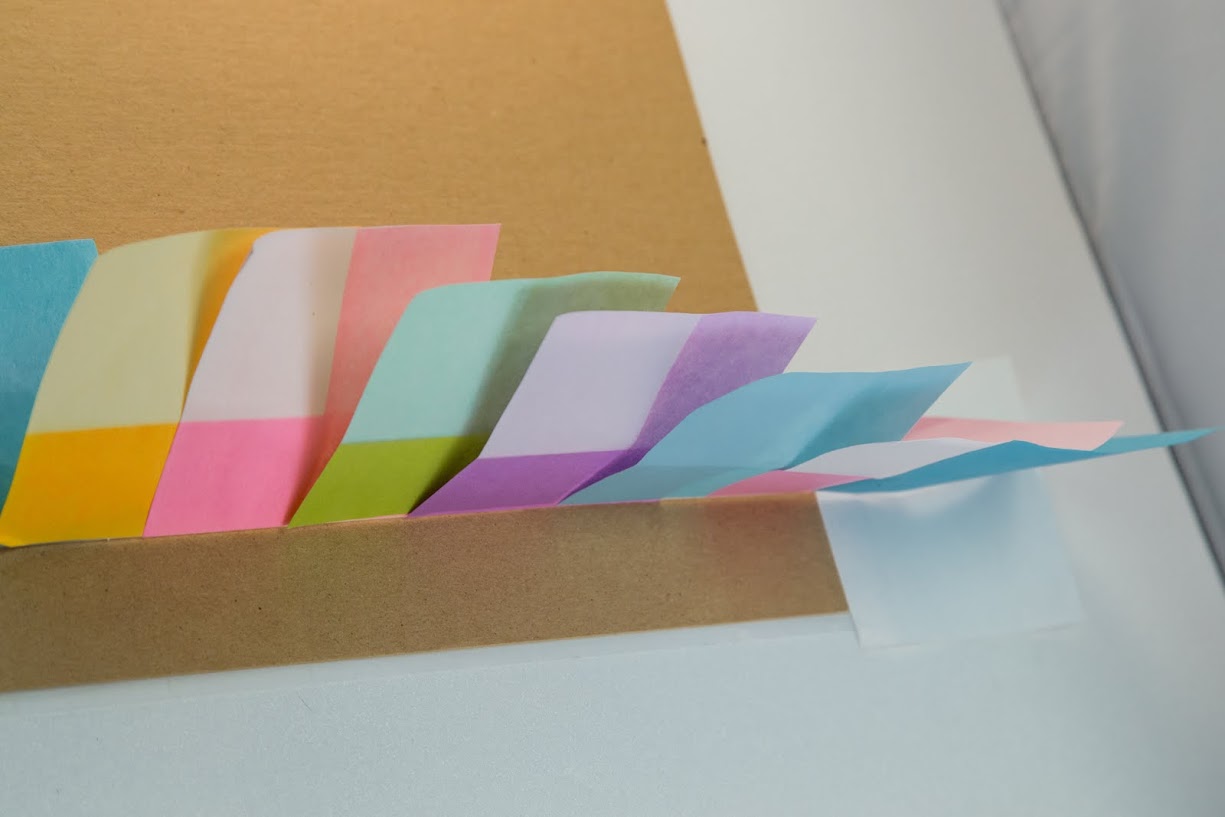
The contrast between the original colors and the part exposed to sunlight is striking, and this is the back of the notes; the fading went right through to the back. The different colors that overlapped even reacted together, so that the orange lying on the blue not only faded to yellow, it also picked up a greenish tinge from the blue. Some of the pink and fuchsia are faded almost to white; those were two different colors when we started: a plain pink and a bright fuchsia.

Overlapping Post-its, photo by Brian Quan

I showed it to the volunteers, and the window shielding went up quickly! We keep the Post-it fade tester in the museum and show it to visitors when explaining the importance of conservation and collections care. Sometimes, the simplest materials can solve your biggest problems.

  1. First, the game chosen by the oldest (over 60) and the youngest (5) participants was the same game – Angry Birds! Second, the decade of people born in the 1960s chose a lot of arcade games. There weren’t any before then, and they fell off sharply after 1970. For those of you who like raw data, it’s available here.

Dust: Arch Enemy and Artwork

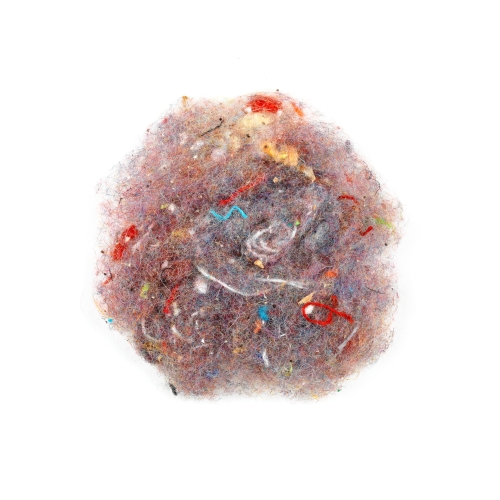
Staub aus dem Naturkundemuseum (c) Klaus Pichler
Dust from a museum of natural history
(c) Klaus Pichler
Day in, day out collections staff is fighting against dust. We wrap artwork, dinosaurs, cars and coffee makers, sometimes we even put old cardboard boxes into new archival boxes. We do everything to keep our arch enemy, the mighty dust, away from our artifacts. And while we brush, wipe and vacuum I bet it never occurred to one of us that this evildoer could have an aesthetic aspect.

But photographer Klaus Pichler, whom we already know from his series “Skeletons in the Closet”, has now captured this aesthetic aspect of dust. Fascinated by the difference between the dust from a natural history museum and a fashion shop I asked him how he got the idea:

Klaus Pichler:
“The idea for this project came by coincidence: I moved from my old apartment and while I was clearing the space I realized the dust in the living room was red and the one in the bedroom was blue. This astonished me and I couldn’t get it out of my mind, so I decided to look into it and to study dust systematically, especially the notorious “dust bunnies”, agglomerations of dust. Right from the start it was my plan to create an archive of dust that should contain dust from a wide range of areas from our society and that all dust samples should be photographed. To decide on which places to collect dust I took the model of the basic living needs (reside, work, recreation, traffic,…) and used it to decide roughly the weighting of the places that should be included in this project. And then the time had come: I went dust hunting!

Staub aus einem Modegeschäft  (c) Klaus Pichler
Dust from a fashion shop
(c) Klaus Pichler
I guess you can imagine the reactions I got when I (without advanced notification, I like to add!) showed up in different shops, apartments, museums, schools, restaurants, etc. I was interested in and asked them permission to search for dust. Especially, as I didn’t go much into detail why I was doing this, but as soon as I got the permission began crawling on all fours, searching for dust bunnies. For many people confronted with my wish it was surely one of the stranger requests in their professional life…

The dust samples I discovered (I tried to collect different samples in every room but always kept only one) went to my dust archive. I cataloged them with consistent categories (date, place, address, description, catalog number) and archived them in numbered petri dishes. Every time I had 25 new samples I made a photo session where I photographed them all at the same conditions with a high-resolution macro camera. The results of my activities as a collector can be found in the book “Dust” that is out now.”

What is it that fascinates you about dust which is for most of us – especially registrars – only an annoyance?

Klaus Pichler:

Staub aus einem Kunstmuseum (c) Klaus Pichler
Dust from an art museum
(c) Klaus Pichler
“When I started this project I expected that there would be a certain range of dust but by the best stretch of my imagination I didn’t anticipate what I discovered then: every dust was different and not a bit of the monochrome dust I expected. Quite the contrary, the different dust bunnies often had a rich coloring, some in one primary color, some mixed in color, some harmonic, some dissonant in terms of color. This was matched by the irritating variety of ingredients – from fibers and hairs to parts that pointed to the purpose of the room the dust was formed in. Pieces of popcorn in cinema dust, dead insects in the dust from the entomology department of the natural history museum, breadcrumbs in the dust from the bakery. Sometimes it’s nearly possible to decide where the dust comes from by looking at the ingredients and the color of the dust, because every room produces an unique kind of dust due to it’s design and purpose. For me all of this was extremely fascinating.

That’s why I’d like to give you this little piece of advice: Next time you are sweeping dust, take a moment and a strong flashlight, guide the beam to the dust bunnies and dive into the fascinating world of dust.”

Thank you for the opportunity to see our dust with different eyes!

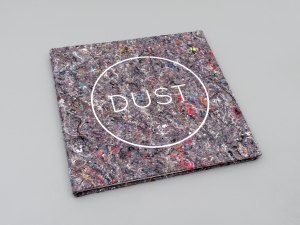
The book “Dust”:

Dust_Book-003Hardcover wrapped with 2mm textile and flocked ‘Dust’ logo, handmade, 30x30cm (open: 30x60cm), 102 pages (4 pages transparent paper, 98 pages uncoated paper), 45 images. Including a folded poster, 50x70cm, printed on uncoated paper.
First edition, 2015. Limited to 450 hand numbered and signed copies.
Can be ordered via the author’s website:
http://kpic.at/images/4497